
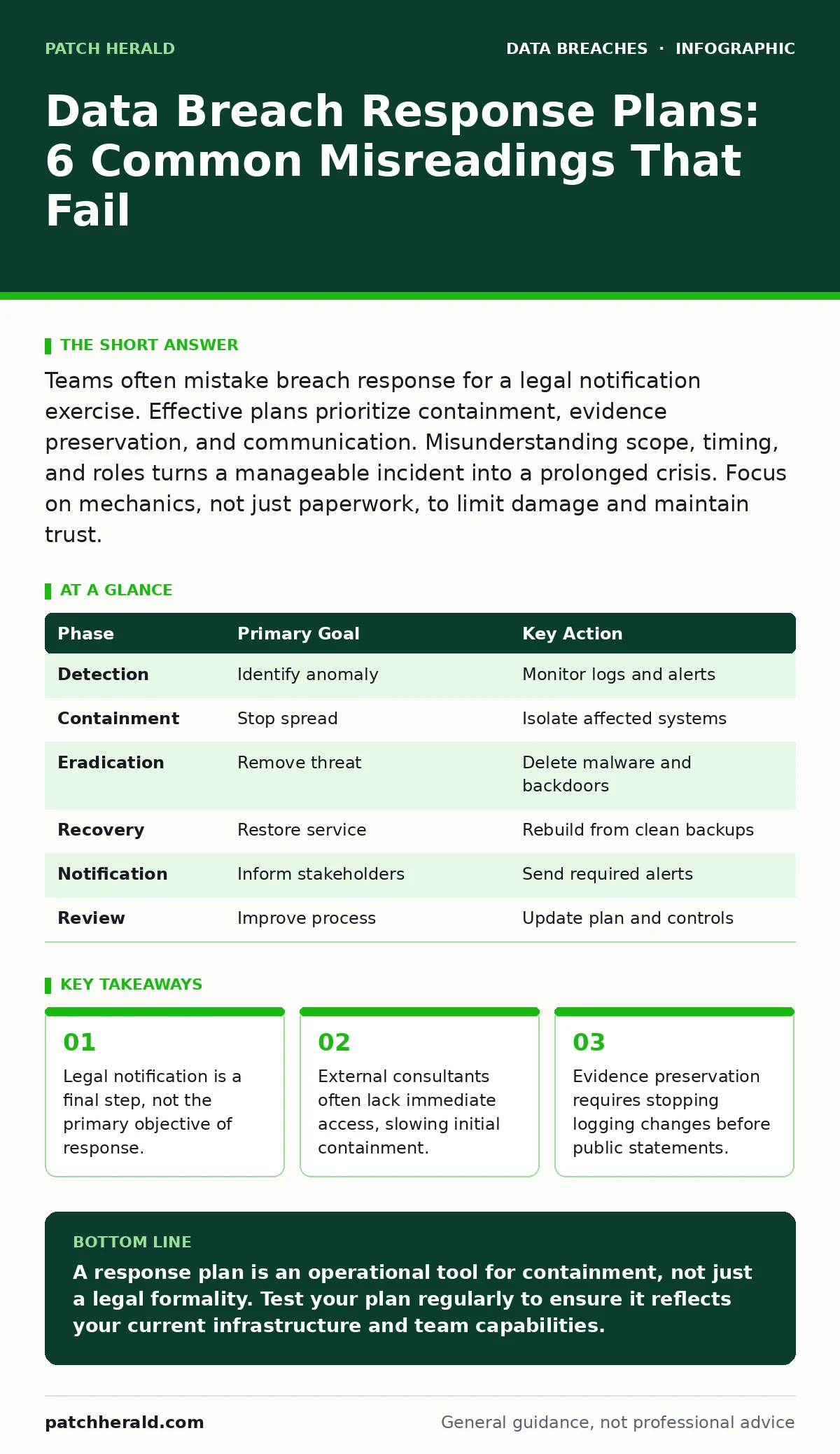
Teams often mistake breach response for a legal notification exercise. Effective plans prioritize containment, evidence preservation, and communication. Misunderstanding scope, timing, and roles turns a manageable incident into a prolonged crisis. Focus on mechanics, not just paperwork, to limit damage and maintain trust.
Misreading: The Plan Is a Legal Checklist
Correct reading: A response plan is an operational manual for technical containment, not a legal template for notification. Many organizations draft their plans to satisfy regulatory requirements first and security needs second. This approach fails because regulators require accurate incident reports, which you cannot generate without proper technical containment.
If you focus on the letter of the law before you stop the bleeding, you lose the data needed to prove your compliance. The primary goal is to isolate the affected systems. Once the threat is contained, you can accurately assess the scope. Only then does the legal team have the facts required for breach notification. Prioritizing paperwork over containment often leads to incomplete reports and further regulatory scrutiny.
Misreading: External Experts Handle the Response
Correct reading: Internal teams must execute the first 48 hours while external partners provide specialized support. Suppose a ransomware event occurs at 3 AM. Waiting for a contracted forensic firm to arrive or gain access can allow the attacker to move laterally. You need an internal point person with authority to disconnect systems immediately.
External experts bring specialized tools and legal insights, but they cannot act until you grant them access and provide context. Relying solely on outsiders creates a dangerous delay window. Your internal plan must define who has the power to pull the plug. This authority should rest with technical staff, not just management. External support enhances the response but does not replace the need for immediate internal action.
Misreading: All Data Loss Is Equal
Correct reading: Response tactics depend entirely on the sensitivity and structure of the compromised data. A leak of public marketing materials requires a different response than a breach of protected health information. Treating all data equally wastes resources on low-risk incidents or under-reacts to high-risk ones. You must classify your data before an incident occurs.
Knowing where your critical assets live allows you to prioritize containment efforts. For example, isolating a database containing personal identifiers is more urgent than securing a compromised guest Wi-Fi network. This tiered approach ensures your limited resources focus on the highest impact areas. It also simplifies the subsequent breach notification process by clarifying what was actually lost.
Misreading: The Plan Lives in a Document
Correct reading: A response plan is a practiced procedure, not a static document on a shelf. Documentation becomes obsolete the moment your infrastructure changes. If your plan mentions servers that no longer exist, it is useless during a crisis. You must test the plan through tabletop exercises at least annually. These simulations reveal gaps in decision authority and communication channels.
Suppose your plan says the CTO makes containment decisions, but the CTO is unreachable during an incident. The test exposes this flaw before real attackers exploit it. Regular drills ensure that staff remember their roles under stress. They also validate that your technical controls, such as full disk encryption, are functioning as expected. A plan that is never tested is a plan that will fail.
Misreading: Containment Means Total Shutdown
Correct reading: Aggressive shutdowns can destroy digital evidence needed for forensic analysis and legal defense. Turning off a compromised server may seem like the safest way to stop an attack. However, many attack artifacts reside in volatile memory. Powering down the system erases this data, making it difficult to determine the entry point or the extent of the breach. Instead of a hard shutdown, isolate the system from the network.
This stops lateral movement while preserving the state of the machine for forensic analysis. You can then image the drive for later examination. This approach balances immediate security needs with the long-term requirement for evidence. It also prevents accidental data loss that could worsen the business impact. Understanding the difference between isolation and shutdown is a critical technical distinction.
See also: Mobile Device Management for Small Teams: Control and Cost · Tax Identity Theft Definition: How Fraudsters Steal Your Refund
Misreading: Communication Is a PR Afterthought
Correct reading: Communication strategy is a core component of the technical response, not a separate public relations task. Silence breeds speculation and erodes trust faster than the breach itself. Customers and partners will demand answers regardless of your technical progress. Your plan must include pre-drafted messages for various scenarios. These messages should be honest but cautious, avoiding speculation on unverified facts.
Coordinate with legal counsel to ensure compliance with local laws. However, technical accuracy must drive the content. Misleading statements about the scope or cause can lead to further legal liability. Proactive communication demonstrates control and competence. It also reduces the volume of inbound inquiries, allowing your technical team to focus on containment.
Misreading: The Plan Ends With Notification
Correct reading: Post-incident review and remediation are the final, critical phases of the response. Sending notification letters does not fix the vulnerability that allowed the breach. Many organizations treat the notification as the finish line. This mistake leaves the door open for repeat incidents. You must conduct a thorough post-incident review to identify root causes. This analysis should involve technical staff, legal teams, and management.
Implement changes to prevent recurrence, such as improving password hygiene or fixing misconfigured cloud storage leaks. Document these changes and update your response plan accordingly. This continuous improvement cycle strengthens your security posture over time. It also demonstrates to regulators and customers that you take security seriously. Ignoring this phase wastes the lessons learned from the incident.
| Phase | Primary Goal | Key Action |
|---|---|---|
| Detection | Identify anomaly | Monitor logs and alerts |
| Containment | Stop spread | Isolate affected systems |
| Eradication | Remove threat | Delete malware and backdoors |
| Recovery | Restore service | Rebuild from clean backups |
| Notification | Inform stakeholders | Send required alerts |
| Review | Improve process | Update plan and controls |
Misreading: One Plan Fits All Scenarios
Correct reading: Different breach types require tailored response procedures within a single framework. A data exfiltration event differs significantly from a ransomware attack or a misconfigured cloud storage leak. Your plan must account for these variations. Include specific playbooks for common scenarios. For instance, a cloud leak requires immediate access revocation, while ransomware requires network isolation.
This specificity reduces decision fatigue during a crisis. It also ensures that the right technical steps are taken for the specific threat. A generic plan often leads to inappropriate actions that worsen the situation. Tailoring your response to the incident type improves efficiency and effectiveness. It also helps in managing data sovereignty concerns by addressing jurisdiction-specific requirements.
Key takeaways
- Legal notification is a final step, not the primary objective of response.
- External consultants often lack immediate access, slowing initial containment.
- Evidence preservation requires stopping logging changes before public statements.
- Communication plans must address customer confusion before regulatory fines.
A response plan is an operational tool for containment, not just a legal formality. Test your plan regularly to ensure it reflects your current infrastructure and team capabilities.
Frequently asked questions
How often should I test my breach response plan?
Test your plan at least annually through tabletop exercises. More frequent testing is beneficial if your infrastructure changes often. Regular drills ensure staff familiarity and reveal gaps in decision authority.
Who should be included in the response team?
Include technical staff, legal counsel, management, and communications personnel. Each role has specific responsibilities during an incident. Ensure all members understand their tasks and decision-making authority.
What is the first step in a breach response?
The first step is detection and initial assessment. Verify the alert and determine the scope of the incident. Immediate containment, such as isolating affected systems, follows quickly. Do not delay action while waiting for full analysis.
How do I preserve digital evidence?
Preserve evidence by isolating systems rather than shutting them down. This maintains volatile memory for forensic analysis. Create forensic images of affected drives before restoring services. Document all actions taken during the response.
How this guide was produced: written by the Patch Herald editorial team with AI assistance, checked against the public references listed below, and reviewed when the facts change. See our editorial policy or report an error.