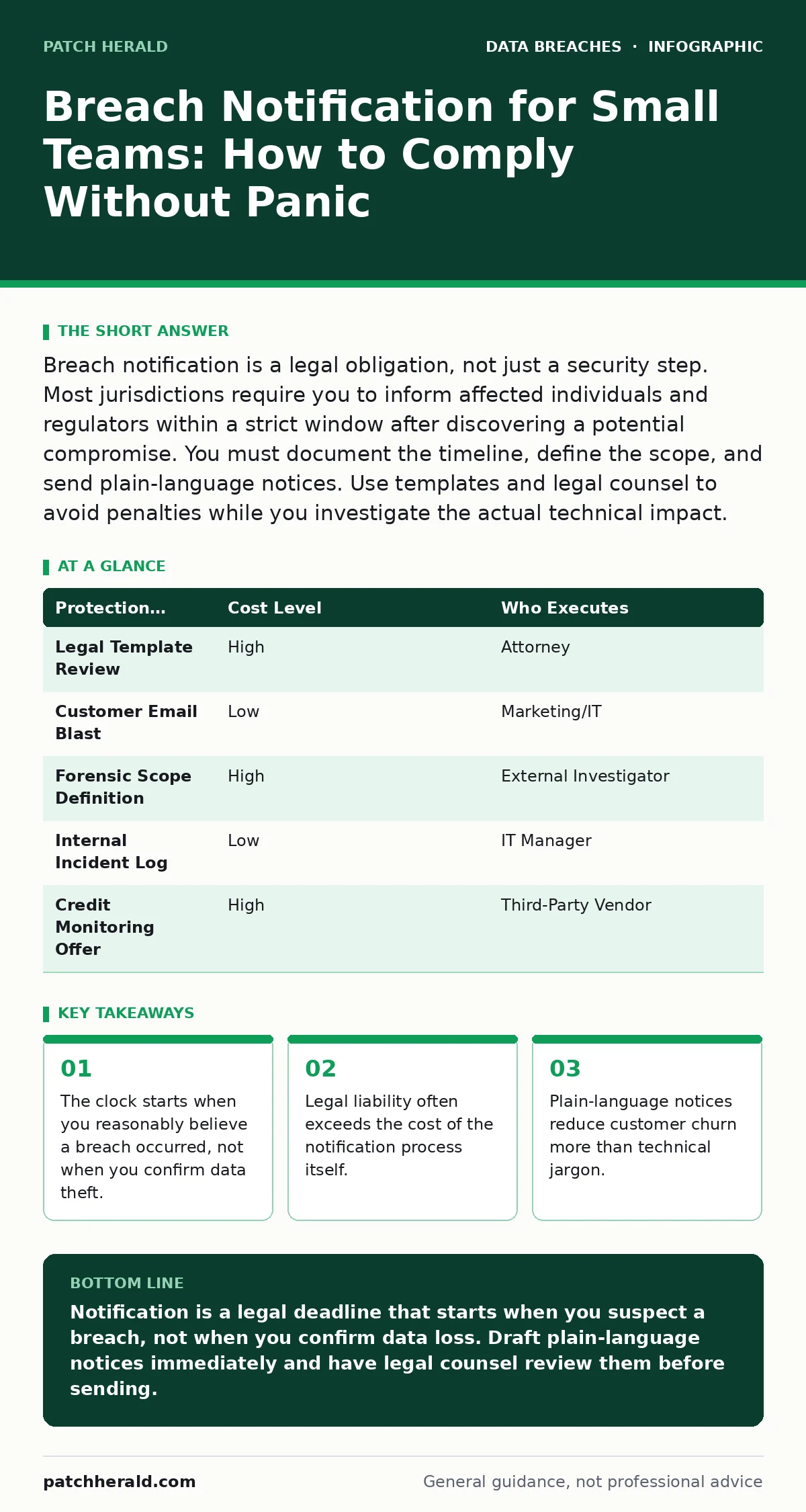
Breach notification is a legal obligation, not just a security step. Most jurisdictions require you to inform affected individuals and regulators within a strict window after discovering a potential compromise. You must document the timeline, define the scope, and send plain-language notices. Use templates and legal counsel to avoid penalties while you investigate the actual technical impact.
The Clock Starts at Discovery, Not Confirmation
You might assume you only need to notify customers after you prove data was stolen. This is a dangerous misconception. Most breach notification laws trigger the clock the moment you have a reasonable belief that a security incident occurred. This includes ransomware infections, lost laptops, or misconfigured cloud storage leaks.
If you wait for forensic proof, you violate statutory deadlines. The law prioritizes transparency over certainty. You must report the potential exposure while you investigate. This creates a unique pressure on small teams. You do not have a dedicated legal department to interpret "reasonable belief." You must make a call based on incomplete information.
This timing constraint separates notification from remediation. You can send a notice while your servers are still offline. The notice is a legal document. The fix is a technical task. They happen in parallel, not in sequence. Understanding this distinction prevents costly delays.
Define the Scope Before You Send Emails
Notification is not a blanket announcement. You must identify who was affected. This requires mapping your data flows. You need to know where customer information lives and who has access to it. If you rely on role-based access control, you can narrow the list of potential victims. If everyone has admin rights, you must assume everyone is affected.
Start by listing the data types involved. Names and addresses require notification in most places. Credit card numbers have stricter rules. Internal employee records may have different thresholds. Do not guess. Check your local regulations for the specific data elements that trigger mandatory disclosure.
If you practice data minimization, this step is faster. You only hold what you need. If you hoard data "just in case," you face a wider blast radius. Review your retention policies. Delete old data that you no longer need for business operations. This reduces the number of people you must notify in a future incident.
The Plain-Language Requirement
Regulators reject notices that hide behind technical jargon. You must write for the person whose data was exposed. Avoid terms like "SQL injection" or "zero-day exploit" unless you explain them simply. Focus on the impact. What happened? What data was involved? What are the risks to the individual? What should they do?
Structure the notice with clear headings. Use bullet points for actions. Provide a phone number or email for questions. If you are unsure how to phrase the technical details, ask a lawyer to review the draft. The tone should be factual and calm. Panic drives away customers. Clarity retains them.
Consider the channel. Email is standard. Some laws require postal mail for severe breaches. Check your specific jurisdiction. A simple email might not satisfy the requirement for high-risk data. Using the wrong channel is a compliance failure. Always verify the delivery method mandated by law.
| Protection Measure | Cost Level | Who Executes |
|---|---|---|
| Legal Template Review | High | Attorney |
| Customer Email Blast | Low | Marketing/IT |
| Forensic Scope Definition | High | External Investigator |
| Internal Incident Log | Low | IT Manager |
| Credit Monitoring Offer | High | Third-Party Vendor |
Affordable Notification Channels
You do not need expensive software to notify customers. A well-drafted email template suffices for most low-risk incidents. The key is accuracy and timeliness. Do not spend money on flashy notification platforms if the content is wrong. Focus your budget on legal review.
For high-risk breaches, consider offering credit monitoring. This shows good faith. It also reduces the likelihood of customer complaints or lawsuits. You can negotiate bulk rates with monitoring services. Do not offer this impulsively. Consult your legal counsel first. Offering monitoring can sometimes be interpreted as an admission of liability.
If you use cloud services, check if your provider offers breach notification assistance. Some contracts include this as a service tier. Review your service level agreements. You might already have access to tools you are not using. This is a hidden resource in your existing contracts.
What to Delegate and What to Keep
Not every step requires an expert. You can draft the initial notice internally. You can send the emails. You can update your website with a statement. However, you should delegate the legal review and the forensic scope assessment.
Legal review ensures you meet all jurisdictional requirements. A missed detail can result in fines that dwarf the cost of a lawyer. Forensic assessment determines if data was actually stolen. This requires specialized skills. An internal IT staff member may lack the objectivity or expertise to prove data exfiltration did not occur.
You can delegate the technical investigation to a third party. This provides an independent report. It protects you against accusations of covering up evidence. It also helps you understand the root cause. Use this report to improve your defenses. Do not just file it away.
See also: Implementing Data Breach Response Plans: A Step-by-Step Guide · Can I have two mobile device management solutions?
Questions for Your IT Provider
If you outsource your IT, you need clarity on breach response. Your provider must have a plan. Ask these questions before an incident occurs.
- Who is the point of contact for a suspected breach?
- What is the guaranteed response time for initial assessment?
- Do you provide forensic investigation services, or do you subcontract them?
- How do you handle log retention for evidence preservation?
- Will you assist in drafting the technical section of the notification?
- What is the cost structure for emergency after-hours breach response?
Do not accept vague answers. "We handle it" is not a plan. You need specific names, timelines, and costs. Ensure your contract includes breach notification support. If it does not, add it. This is a standard clause in modern IT service agreements.
The Hidden Cost of Silence
Some small businesses try to hide breaches to avoid bad publicity. This is rarely successful. Data breaches often leave digital footprints. Regulators share information. Victims talk. If you fail to notify and the breach becomes public through other means, the penalties are higher.
Trust is hard to build and easy to lose. Customers respect transparency. They understand that hackers exist. They do not understand secrecy. Hiding a breach suggests you have something to hide. Notifying promptly suggests you are responsible and in control.
Integrate notification into your data breach response plans. Do not treat it as an afterthought. Pre-approved templates and clear decision trees save time. They reduce stress. They ensure compliance. This preparation is worth the upfront effort.
Final Steps and Documentation
After you send the notice, document everything. Keep copies of the notices, the timestamps, and the delivery receipts. Keep records of all communications with regulators and customers. This documentation is your defense if a complaint arises.
Review the incident. What failed? Was it a password hygiene issue? A lack of full disk encryption on a lost device? Update your policies to address the gap. Breach notification is the last step of the incident, but the first step of improvement.
Key takeaways
- The clock starts when you reasonably believe a breach occurred, not when you confirm data theft.
- Legal liability often exceeds the cost of the notification process itself.
- Plain-language notices reduce customer churn more than technical jargon.
Notification is a legal deadline that starts when you suspect a breach, not when you confirm data loss. Draft plain-language notices immediately and have legal counsel review them before sending.
Frequently asked questions
Do I need to notify customers if no data was actually stolen?
Yes, if the law requires notification upon reasonable belief of a breach. Many jurisdictions mandate reporting of the incident itself, regardless of confirmed data exfiltration, to allow individuals to monitor their accounts.
How long do I have to send breach notifications?
The timeframe varies by jurisdiction and data type. Some regions require notification within seventy-two hours of discovery. Others allow thirty days. Check your local laws, as the clock starts at discovery, not confirmation.
Can my IT provider send the breach notification for me?
Your provider can draft the technical details and manage the delivery, but you remain legally liable for the content. Ensure the notice is reviewed by legal counsel to ensure it meets all regulatory requirements and does not admit undue liability.
What if I don't have enough information to fill out a notification?
Send a preliminary notice stating that a breach is under investigation. Most laws allow for initial notifications with limited details, followed by subsequent updates as more information becomes available. This stops the clock on the initial deadline.
How this guide was produced: written by the Patch Herald editorial team with AI assistance, checked against the public references listed below, and reviewed when the facts change. See our editorial policy or report an error.