
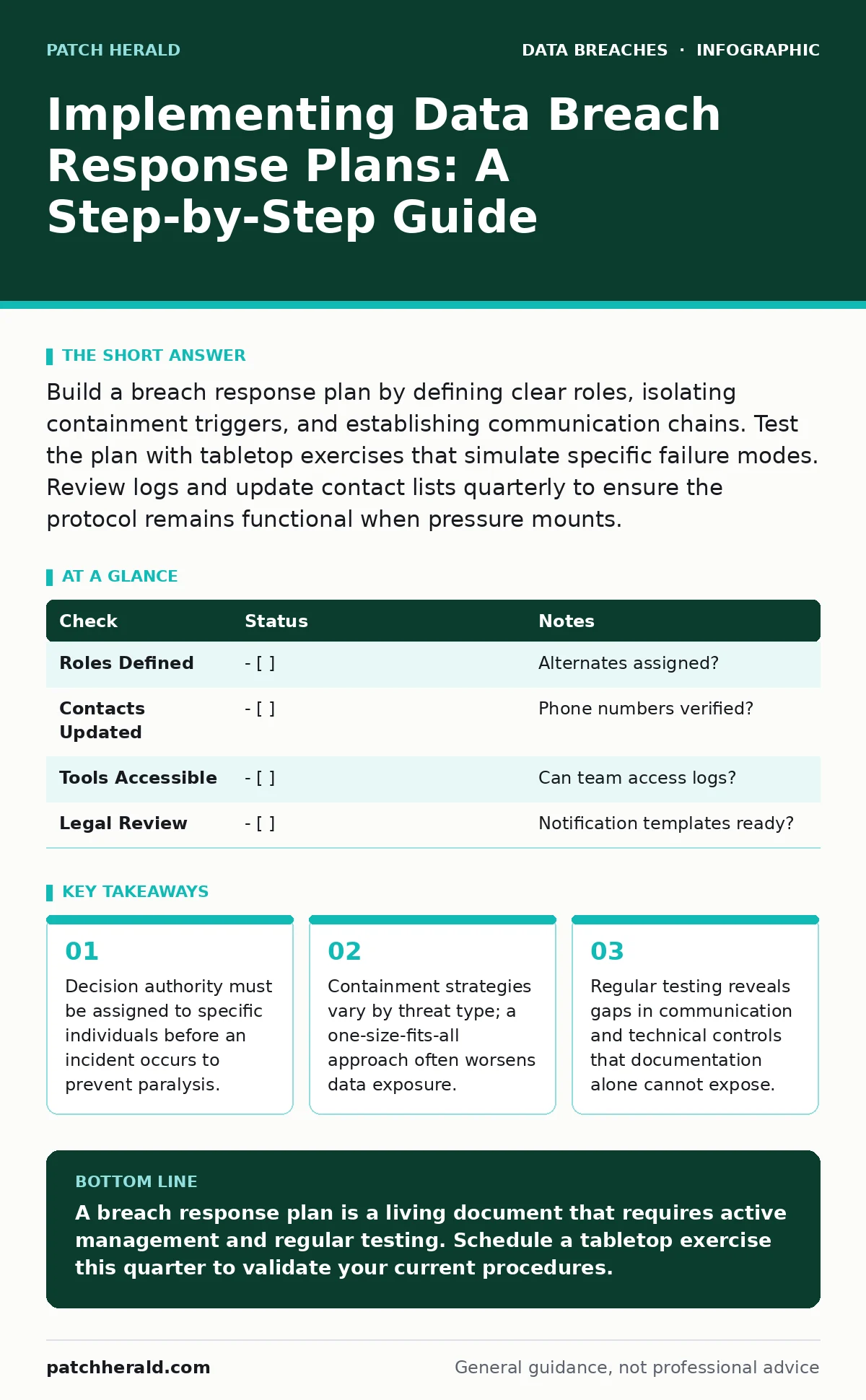
Build a breach response plan by defining clear roles, isolating containment triggers, and establishing communication chains. Test the plan with tabletop exercises that simulate specific failure modes. Review logs and update contact lists quarterly to ensure the protocol remains functional when pressure mounts.
Defining Scope and Authority
A data breach response plan is a documented set of instructions for handling unauthorized access to information. It is not merely a technical checklist. It is a governance tool that dictates who makes decisions when systems fail. Without clear authority, teams hesitate. Hesitation allows attackers to expand their foothold.
You must define the incident response team before a crisis hits. This team includes technical staff, legal counsel, and communications personnel. Each member needs a specific role. The technical lead isolates systems. The legal lead assesses liability. The communications lead manages external messaging.
Step 1: Establish Detection Triggers
Detection begins with knowing what normal behavior looks like. You cannot identify an anomaly if you have no baseline. Configure your monitoring systems to alert on deviations from standard patterns. This includes unusual login times, large data transfers, or repeated failed authentication attempts.
The trigger must be objective. Avoid vague language like "suspicious activity." Instead, specify metrics. For example, flag any outbound transfer exceeding a set threshold. This removes ambiguity during high-stress moments. The goal is to catch the incident early, before lateral movement occurs.
Check this step by reviewing your current alert rules. Do they cover your most sensitive assets? Do they generate too many false positives? If analysts ignore alerts due to fatigue, the plan has already failed.
Step 2: Define Containment Procedures
Containment stops the bleeding. It prevents the attacker from moving deeper into your network. This step requires two distinct strategies: short-term and long-term. Short-term containment isolates the immediate threat. Long-term containment restores stability while preserving evidence.
Short-term actions might include disconnecting a compromised server from the network. This stops data exfiltration but may impact business operations. Long-term actions involve patching vulnerabilities and resetting credentials. You must balance speed with thoroughness. Rushing containment can destroy forensic evidence needed for later analysis.
Review your network architecture. Can you isolate segments without shutting down critical services? If not, your network design needs adjustment. See our guide on role-based access control to understand how limiting permissions can naturally contain breaches.
Step 3: Execute Eradication and Recovery
Eradication removes the root cause. It is not enough to block an IP address. You must find and eliminate the malware, close the vulnerability, or revoke the stolen credentials. Recovery restores systems to normal operation. This phase is where many organizations cut corners.
Do not restore from backups without verifying their integrity. Attackers often encrypt or delete backups as part of their entry. Verify that the backup is clean before applying it. This prevents reinfection.
Document every action taken. This creates an audit trail. It proves due diligence. It also helps improve future responses. If you used full disk encryption, verify that decryption keys are secure and accessible only to authorized personnel.
Step 4: Manage Communication and Notification
Communication is a legal and reputational necessity. You must notify affected parties within statutory timeframes. This includes customers, regulators, and potentially law enforcement. The message must be clear, concise, and accurate.
Prepare templates in advance. Do not write press releases during an incident. Templates ensure consistency and speed. They also reduce the risk of admitting liability prematurely. Coordinate with legal counsel before sending any external communications.
See our guide on breach notification for details on regulatory requirements. Failure to notify correctly can result in fines that exceed the cost of the breach itself.
See also: Breach Notification for Small Teams: How to Comply Without Panic · Dumpster Diving Mistakes That Expose Your Business Data
Step 5: Conduct Post-Incident Review
The incident is over, but the work is not. You must conduct a post-incident review. This meeting analyzes what happened, what worked, and what failed. It is not a blame game. It is a learning opportunity.
Create a timeline of events. Identify gaps in detection or response. Update the plan based on these findings. If a step took too long, automate it. If a contact was unreachable, update the directory. This continuous improvement cycle is what makes a plan effective over time.
Verifying Plan Effectiveness
A plan that sits in a drawer is useless. You must test it regularly. Tabletop exercises simulate a breach scenario. They force team members to think through their roles under pressure.
Start with low-stakes scenarios. Progress to complex, multi-vector attacks. Measure response times. Identify communication breakdowns. Did the technical team know who to call? Did legal understand the technical impact?
| Check | Status | Notes |
|---|---|---|
| Roles Defined | - [ ] | Alternates assigned? |
| Contacts Updated | - [ ] | Phone numbers verified? |
| Tools Accessible | - [ ] | Can team access logs? |
| Legal Review | - [ ] | Notification templates ready? |
Maintaining Plan Relevance
Technology changes. Threats evolve. Your plan must adapt. Review it quarterly. Update it after major system changes. Add new threats to your detection triggers. Remove obsolete procedures.
Integrate data minimization principles into your response strategy. The less data you hold, the less you need to protect. This reduces the impact of any future breach. Also, ensure log retention policies support forensic analysis. If you delete logs too quickly, you lose the ability to investigate.
Key takeaways
- Decision authority must be assigned to specific individuals before an incident occurs to prevent paralysis.
- Containment strategies vary by threat type; a one-size-fits-all approach often worsens data exposure.
- Regular testing reveals gaps in communication and technical controls that documentation alone cannot expose.
A breach response plan is a living document that requires active management and regular testing. Schedule a tabletop exercise this quarter to validate your current procedures.
Frequently asked questions
How often should we test our breach response plan?
Test at least twice a year. Increase frequency if your environment changes significantly or if new threats emerge.
Who should be included in the incident response team?
Include IT security, legal, HR, communications, and executive leadership. Each brings necessary expertise and decision-making power.
What is the first step when a breach is suspected?
Isolate the affected systems to prevent further damage. Do not shut them down immediately if you need to preserve evidence.
How do we know if our detection triggers are working?
Review alert logs regularly. If you see no alerts for known malicious patterns, your detection is failing.
How this guide was produced: written by the Patch Herald editorial team with AI assistance, checked against the public references listed below, and reviewed when the facts change. See our editorial policy or report an error.