
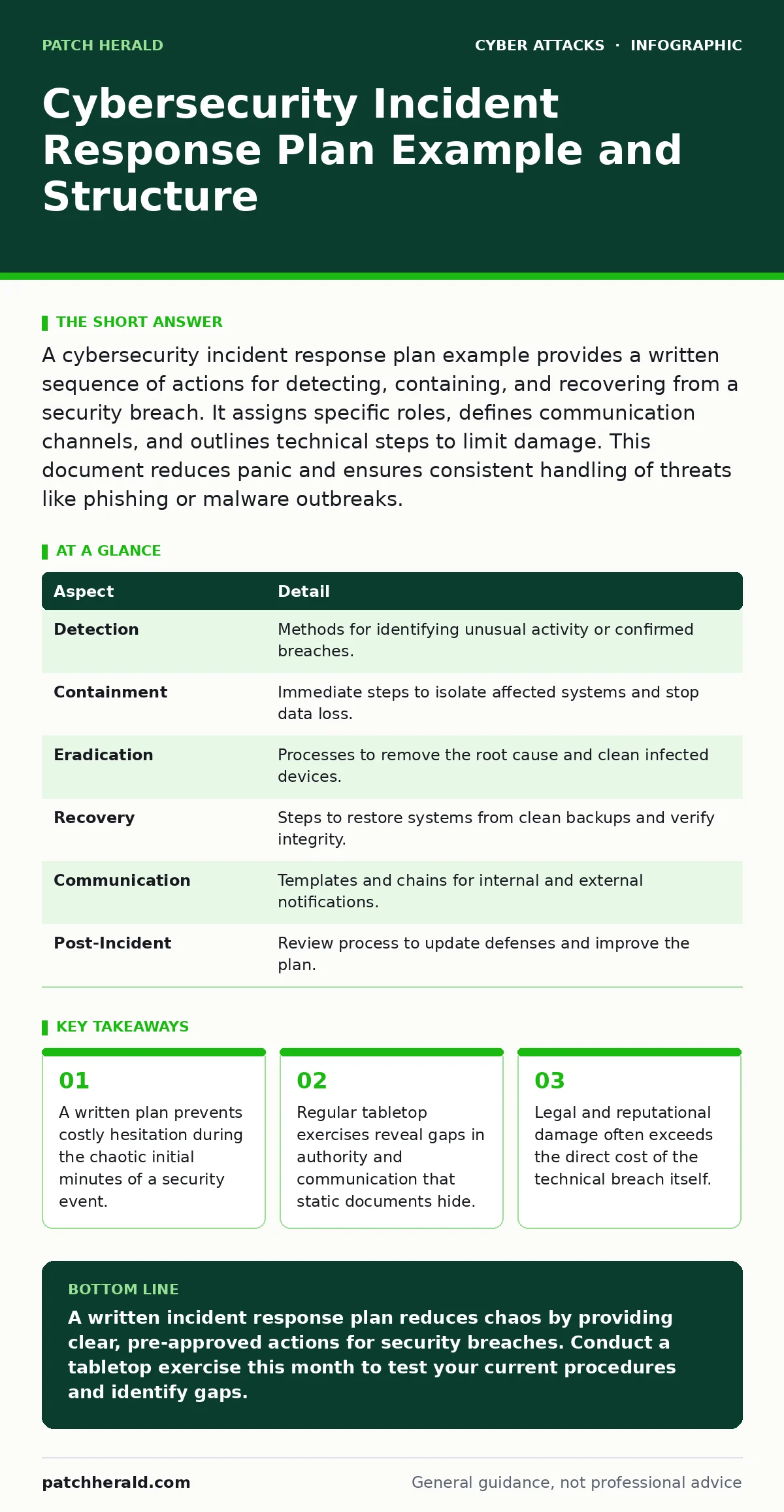
A cybersecurity incident response plan example provides a written sequence of actions for detecting, containing, and recovering from a security breach. It assigns specific roles, defines communication channels, and outlines technical steps to limit damage. This document reduces panic and ensures consistent handling of threats like phishing or malware outbreaks.
The Fire Drill Analogy for Digital Security
Imagine a building fire. You do not wait for the flames to reach the second floor to decide who calls the fire department. You have a pre-mapped exit route. You know which alarm to pull. You have assigned someone to check the restrooms. A cybersecurity incident response plan example functions with the same logic. It is a pre-defined set of instructions that tells you exactly what to do when your digital perimeter is breached.
The plan removes the need for high-stakes decision-making during a crisis. When stress levels spike, human cognitive function declines. Complex problems become simple failures of execution. A written procedure allows your team to act on muscle memory rather than panic. This structure applies whether the threat is a sophisticated ransomware group or a simple employee error.
What Is an Incident Response Plan
An incident response plan is a documented framework that guides an organization through the lifecycle of a security incident. It defines how you detect an anomaly, how you contain the spread, how you eradicate the threat, and how you recover normal operations. The plan also dictates how you communicate with stakeholders, regulators, and potentially affected customers.
This document is not a technical manual. It does not list every possible command line tool. Instead, it establishes authority. It answers the question of who has the right to shut down a critical server. It clarifies who speaks to the press. Without this clarity, conflicting orders can cause more damage than the initial attack. The plan serves as the single source of truth for your security posture during chaos.
| Aspect | Detail |
|---|---|
| Detection | Methods for identifying unusual activity or confirmed breaches. |
| Containment | Immediate steps to isolate affected systems and stop data loss. |
| Eradication | Processes to remove the root cause and clean infected devices. |
| Recovery | Steps to restore systems from clean backups and verify integrity. |
| Communication | Templates and chains for internal and external notifications. |
| Post-Incident | Review process to update defenses and improve the plan. |
Who Is Affected by a Security Breach
A security incident affects far more than just the IT department. The impact ripples through legal, human resources, and executive leadership. Legal teams must assess liability and regulatory compliance. Human resources may need to address employee misconduct if the breach originated internally. Executive leadership faces fiduciary responsibilities to shareholders and board members.
Customers are the primary external victims. They trust you with their data. A breach violates that trust. If you fail to notify them promptly or accurately, you face lawsuits and reputational ruin. Even if no sensitive data was stolen, the mere appearance of weakness can drive customers to competitors. You must consider the human element. Employees may fear job loss. Vendors may question your stability. The plan must address these human dynamics, not just the technical ones.
How the Plan Works in Practice
The plan operates in phases. The first phase is preparation. This involves assembling the response team, defining roles, and ensuring you have the necessary tools. The second phase is detection and analysis. You identify the scope of the incident. You determine if it is a false positive or a real threat. This phase often overlaps with daily operations like monitoring for phishing attempts.
The third phase is containment, eradication, and recovery. You isolate the infected systems. You remove the malicious code. You restore clean data. The final phase is post-incident activity. You review what happened. You update the plan based on lessons learned. This cycle ensures that you do not repeat the same mistakes. The plan is a living document, not a static file. It evolves as your technology and threat environment change.
Common Mistakes in Plan Design
Many organizations create a plan that sits in a digital drawer. They write it once and never test it. This is a critical error. A plan that has not been exercised is a hypothesis, not a reality. You may find that the designated incident commander is on vacation. You may discover that the backup systems are not actually restorable.
Another common mistake is focusing solely on technology. Teams often spend hours on firewall rules but neglect communication protocols. When a breach occurs, the inability to communicate clearly causes significant delays. You must also avoid overly complex procedures. If a step requires a specialist who is not on staff, the plan fails. Keep the initial response steps simple and executable by general IT staff.
A third error is ignoring the legal implications. You may take actions that destroy evidence needed for law enforcement. You may notify the wrong parties, violating privacy laws. The plan must include a legal review step before major actions are taken. This balance between technical urgency and legal prudence is difficult but necessary.
See also: Implementing Data Breach Response Plans: A Step-by-Step Guide · Drive-By Downloads Explained: Mechanics, Risks, and Silent Prevention
Cybersecurity Incident Response Plan Example
When searching for a cybersecurity incident response plan example, you are looking for a template that fits your specific environment. There is no universal plan. A small business has different needs than a hospital. However, the core components remain the same. You need a clear chain of command. You need defined thresholds for escalation. You need contact lists for key personnel and external partners.
An effective example includes a decision tree. If event A occurs, do step B. If step B fails, do step C. This linear logic prevents analysis paralysis. The example should also include communication templates. These templates ensure that your messages are consistent and legally sound. You should have a template for internal staff, a template for customers, and a template for regulators.
Do not copy a plan from the internet without customization. Your network architecture is unique. Your legal obligations are specific. Use the example as a starting point, not a final product. Customize it to reflect your actual resources and constraints. Test it regularly to ensure it remains relevant.
The Hidden Cost of Inaction
The most expensive phase of an incident is the delay between detection and response. Every minute you spend debating whether to act is a minute the attacker has to move laterally. They exfiltrate more data. They install more backdoors. They compromise more accounts. The cost of containment increases exponentially with time.
Inaction also erodes organizational confidence. Employees lose trust in leadership’s ability to protect them. Customers lose trust in your ability to protect their data. This loss of trust is difficult to recover. It requires years of consistent, transparent behavior to rebuild. A swift, coordinated response demonstrates competence and control. It shows that you take security seriously.
You must also consider the impact on your supply chain. If you are compromised, your partners may be at risk. You have a responsibility to notify them. Failure to do so can damage business relationships. It can also expose you to secondary liability. The plan must include procedures for notifying vendors and partners. This extends your security posture beyond your own walls.
Integrating with Broader Security Practices
An incident response plan does not exist in isolation. It connects to your broader security strategy. It relies on effective monitoring to detect threats early. It depends on strong access controls to limit the spread of an attack. It complements practices like payment verification procedures to prevent financial fraud.
You must also consider external threats. Attacks like evil twin Wi-Fi attacks or Bluetooth attacks can bypass perimeter defenses. Your plan must account for mobile and remote work scenarios. Employees connecting to untrusted networks are a vulnerability. The plan should include steps for securing remote devices.
Training is the final piece. Your team must understand the plan. They must know their roles. They must be comfortable with the procedures. Regular training reduces fear and increases efficiency. It ensures that everyone is on the same page. This preparation is the difference between a manageable incident and a catastrophic failure.
Key takeaways
- A written plan prevents costly hesitation during the chaotic initial minutes of a security event.
- Regular tabletop exercises reveal gaps in authority and communication that static documents hide.
- Legal and reputational damage often exceeds the direct cost of the technical breach itself.
A written incident response plan reduces chaos by providing clear, pre-approved actions for security breaches. Conduct a tabletop exercise this month to test your current procedures and identify gaps.
Frequently asked questions
How often should I update my incident response plan?
Update the plan annually or whenever you make significant changes to your network architecture or organizational structure.
Who should be on the incident response team?
Include IT staff, legal counsel, human resources, and executive leadership to address technical, legal, and reputational aspects.
Do I need a plan if I am a small business?
Yes, small businesses are frequent targets. A simple, written plan is better than no plan at all and can save your business from ruin.
What is the first step when I suspect a breach?
Follow your plan’s detection phase. Verify the alert and isolate the affected system to prevent further damage.
How this guide was produced: written by the Patch Herald editorial team with AI assistance, checked against the public references listed below, and reviewed when the facts change. See our editorial policy or report an error.