
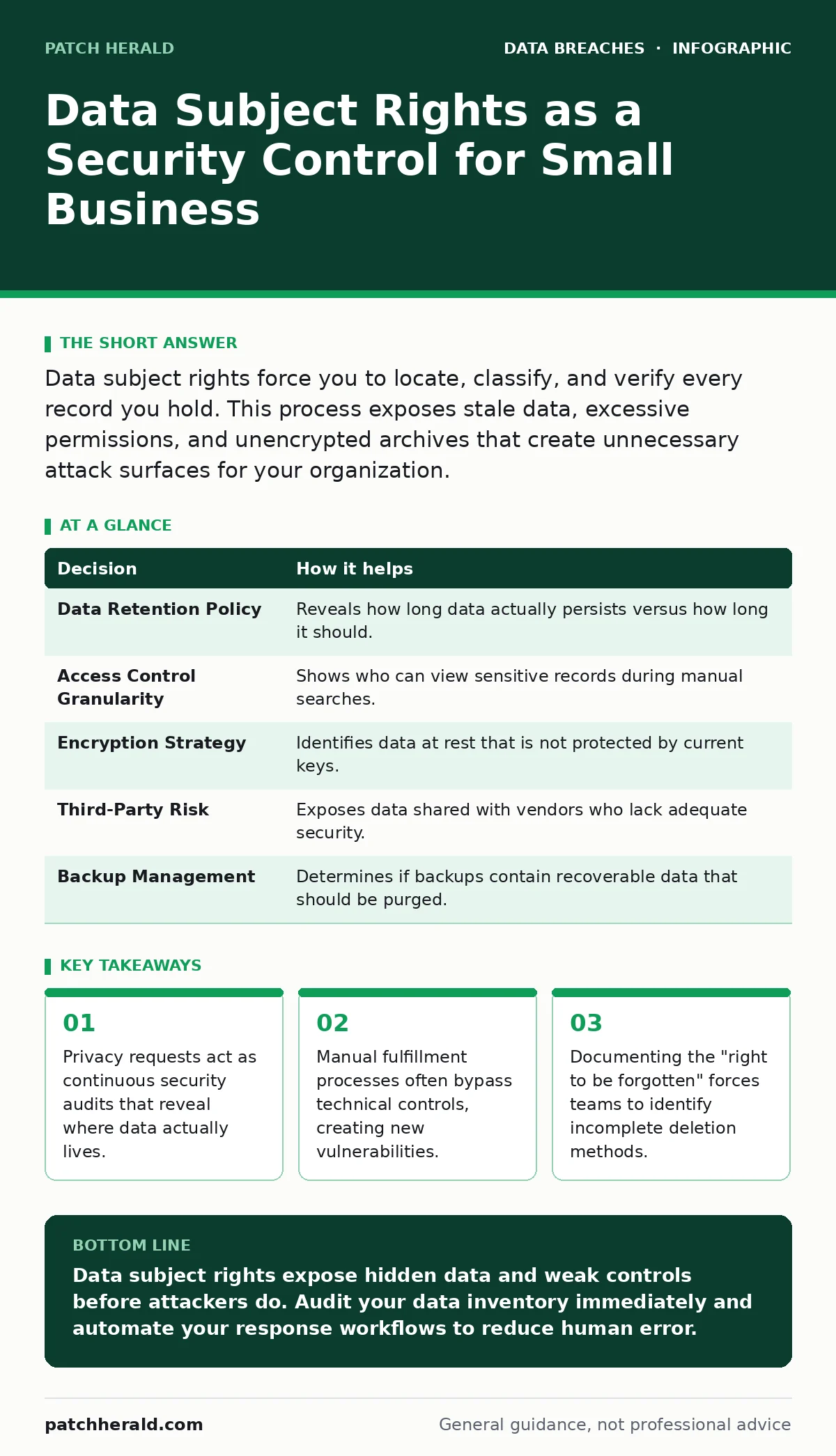
Data subject rights force you to locate, classify, and verify every record you hold. This process exposes stale data, excessive permissions, and unencrypted archives that create unnecessary attack surfaces for your organization.
How Privacy Requests Reveal Technical Debt
You hold data that you do not remember collecting. Data subject rights, such as the right to access or the right to erasure, require you to prove exactly where that information resides. This requirement forces a technical inventory that most security teams neglect until a crisis occurs. When you map data flows to satisfy these legal obligations, you often discover legacy databases, unmanaged backups, and developer test environments that contain production records. These hidden repositories lack the same monitoring and access controls as your primary systems.
The mechanism works by shifting the burden of proof. You cannot claim ignorance of data location when a user asks for their information. You must demonstrate the lineage of that record from entry to storage. This process highlights the gap between your documented architecture and your actual infrastructure. It reveals where data sovereignty requirements may be violated by cross-border transfers you did not authorize. It also shows where mobile device management policies fail to capture data stored on personal devices used for work.
The Cost of Ignoring Data Rights
Suppose a team treats privacy requests as purely administrative tasks. They assign a compliance officer to manually search email archives and shared drives. This approach misses data embedded in application logs, analytics platforms, and third-party integrations. The result is a false sense of security. The organization believes it has complied, but the data remains exposed in systems that lack proper encryption or access controls.
When an attacker exploits a misconfigured cloud storage leak, they find the very data the team failed to locate. The absence of a centralized data map means you cannot quickly isolate the affected records. You cannot determine if the exposed data is sensitive, such as protected health information, or if it has been copied to secondary systems. The lack of visibility during a breach turns a contained incident into a widespread disaster. The team spends days guessing where the data went instead of executing a precise data breach response plan.
Contrasting Team Approaches
Team A integrates privacy workflows into their security operations. They treat each request as a test of their data governance. If the automated search fails to find a record, they investigate why. Is the data deleted? Is it in a system not yet inventoried? This curiosity drives continuous improvement. They identify stale accounts and unused permissions during the search process. They reduce the attack surface by removing data that no longer serves a business purpose.
Team B views privacy as a cost center. They rush to fulfill requests to avoid penalties, often relying on memory rather than evidence. They delete files from visible folders but miss the underlying database entries. They do not update their access control lists. The data remains accessible to anyone with a valid login, even if the original record was "deleted" from the user interface. This inconsistency creates confusion and risk. It also means that in the event of doxxing, they cannot quickly verify what information was actually removed.
Decisions Informed by Rights Fulfillment
| Decision | How it helps |
|---|---|
| Data Retention Policy | Reveals how long data actually persists versus how long it should. |
| Access Control Granularity | Shows who can view sensitive records during manual searches. |
| Encryption Strategy | Identifies data at rest that is not protected by current keys. |
| Third-Party Risk | Exposes data shared with vendors who lack adequate security. |
| Backup Management | Determines if backups contain recoverable data that should be purged. |
You use the insights from these decisions to harden your environment. For example, if you find that customer addresses are stored in plain text in a marketing tool, you decide to encrypt that field at rest. If you discover that former employees still have access to historical records, you revoke those permissions immediately. These are not theoretical improvements; they are direct responses to the realities of your data landscape. The process of fulfilling rights provides the evidence needed to justify these security investments to stakeholders.
Building a Secure Fulfillment Workflow
You need a standardized process for handling data subject requests. Start by defining the scope of what constitutes personal data in your context. Include direct identifiers like names and email addresses, but also indirect identifiers like IP addresses or device IDs when combined with other data. Create a checklist for each request type. For access requests, verify the identity of the requester to prevent unauthorized disclosure. For erasure requests, ensure you understand the technical difference between soft deletes and hard deletes.
Implement database activity monitoring to track access patterns during the fulfillment process. This ensures that staff members do not export large volumes of data under the guise of processing a request. It also detects if an insider is abusing the process to steal information. Train your staff to recognize social engineering attempts that use privacy requests as a cover.
See also: Tax Identity Theft Definition: How Fraudsters Steal Your Refund · What Is Database Activity Monitoring and Why It Matters
The Hidden Risks of Manual Processes
Manual handling of data requests introduces human error. A staff member might miss a field in a spreadsheet or forget to check a secondary archive. This inconsistency means your compliance status is unknown at any given moment. You cannot guarantee that data is secure if you cannot guarantee where it is. Automation reduces this risk by applying the same logic to every request. It ensures that no data store is overlooked.
However, automation requires accurate data mapping. If your automated tools are configured incorrectly, they will fail to find data just as effectively as a manual search. You must regularly validate your data inventory against your actual infrastructure. Use periodic audits to check if new applications or integrations have introduced new data stores. Update your automation scripts to include these new sources. This ongoing maintenance is the price of security. It ensures that your defense mechanisms evolve with your technology.
Integrating Privacy and Security
Privacy and security are not separate functions. They share the same goal: controlling access to sensitive information. By integrating data subject rights into your security posture, you gain a powerful tool for discovery and validation. You stop treating compliance as a checkbox and start using it as a lens to view your technical environment. This perspective helps you identify weaknesses before they are exploited. It turns a legal obligation into a competitive advantage.
You must communicate this integration to your team. Explain that every privacy request is an opportunity to improve security. Encourage staff to report discrepancies between what they expect to find and what they actually find. Create a feedback loop where insights from privacy requests inform security updates. This cultural shift ensures that data protection becomes a shared responsibility rather than a siloed task. It builds a more resilient organization that can adapt to changing threats and regulations.
Key takeaways
- Privacy requests act as continuous security audits that reveal where data actually lives.
- Manual fulfillment processes often bypass technical controls, creating new vulnerabilities.
- Documenting the "right to be forgotten" forces teams to identify incomplete deletion methods.
Data subject rights expose hidden data and weak controls before attackers do. Audit your data inventory immediately and automate your response workflows to reduce human error.
Frequently asked questions
How do data subject rights improve incident response?
They force you to maintain an accurate data map, allowing you to quickly identify what was compromised and who was affected during a breach.
Can fulfilling privacy requests reveal insider threats?
Yes, monitoring access during fulfillment can detect staff members exporting excessive data or accessing records outside their normal duties.
Does deleting data for privacy requests weaken backups?
No, it requires you to manage backup retention carefully, ensuring you do not keep sensitive data longer than necessary while maintaining recovery capabilities.
How do I handle requests for data in third-party systems?
You must have contractual clauses requiring vendors to assist with deletion or access, and you should verify their compliance through regular audits.
How this guide was produced: written by the Patch Herald editorial team with AI assistance, checked against the public references listed below, and reviewed when the facts change. See our editorial policy or report an error.