Yes, IP addresses can be traced to a specific internet service provider and general geographic region. They do not reveal your exact home address or identity. Law enforcement and network administrators use logs to link an address to a specific user account over time.
Can IP addresses be traced to a person?
IP addresses can be traced to an internet service provider, but not directly to a person. The address identifies the network gateway assigned by your provider. It points to a city or region, not a street address. Law enforcement must request subscriber data from the provider to link the address to a name. This process requires legal authorization and specific time-stamped logs.
How far back can an IP address be traced?
Tracing depends on the retention policies of the internet service provider and the hosting company. Providers keep logs of which customer was assigned which address at which time. These logs are typically retained for months or years. Once the log is deleted, the link between the address and the user is lost. Static addresses remain assigned to one user, making them easier to track over long periods.
What information does an IP address reveal?
An IP address reveals the internet service provider and the general geographic location of the connection. It shows the type of connection, such as cable, fiber, or cellular. It does not show your browser history, search queries, or personal identity. Websites see the address to route data back to you. They cannot see your internal network structure or other devices on your Wi-Fi.
Are private IP addresses visible to the internet?
Private IP addresses are not visible to external servers or websites. Your router uses Network Address Translation to mask these internal addresses. The router assigns a unique private address to each device on your home or office network. When a device sends data out, the router replaces the private address with your public IP address. This hides the internal layout of your network from outside observers.
Can someone track my location using my IP address?
IP geolocation maps an address to a physical region, usually a city or postal code. It cannot pinpoint your exact house or street. The accuracy depends on the database used by the tracker. Some databases are more precise than others. Cellular networks may offer slightly better location data than fixed broadband, but still not exact coordinates. Do not rely on IP masking for physical privacy.
See also: How Certificate Authorities Validate Identity and Prevent Impersonation
Does using a VPN hide my IP address?
A Virtual Private Network replaces your public IP address with one from the VPN provider. The website sees the VPN server's address, not yours. The VPN provider still knows your real address and your activity. If the VPN keeps logs, your activity can be linked to you. If the VPN leaks your real address due to configuration errors, your privacy is compromised. A VPN shifts trust from your provider to the VPN company.
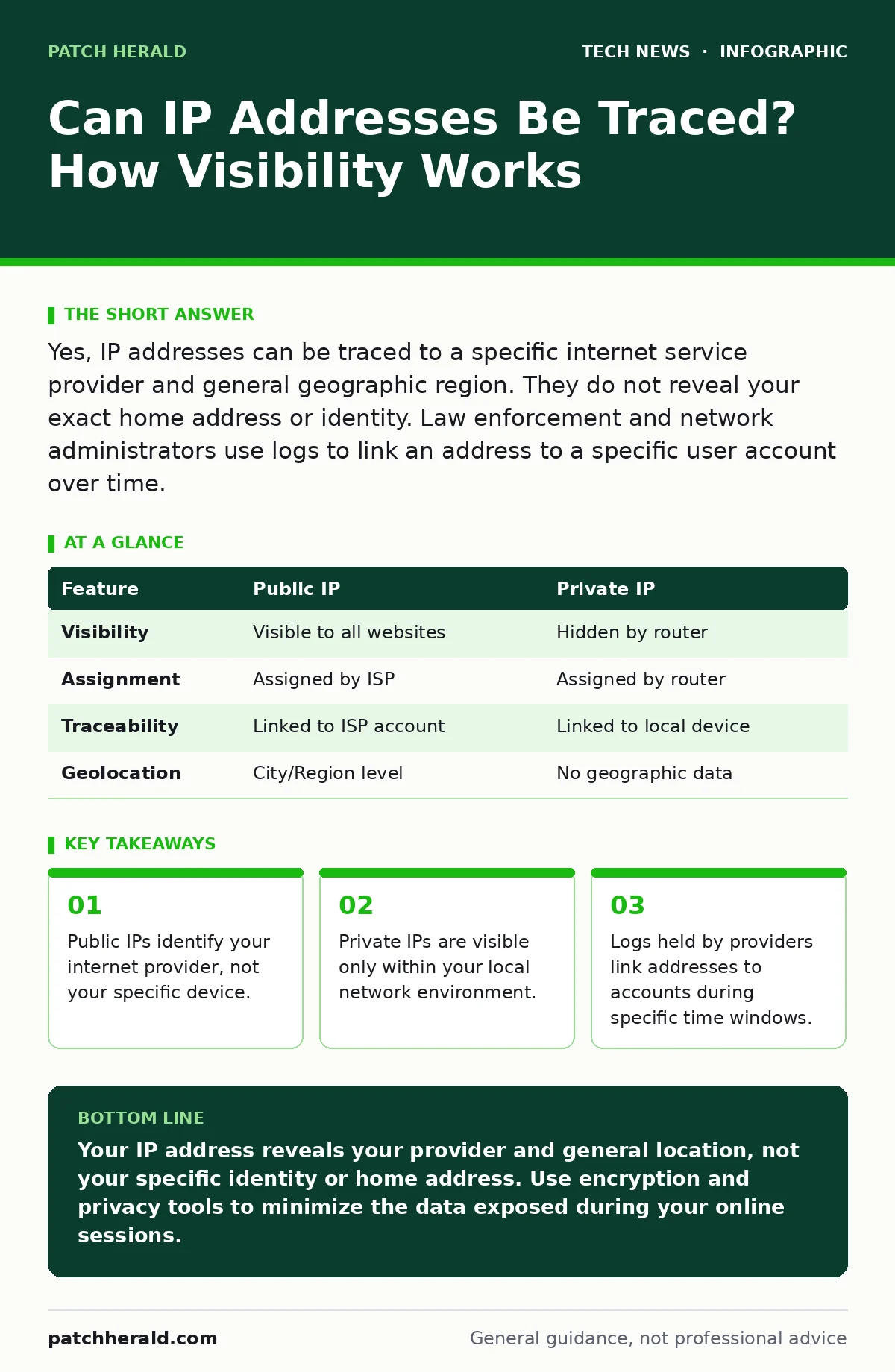
| Feature | Public IP | Private IP |
|---|---|---|
| Visibility | Visible to all websites | Hidden by router |
| Assignment | Assigned by ISP | Assigned by router |
| Traceability | Linked to ISP account | Linked to local device |
| Geolocation | City/Region level | No geographic data |
What happens if I change my IP address?
Most residential connections use dynamic IP addresses that change periodically. Your provider may assign a new address when you restart the router or after a set time. This makes long-term tracking of a single address difficult. However, the provider still logs the sequence of addresses assigned to your account. Changing the address does not erase past logs or hide your identity from the provider.
How do I protect my privacy online?
Use encryption to prevent eavesdropping on your data content. Ensure your website connections use HTTPS to encrypt traffic between you and the server. Review your browser settings to limit tracking scripts. Consider using privacy-focused search engines that do not log queries. Keep your router firmware updated to prevent known vulnerabilities. See our guide on software updates for maintaining device security.
Can IP tracing bypass security measures?
Advanced tracing can bypass simple proxies but struggles with strong encryption. Law enforcement can request data from multiple providers to follow a chain of connections. Tor networks add layers of routing to obscure the origin. However, exit nodes can still be monitored. No method is perfect against determined, resourced adversaries. Focus on minimizing the data you share rather than hiding your address entirely.
Key takeaways
- Public IPs identify your internet provider, not your specific device.
- Private IPs are visible only within your local network environment.
- Logs held by providers link addresses to accounts during specific time windows.
Your IP address reveals your provider and general location, not your specific identity or home address. Use encryption and privacy tools to minimize the data exposed during your online sessions.
Frequently asked questions
Can a website see my IP address?
Yes, every website you visit receives your public IP address to deliver content to your device. This is standard for all internet communication.
Does clearing my browser history hide my IP address?
No, browser history is stored locally on your device. Your IP address is transmitted to servers and logged by your internet provider independently of your browser settings.
Can I get a permanent IP address?
You can request a static IP address from your provider, often for an additional fee. This keeps your address constant, making it easier for you to host services but also easier to track over time.
Is my IP address unique to me?
Your public IP address is unique on the internet at any given moment. However, many users share the same address temporarily through carrier-grade Network Address Translation, especially on mobile networks.
How this guide was produced: written by the Patch Herald editorial team with AI assistance, checked against the public references listed below, and reviewed when the facts change. See our editorial policy or report an error.