
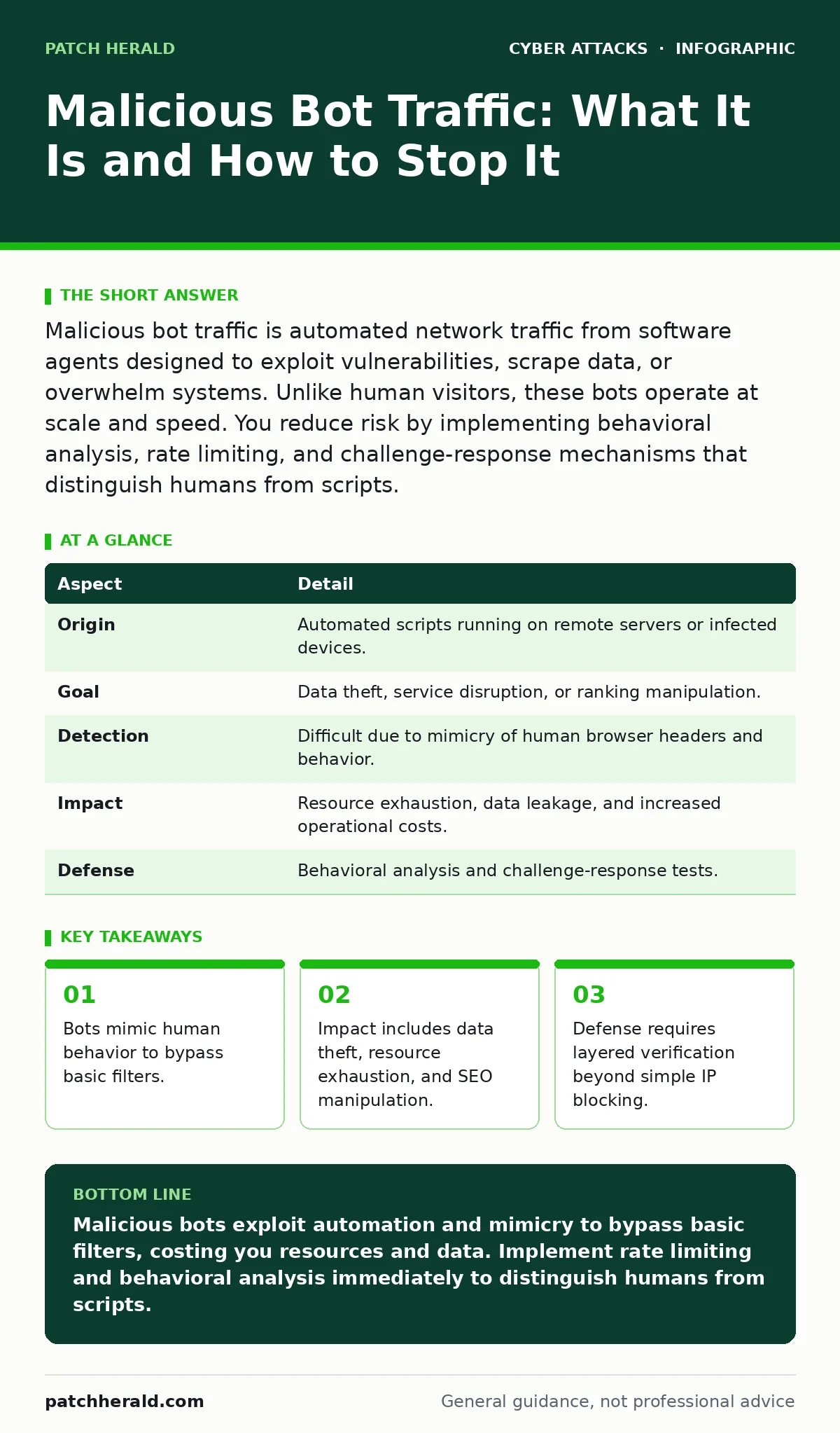
Malicious bot traffic is automated network traffic from software agents designed to exploit vulnerabilities, scrape data, or overwhelm systems. Unlike human visitors, these bots operate at scale and speed. You reduce risk by implementing behavioral analysis, rate limiting, and challenge-response mechanisms that distinguish humans from scripts.
Understanding Malicious Bot Traffic
Imagine a library where thousands of people enter simultaneously. Most visitors read books quietly. A few, however, rip pages from encyclopedias to sell elsewhere, slam doors to block entry, or steal sensitive records. These aggressive actors are the bots. Malicious bot traffic refers to automated requests sent to your servers by software agents rather than human users. These agents execute pre-defined scripts to achieve specific goals, such as harvesting email addresses, testing for weak login credentials, or submitting spam comments. The traffic appears in your server logs as a stream of HTTP requests, indistinguishable from normal browsing at a glance.
The scale of this automation is the defining characteristic. A human user clicks a button once per second. A bot can send thousands of requests per second. This speed allows attackers to test millions of password combinations in minutes or scrape your entire product catalog before you can react. The traffic does not always crash your system. Often, it operates silently in the background, draining your bandwidth and database resources while you remain unaware.
| Aspect | Detail |
|---|---|
| Origin | Automated scripts running on remote servers or infected devices. |
| Goal | Data theft, service disruption, or ranking manipulation. |
| Detection | Difficult due to mimicry of human browser headers and behavior. |
| Impact | Resource exhaustion, data leakage, and increased operational costs. |
| Defense | Behavioral analysis and challenge-response tests. |
How Automated Attacks Bypass Defenses
Malicious bots do not always look like machines. Modern attack tools use residential IP addresses, which are internet connections provided by actual households to their owners. By routing traffic through these residential IPs, attackers hide behind the legitimacy of real users. Your firewall sees traffic coming from a neighbor’s house, not a data center in a foreign country. This makes IP-based blocking ineffective.
The bots also replicate the technical fingerprint of popular web browsers. They include correct User-Agent strings, which are text strings that servers use to identify the client software. They handle cookies and JavaScript execution just like Chrome or Firefox would. When a bot behaves identically to a human, traditional security measures fail. You cannot block the traffic without blocking legitimate customers who use the same browsers and internet service providers. This mimicry forces defenders to move beyond simple signature matching.
Common Forms of Bot Abuse
Attackers deploy bots for various purposes, each carrying distinct risks. Credential stuffing is a primary form. Here, bots take stolen username and password pairs from previous breaches and attempt to log in to your accounts. They automate the trial-and-error process that would take a human years to complete. This leads directly to account takeover if users reuse passwords across sites.
Another common form is web scraping. Bots crawl your site to copy product descriptions, pricing, or proprietary data. This data is then used by competitors or sold on dark markets. SEO spam is another variant. Bots submit thousands of links or comments to manipulate search engine rankings. These actions degrade your site’s reputation and clutter your content with malicious links. Each form exploits different aspects of your web application’s logic and infrastructure.
Who Bears the Cost
Every organization with a public-facing web server is a target. Small businesses are often preferred targets because they may lack dedicated security teams or advanced detection tools. Attackers know that a small e-commerce store might not notice a slow leak of customer data. They also know that smaller organizations have limited bandwidth and compute resources. A modest bot attack can overwhelm a small server that a large enterprise could absorb without notice.
The cost is not just reputational. It is operational and financial. Every bot request consumes CPU cycles and network bandwidth. You pay for this infrastructure usage regardless of whether the visitor is human or machine. High volumes of malicious traffic can trigger auto-scaling events in cloud environments, inflating your monthly bills. Additionally, the time spent investigating and mitigating the attack diverts staff from productive work. The hidden cost is the erosion of trust when users experience slow or unresponsive services.
What People Usually Get Wrong
Many administrators believe that blocking known bad IP addresses stops the problem. This approach fails because attackers constantly rotate their IP pools. By the time you block one IP, the bot has moved to another. Relying on static lists is a losing game. You cannot maintain a blacklist that keeps pace with a dynamic attack surface. This misconception leads to false confidence and delayed response.
Another common error is assuming that HTTPS encryption protects against bots. Encryption secures the data in transit, preventing eavesdropping. It does not verify the identity of the sender. A bot can establish an encrypted connection just as easily as a human. Treating encryption as a security control rather than a privacy control leaves your application logic exposed. You must verify the client, not just secure the channel. This misunderstanding often persists because encryption certificates are visible and tangible, while behavioral analysis is abstract.
See also: How Certificate Authorities Validate Identity and Prevent Impersonation
Reducing Risk Through Layered Defense
Effective mitigation requires multiple layers of verification. Rate limiting is the first line of defense. This mechanism restricts the number of requests a single client can make within a specific time window. If a client exceeds this threshold, the server temporarily blocks further requests. This slows down brute-force attacks and scraping. It does not stop a determined attacker, but it raises the cost of the attack and makes it easier to detect anomalies.
Challenge-response tests add a second layer. These tests present a task that is easy for humans but difficult for scripts. Captchas are the most well-known example, requiring users to identify objects or type distorted text. Newer methods use invisible challenges that analyze mouse movements, typing speed, and interaction patterns. These behavioral signals reveal whether a human is controlling the input. Implementing zero trust security principles helps here, as you verify every request regardless of its origin. This approach ensures that even compromised sessions are scrutinized.
Monitoring and Incident Response
Detection relies on continuous monitoring of traffic patterns. Look for spikes in requests from specific regions or user agents. Analyze the frequency of failed login attempts. These metrics provide early warning signs of an attack. You need incident response plans that define clear steps for isolating affected services and throttling traffic. Without a pre-defined plan, reaction times slow down during a crisis.
Regularly review your access logs for anomalies. Look for requests that target non-existent pages or API endpoints. These attempts often probe for vulnerabilities. Correlate these events with system performance metrics. A drop in response time combined with a rise in traffic volume suggests a resource-heavy attack. By establishing a baseline of normal behavior, you can identify deviations quickly. This proactive stance allows you to adjust your defenses before the attack causes significant damage.
Integrating Security into Development
Security must be built into your application architecture, not added as an afterthought. Secure coding practices reduce the attack surface available to bots. Validate all user inputs on the server side. Assume that every request could be malicious. This mindset prevents injection attacks that bots often exploit. Use standard protocols and libraries that have been reviewed by the security community.
Regular penetration testing helps identify weaknesses in your bot mitigation strategies. Testers can simulate various bot behaviors to see if your defenses hold. This testing reveals gaps in your rate limiting or challenge mechanisms. Addressing these gaps before an attack occurs is more effective than reacting in real-time. By treating security as a continuous development process, you build a resilient system that adapts to evolving threats.
Key takeaways
- Bots mimic human behavior to bypass basic filters.
- Impact includes data theft, resource exhaustion, and SEO manipulation.
- Defense requires layered verification beyond simple IP blocking.
Malicious bots exploit automation and mimicry to bypass basic filters, costing you resources and data. Implement rate limiting and behavioral analysis immediately to distinguish humans from scripts.
Frequently asked questions
Can a firewall stop malicious bot traffic?
A traditional firewall filters traffic based on IP addresses and ports. It cannot distinguish between a human and a bot if they use the same IP and port. You need application-layer controls to stop bots.
How do I know if a bot is attacking my site?
Look for unusual spikes in traffic, high error rates, or failed login attempts. Monitor your server logs for repetitive requests from the same source or user agent strings that do not match standard browsers.
Is using a captcha enough to stop bots?
Captchas are effective but not foolproof. Advanced bots can use machine learning to solve simple captchas. Combine captchas with rate limiting and behavioral analysis for better protection.
Do I need a separate guide on website defacement?
Bot traffic can lead to website defacement if the bot exploits a vulnerability to upload malicious files. Understanding bot traffic helps you prevent the initial access that leads to defacement.
How this guide was produced: written by the Patch Herald editorial team with AI assistance, checked against the public references listed below, and reviewed when the facts change. See our editorial policy or report an error.