
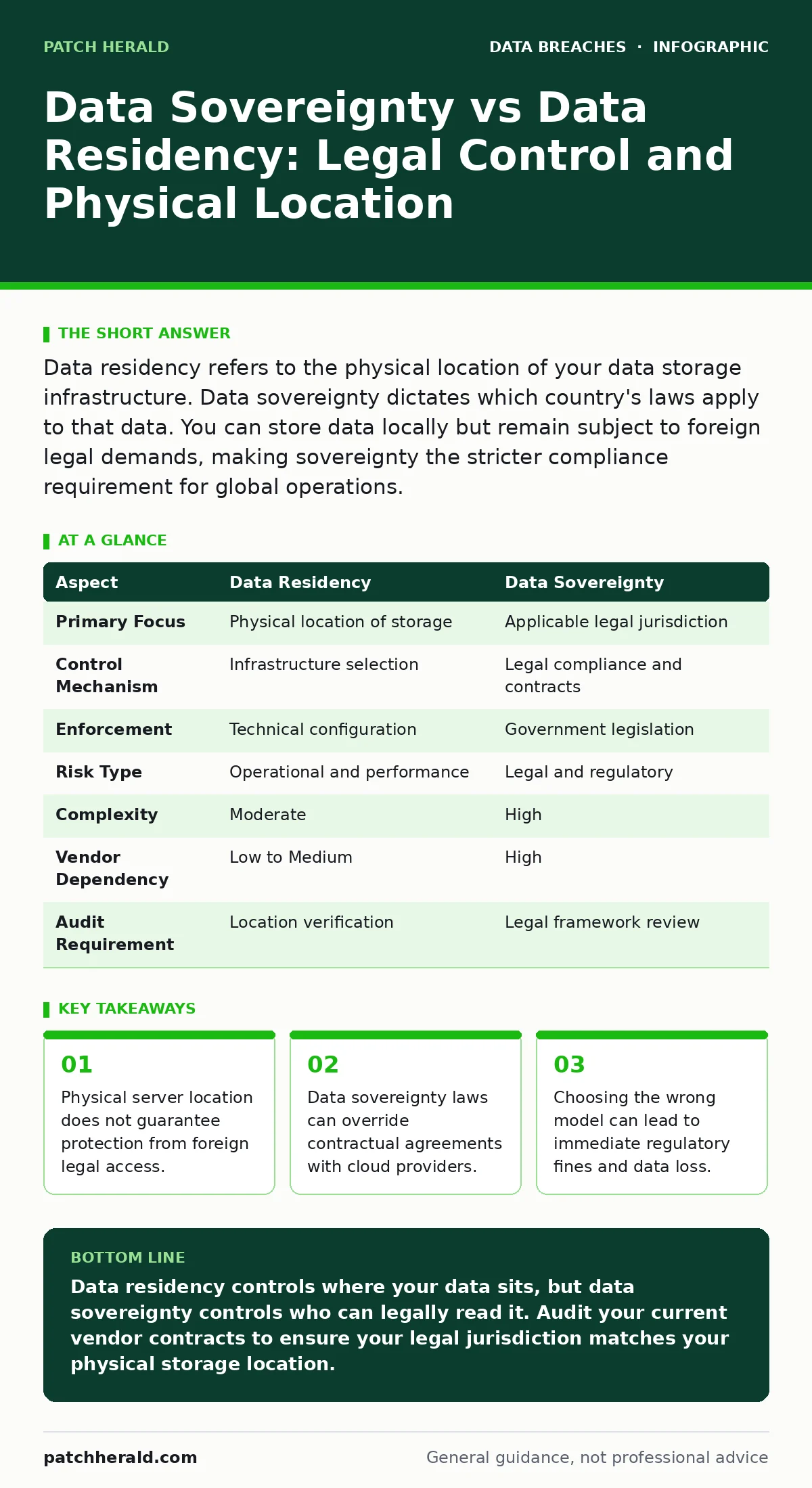
Data residency refers to the physical location of your data storage infrastructure. Data sovereignty dictates which country's laws apply to that data. You can store data locally but remain subject to foreign legal demands, making sovereignty the stricter compliance requirement for global operations.
The Core Distinction
Data residency specifies the geographic location of your data at rest. It answers the question of where the physical hard drives sit. Data sovereignty determines which national laws govern the processing, storage, and transfer of that data. It answers who has the legal authority to access it. Many organizations confuse these terms. They assume that storing data in a specific country protects it from other nations' laws. This assumption is false. A server in Country A may still be subject to the laws of Country B if the service provider is headquartered there.
What Is Data Residency?
Data residency is a technical and operational constraint. It requires you to map your data flows to specific geographic regions. You select a cloud region or a physical data center. This choice is often driven by performance needs, such as reducing latency for users in that area. It is also driven by local regulations that mandate data stays within borders. For example, some nations require that citizen data never leaves their territory. You must verify the actual physical location of the storage devices. Virtualization layers can obscure this reality. A provider may claim a region is local, but the underlying hardware might be replicated elsewhere for backup purposes.
What Is Data Sovereignty?
Data sovereignty is a legal framework. It asserts that data within a nation's borders is subject to that nation's laws. This concept becomes complex when data moves across borders or is processed by foreign entities. Sovereignty laws can require that data be accessible to government agencies for national security purposes. They can also restrict how data is encrypted or shared. The key insight is that sovereignty follows the data owner or the processor, not just the server. If you use a service owned by a foreign corporation, that corporation's home country laws may apply to your data, regardless of where the server sits.
Data Sovereignty vs Data Residency Comparison
| Aspect | Data Residency | Data Sovereignty |
|---|---|---|
| Primary Focus | Physical location of storage | Applicable legal jurisdiction |
| Control Mechanism | Infrastructure selection | Legal compliance and contracts |
| Enforcement | Technical configuration | Government legislation |
| Risk Type | Operational and performance | Legal and regulatory |
| Complexity | Moderate | High |
| Vendor Dependency | Low to Medium | High |
| Audit Requirement | Location verification | Legal framework review |
When To Choose Data Residency
Choose data residency when your primary goal is performance or simple regulatory compliance. Local storage reduces latency for end-users. It ensures faster response times for applications. Some industries require data to remain within specific borders for operational reasons. This approach is simpler to implement. You select a region in your cloud console. You verify that backups stay in the same region. It is sufficient when the laws of the storage location are the only laws that matter. It does not protect you from foreign subpoenas or international data requests. It is a baseline requirement, not a complete legal shield.
See also: Password Hygiene for Small Teams: Practical Controls That Actually Work · Implementing Data Breach Response Plans: A Step-by-Step Guide
When To Choose Data Sovereignty
Choose data sovereignty when you handle sensitive information subject to strict international laws. This is necessary for protected health information or financial records. You must ensure that no foreign government can access your data without due process. This requires careful vendor selection. You need providers that offer local legal entities.
These entities must be subject to local laws, not foreign ones. You may need to implement database activity monitoring to ensure no unauthorized access occurs. Sovereignty strategies often involve keeping data on-premises or using sovereign cloud options. These options are more expensive and complex but provide stronger legal protection.
Overlapping Requirements and Pitfalls
The overlap occurs when physical location and legal jurisdiction align. This is the ideal state for most organizations. However, misalignment creates risk. Imagine you store data in a country with strong privacy laws. But your cloud provider is owned by a company in a country with weak privacy laws. The owning country's laws may allow access to your data. This is a common pitfall in global cloud adoption.
You must review the provider's legal structure. Check where their data centers are owned. Verify who has administrative access. Do not rely solely on marketing claims about local presence. Conduct a legal review of the service agreement. Understand the clauses related to government access. This diligence prevents misconfigured cloud storage leaks from becoming legal disasters.
Strategic Implementation Steps
Start by classifying your data. Identify what is sensitive and what is not. Map your data flows to understand where it moves. Select vendors based on legal jurisdiction, not just geography. Implement encryption keys that you control. This adds a layer of protection even if the infrastructure is compromised. Regularly audit your configurations.
Ensure that backups and disaster recovery sites comply with your chosen model. Train your staff on the difference between technical location and legal control. Update your breach notification plans to account for cross-border legal requirements. Stay informed about changes in international data laws. These changes can affect your compliance status overnight.
Key takeaways
- Physical server location does not guarantee protection from foreign legal access.
- Data sovereignty laws can override contractual agreements with cloud providers.
- Choosing the wrong model can lead to immediate regulatory fines and data loss.
Data residency controls where your data sits, but data sovereignty controls who can legally read it. Audit your current vendor contracts to ensure your legal jurisdiction matches your physical storage location.
Frequently asked questions
Does data residency guarantee data sovereignty?
No. Data residency only confirms physical location. Sovereignty depends on the legal jurisdiction governing the data processor, which may differ from the server location.
How does data sovereignty affect cloud providers?
Providers must operate under local laws if they host sovereign data. This may require local subsidiaries and separate legal entities to isolate data from foreign legal demands.
What is the role of encryption in data sovereignty?
Encryption protects data content, but sovereignty laws may require key disclosure. If you control the keys, you maintain more sovereignty, even if the provider is foreign.
Can data sovereignty laws conflict with international treaties?
Yes. Conflicts arise when one nation demands data access and another prohibits it. Organizations must navigate these conflicts through legal counsel and careful vendor selection.
How this guide was produced: written by the Patch Herald editorial team with AI assistance, checked against the public references listed below, and reviewed when the facts change. See our editorial policy or report an error.