
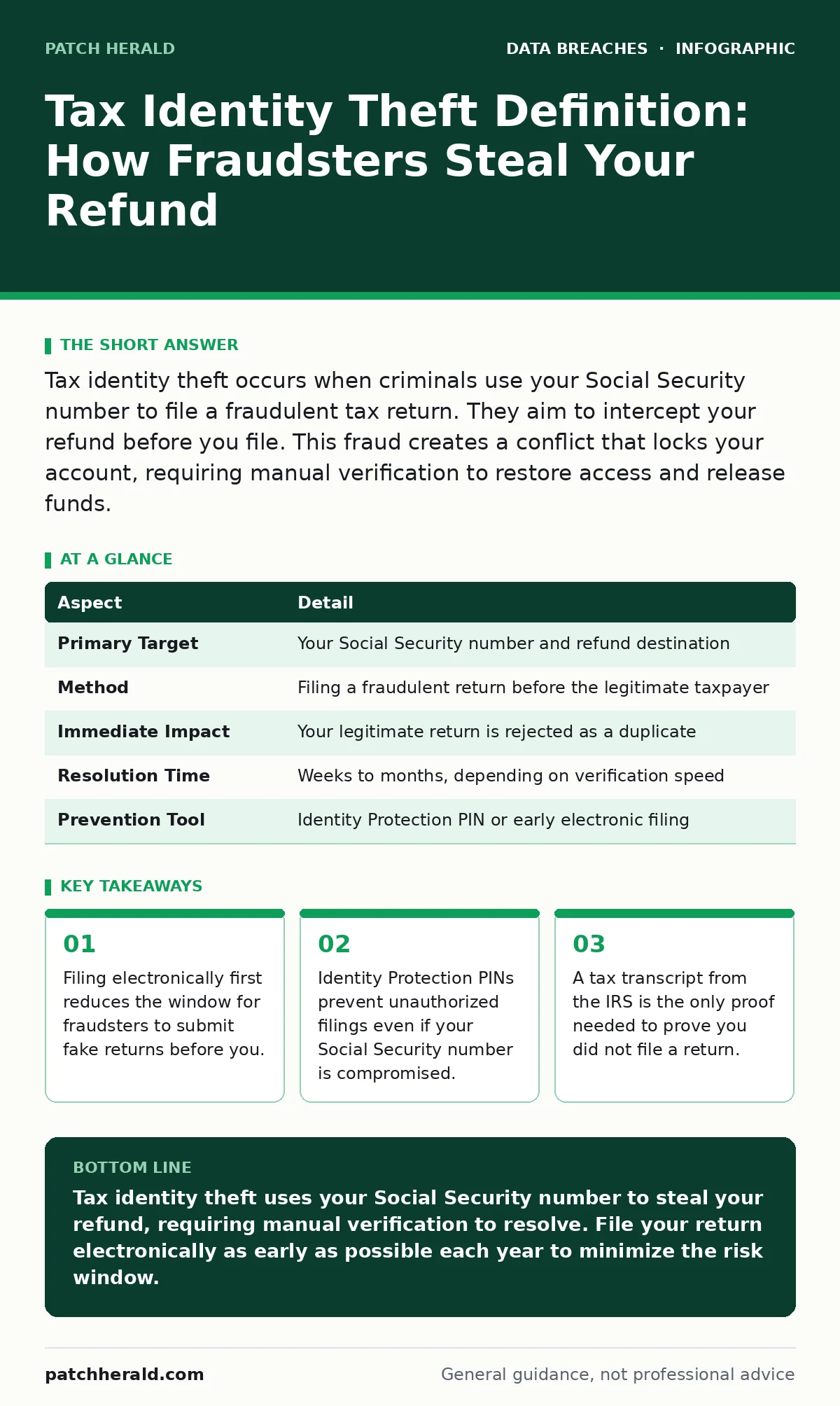
Tax identity theft occurs when criminals use your Social Security number to file a fraudulent tax return. They aim to intercept your refund before you file. This fraud creates a conflict that locks your account, requiring manual verification to restore access and release funds.
The Mechanics of Stolen Refunds
Imagine leaving a sealed envelope containing cash on your porch. You intend to mail it to the bank, but someone else picks it up, opens it, and deposits the money into their account. By the time you arrive at the bank, the deposit has already cleared. Tax identity theft operates on this same principle of timing and access. The criminal does not need to break into your computer. They only need your name, date of birth, and Social Security number. These three data points are sufficient to impersonate you in the eyes of the tax authority.
Once the fraudster has your information, they prepare a fake tax return. They claim you are entitled to a refund and provide their own bank account details for the deposit. They submit this return early in the filing season. The tax processing system accepts the first return it receives for a given Social Security number. It assumes the filer is the legitimate taxpayer. The system then processes the refund and sends the money to the fraudster.
| Aspect | Detail |
|---|---|
| Primary Target | Your Social Security number and refund destination |
| Method | Filing a fraudulent return before the legitimate taxpayer |
| Immediate Impact | Your legitimate return is rejected as a duplicate |
| Resolution Time | Weeks to months, depending on verification speed |
| Prevention Tool | Identity Protection PIN or early electronic filing |
Tax Identity Theft Definition
The tax identity theft definition centers on the unauthorized use of personal identifying information to file a false income tax return. The goal is always financial gain, specifically the interception of a tax refund. This is distinct from credit card fraud, where the victim is charged for unauthorized purchases. In tax fraud, the government sends money to the criminal. You do not see the theft happen in real time. You only discover it when you attempt to file your own return and the system rejects it.
The rejection message usually states that a return has already been filed using your Social Security number. This is the first sign of intrusion. The tax authority has detected a conflict. It locks the account to prevent further filings. You must now prove that you are the legitimate taxpayer and that the previous filing was fraudulent. This process requires direct contact with the tax agency and often involves waiting for manual review.
Who Is Most at Risk
Anyone with a Social Security number is a potential target, but certain groups face higher exposure. Small business owners are frequent targets because their returns often show larger refunds or deductions. Criminals look for accounts with significant financial activity. They also target individuals who have experienced data breaches. If your personal information was exposed in a corporate leak, it likely appears on underground markets. Fraudsters purchase these data sets and use automated tools to test them against tax systems.
People who file paper returns are also at greater risk. Electronic filing sends your data directly to the tax authority with encryption. Paper returns travel through the postal system and are processed manually. This creates a larger time gap between your filing and the official record. Fraudsters can exploit this gap to submit their fake return first. Delaying your filing until the last week of the season also increases risk. The later you file, the more time criminals have to act on stolen data.
What People Usually Get Wrong
Many people believe that changing their password stops tax identity theft. This is incorrect. Tax filings are authenticated by Social Security numbers, not user passwords. Changing your email password does not protect your tax identity. The fraudster does not need your login credentials. They need your government-issued identifier. You must assume your Social Security number is compromised if you suspect fraud.
Another common mistake is ignoring unsolicited calls about tax refunds. The tax authority will never call you to request personal or financial information. Scammers use these calls to harvest additional data. They may claim you have a pending refund and need to verify your identity. They ask for your bank account number or PIN. Providing this information gives them direct access to your funds. Hang up immediately. Do not provide any details.
A third error is assuming that a refund check in the mail means you are safe. If you receive a refund check but did not file a return, do not cash it. Cashing a fraudulent check makes you complicit in the fraud. Contact the tax authority immediately to report the check. They will cancel the payment and begin an investigation. You may be required to return the funds if you have already deposited them.
Immediate Response Steps
If you receive a notice that a return was filed under your name, act quickly. First, verify the notice is legitimate. Check the sender's address and contact information against official government websites. Do not use phone numbers printed on the notice. Scammers often create fake notices with real-looking logos but fraudulent contact details. Use the official website to find the correct phone number.
Second, contact the tax authority to report the fraud. You will need to provide your personal information and explain the situation. They will place a lock on your account to prevent further filings. They may issue an Identity Protection PIN. This is a unique six-digit number that you must include on your tax return. It acts as a second factor of authentication. Only you and the tax authority know this PIN. No one else can file a return for you without it.
Third, monitor your credit reports. Tax identity theft often accompanies other forms of financial fraud. Criminals may use your information to open new credit accounts. Regular monitoring helps you detect these attempts early. You can place a fraud alert or a credit freeze on your reports. A freeze prevents new accounts from being opened in your name. You must temporarily lift the freeze to file your taxes or apply for credit.
See also: Mobile Device Management for Small Teams: Control and Cost · What Is Database Activity Monitoring and Why It Matters
Long-Term Protection Strategies
Protecting your tax identity requires ongoing vigilance. Request a tax transcript from the IRS annually. This document shows all returns filed under your Social Security number. Review it for any filings you did not make. If you see an unfamiliar return, report it immediately. This is the most reliable way to detect fraud before it causes significant harm.
Consider using a tax professional who is enrolled with the IRS. Enrolled agents and certified public accountants have access to additional security features. They can help you navigate the process of resolving fraud. They also understand the nuances of tax law and can advise on the best way to protect your financial interests. Do not rely solely on software for complex situations.
Review your privacy settings on social media. Public profiles often contain enough information to answer security questions. Fraudsters use this data to bypass account recovery processes. Limit the amount of personal information you share online. Avoid posting photos of mail, packages, or documents that contain your address or name. These images can be used to reconstruct your identity profile.
Related Security Measures
Tax identity theft is often a symptom of broader data security failures. If your personal information was exposed in a data breach, you need a robust data breach response plans to mitigate the damage. Review your data subject rights to understand how companies handle your personal information. Misconfigured cloud storage leaks are a common source of large-scale data exposure. Ensure that any cloud services you use are properly secured.
Doxxing can also lead to tax fraud. If your personal details are published online, they become available to criminals. Mobile device management is critical if you use your phone for work. Lost or stolen devices can provide access to sensitive emails and documents. Protected health information is often targeted in healthcare breaches, which can expose your Social Security number. Database activity monitoring can help detect unauthorized access to sensitive records. Finally, breach notification laws require companies to inform you if your data is compromised. Pay attention to these notices and take immediate action.
Key takeaways
- Filing electronically first reduces the window for fraudsters to submit fake returns before you.
- Identity Protection PINs prevent unauthorized filings even if your Social Security number is compromised.
- A tax transcript from the IRS is the only proof needed to prove you did not file a return.
Tax identity theft uses your Social Security number to steal your refund, requiring manual verification to resolve. File your return electronically as early as possible each year to minimize the risk window.
Frequently asked questions
Can I file my taxes if my Social Security number was stolen?
Yes, you can file, but you may need an Identity Protection PIN. Contact the tax authority to request one before filing.
How long does it take to resolve tax identity theft?
Resolution times vary, but it can take several weeks or months. The process involves manual review and verification of your identity.
Will I be charged for the fraudster's taxes?
No, you are not responsible for the fraudulent return. The tax authority will reverse any refunds issued to the fraudster.
Does having a good credit score prevent tax identity theft?
No, tax identity theft is based on your Social Security number, not your credit history. Credit scores do not protect your tax identity.
How this guide was produced: written by the Patch Herald editorial team with AI assistance, checked against the public references listed below, and reviewed when the facts change. See our editorial policy or report an error.