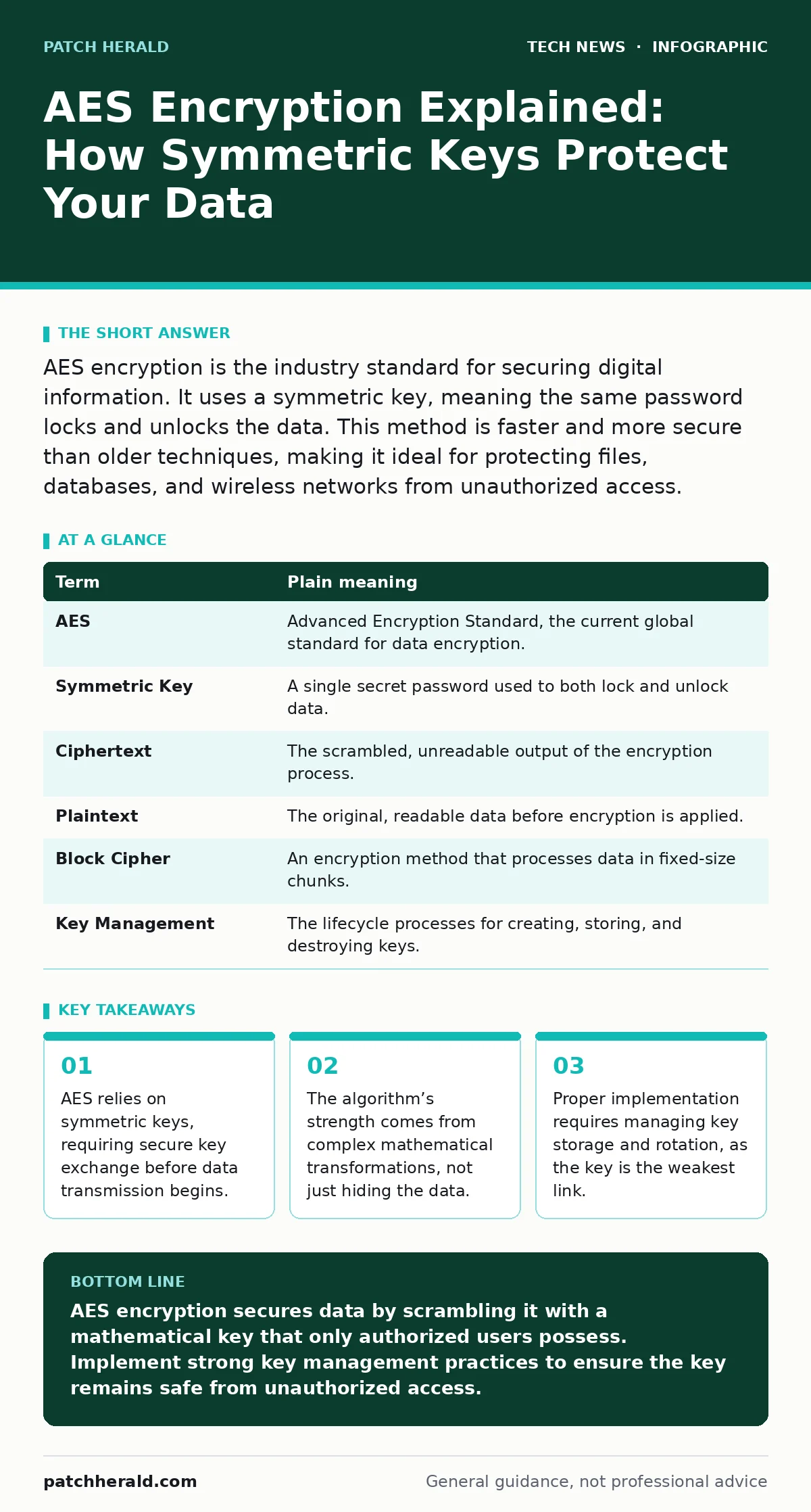
AES encryption is the industry standard for securing digital information. It uses a symmetric key, meaning the same password locks and unlocks the data. This method is faster and more secure than older techniques, making it ideal for protecting files, databases, and wireless networks from unauthorized access.
The Digital Lockbox Analogy
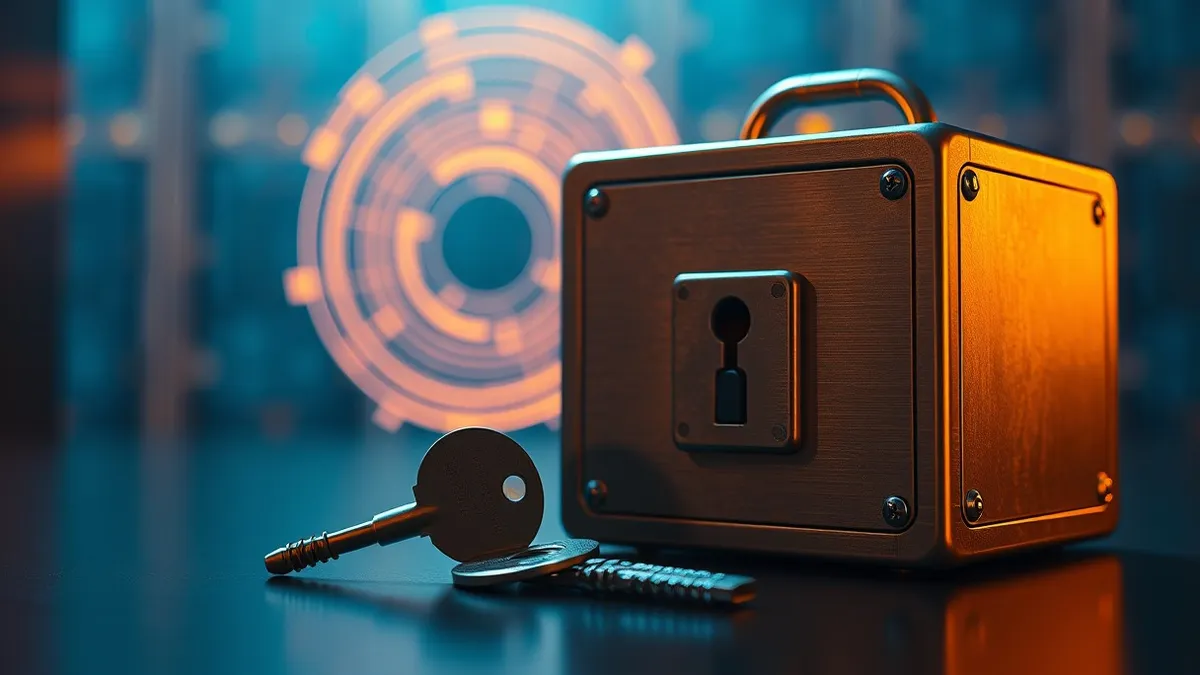
Imagine you have a heavy steel lockbox that can only be opened with a specific physical key. You place your sensitive documents inside, shut the lid, and turn the key. The internal tumblers shift into a chaotic arrangement that matches only that specific key. To anyone else, the box is just a sealed metal container. They cannot see inside, and they cannot open it without the exact metal key you hold. This is how AES encryption works for your digital files.
In this analogy, the documents are your plaintext data. The act of locking the box is the encryption process. The sealed box is the ciphertext, which looks like random noise. The physical key is the cryptographic key. If you lose the key, the documents remain safe from thieves, but you also cannot read them. This trade-off is the foundation of symmetric encryption.
Core Mechanics of Symmetric Encryption
AES stands for Advanced Encryption Standard. It is a symmetric block cipher, meaning it processes data in fixed-size chunks called blocks. A symmetric cipher uses the same secret key for both encrypting and decrypting information. This differs from asymmetric encryption, which uses a public key to lock and a private key to unlock. Symmetric methods are significantly faster because the mathematical operations are less complex.
The algorithm takes a block of plaintext and applies a series of mathematical transformations. These steps include substitution, permutation, and mixing with the key. The result is ciphertext that bears no visible resemblance to the original input. Without the correct key, reversing these steps is computationally infeasible. The security does not come from keeping the algorithm secret, but from keeping the key secret.
Clarifying Common Points of Confusion
Many users confuse the strength of the encryption with the length of the key. AES supports key sizes of 128, 192, and 256 bits. A 256-bit key is not twice as strong as a 128-bit key; it is exponentially harder to crack. However, 128-bit AES is currently considered secure for most commercial applications. The choice depends on your threat model and regulatory requirements.
Another misconception is that encryption alone solves all security problems. Encryption protects data at rest and in transit, but it does not verify identity. If you send an encrypted file to the wrong person, they still possess the key if you shared it insecurely. This is why key management is often more difficult than the encryption itself. You must ensure the key is stored securely and transmitted safely.
The Hidden Cost of Key Management
The biggest vulnerability in any AES implementation is not the algorithm, but the key handling. If you store the key in the same database as the encrypted data, a breach exposes both. Imagine losing the key to your lockbox but keeping the box in your bedroom. A burglar who breaks into your bedroom finds the key right next to the box. This is a common mistake in software development.
You should use a hardware security module or a dedicated key management service. These tools isolate keys from the application logic. They also provide audit trails for key usage. Without proper isolation, the encryption provides a false sense of security. The data is scrambled, but the means to unscramble it are easily accessible to an attacker with system access.
Real-World Applications Beyond Files
You encounter AES encryption in several daily technologies without realizing it. WPA3 security protocols use AES to protect wireless network traffic. This ensures that passwords and data sent over Wi-Fi are not intercepted by neighbors. Guest Wi-Fi networks often rely on these same standards to isolate visitors from your main network.
Cloud storage providers use AES to encrypt your files before they leave your device. Remote desktop security protocols also utilize AES to scramble screen updates and input commands. Even IoT security devices use lightweight versions of AES to protect sensor data. Understanding that these diverse systems rely on the same core principle helps you evaluate their security uniformly.
| Term | Plain meaning |
|---|---|
| AES | Advanced Encryption Standard, the current global standard for data encryption. |
| Symmetric Key | A single secret password used to both lock and unlock data. |
| Ciphertext | The scrambled, unreadable output of the encryption process. |
| Plaintext | The original, readable data before encryption is applied. |
| Block Cipher | An encryption method that processes data in fixed-size chunks. |
| Key Management | The lifecycle processes for creating, storing, and destroying keys. |
See also: SSH Key Management: Practical Answers to Common Security Questions
Try This Now: Verify Your Encryption
- Check your cloud storage settings to confirm that server-side encryption is enabled. Most providers use AES-256 by default, but you must verify it is active for your account.
- Review your home router security settings to ensure WPA3 is selected. If your devices do not support WPA3, use WPA2 with AES, avoiding the weaker TKIP option.
- Audit your SSH key management practices. Ensure that your private keys are encrypted with a passphrase and stored securely, as they act as the keys to your server access.
Looking Ahead to Future Threats
While AES is secure against classical computers, quantum computing poses a theoretical future risk. Quantum algorithms could potentially solve the mathematical problems that AES relies on. Post-quantum cryptography research is already underway to develop new standards that resist quantum attacks.
For now, AES remains the best choice for everyday security. The transition to post-quantum standards will take years. You should focus on implementing AES correctly today. Proper key management and secure protocols provide robust protection against current threats. Open-source software security audits often highlight AES implementations as reliable, provided they are configured correctly.
Key takeaways
- AES relies on symmetric keys, requiring secure key exchange before data transmission begins.
- The algorithm’s strength comes from complex mathematical transformations, not just hiding the data.
- Proper implementation requires managing key storage and rotation, as the key is the weakest link.
AES encryption secures data by scrambling it with a mathematical key that only authorized users possess. Implement strong key management practices to ensure the key remains safe from unauthorized access.
Frequently asked questions
Is AES-256 overkill for personal use?
For most personal users, AES-128 provides sufficient security. However, AES-256 is the standard for high-sensitivity data and future-proofing against advanced threats.
Can hackers break AES encryption?
Breaking AES by guessing the key is computationally infeasible with current technology. Attacks usually target weak key storage or implementation flaws, not the algorithm itself.
Does encryption slow down my computer?
Modern processors have hardware acceleration for AES. The performance impact is negligible for most everyday tasks, including file transfers and web browsing.
How do I know if my data is encrypted?
Look for padlock icons in browsers, check cloud storage settings, and verify that file extensions indicate encryption. For networks, ensure your Wi-Fi settings show WPA2 or WPA3.
How this guide was produced: written by the Patch Herald editorial team with AI assistance, checked against the public references listed below, and reviewed when the facts change. See our editorial policy or report an error.