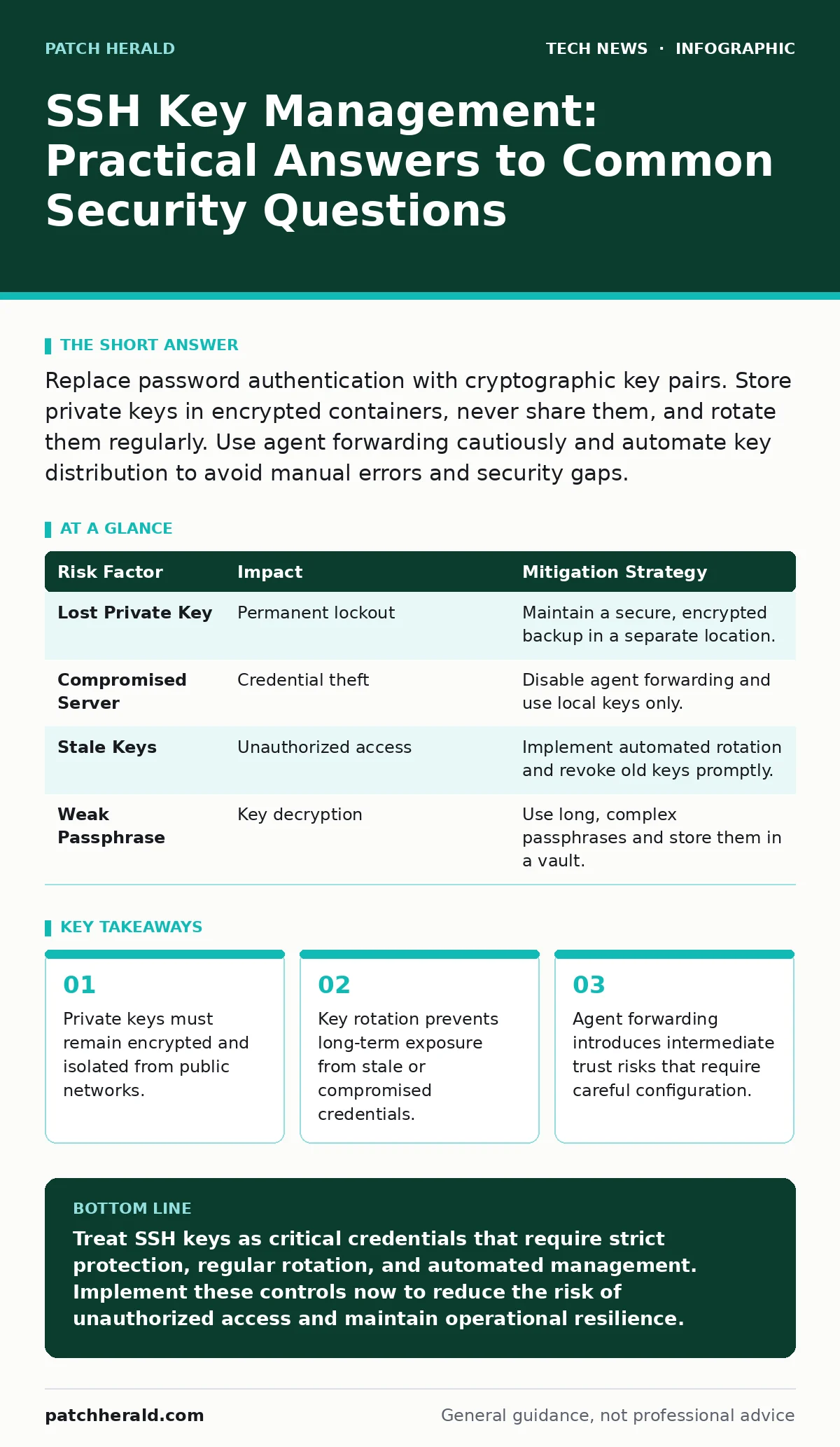
Replace password authentication with cryptographic key pairs. Store private keys in encrypted containers, never share them, and rotate them regularly. Use agent forwarding cautiously and automate key distribution to avoid manual errors and security gaps.
What Is an SSH Key Pair?
An SSH key pair consists of two mathematically linked files: a public key and a private key. The public key resides on the server you wish to access, while the private key stays on your local machine. When you attempt to connect, the server challenges your client to prove it holds the matching private key. This process eliminates the need for transmitting passwords over the network, which reduces the risk of interception.
Why Should You Disable Password Authentication?
Disabling password authentication removes the attack surface for brute-force attempts and credential stuffing. Attackers cannot guess a strong cryptographic key as they might a weak password. You must generate a key pair before disabling passwords to avoid locking yourself out of your servers. This change ensures that only devices with the correct private key can establish a session.
How Do You Store Private Keys Securely?
Private keys should be stored in an encrypted format on disk and protected by a strong passphrase. A passphrase adds a layer of protection if the key file itself is stolen. Do not store private keys in cloud storage, email attachments, or unencrypted USB drives. The operating system’s keychain or a dedicated credential manager can handle the passphrase entry, reducing friction while maintaining security.
What Is Key Rotation and Why Does It Matter?
Key rotation is the process of generating new key pairs and replacing old ones on all connected servers. Even if a private key is compromised without immediate detection, rotation limits the window of exposure. You should establish a schedule for rotation, such as every six months, or trigger it immediately upon suspicion of compromise. Failing to rotate keys leaves stale credentials active, increasing risk over time.
Is SSH Agent Forwarding Safe?
SSH agent forwarding allows you to use your local private keys on remote servers without copying them there. This is convenient for chaining connections but introduces significant risk. If the intermediate server is compromised, an attacker can use your forwarded credentials to access other systems. You should only enable forwarding when absolutely necessary and disable it by default in your SSH configuration.
| Risk Factor | Impact | Mitigation Strategy |
|---|---|---|
| Lost Private Key | Permanent lockout | Maintain a secure, encrypted backup in a separate location. |
| Compromised Server | Credential theft | Disable agent forwarding and use local keys only. |
| Stale Keys | Unauthorized access | Implement automated rotation and revoke old keys promptly. |
| Weak Passphrase | Key decryption | Use long, complex passphrases and store them in a vault. |
See also: Difference Between Public Key and Private Key Encryption Explained
How Do You Revoke a Compromised Key?
Revoking a compromised key requires removing the corresponding public key from the server’s authorized_keys file. You must also generate a new key pair and distribute the new public key to all affected systems. Document the revocation event and update your access logs to track the change. This immediate action prevents further unauthorized access using the stolen credential.
Can You Use SSH Keys for Multi-Factor Authentication?
SSH keys alone provide single-factor authentication based on something you possess. To achieve multi-factor authentication, combine key-based access with a second factor, such as a time-based one-time password. Many SSH servers support integration with external authentication modules like PAM. This layered approach ensures that even if a private key is stolen, the attacker cannot log in without the second factor.
What Are the Best Practices for Key Permissions?
Strict file permissions are necessary to protect private keys from unauthorized reading. The private key file should be readable and writable only by the owner. The directory containing the key should also have restricted access. Incorrect permissions can cause SSH to reject the key for security reasons, preventing login. Regular audits of file permissions help maintain this strict control.
How Do You Manage Keys Across Multiple Servers?
Managing keys across many servers requires a centralized approach to distribution and revocation. Manual updates are error-prone and difficult to audit. Use automated tools to push public keys to servers and remove them when access is no longer needed. This ensures that access rights reflect current organizational roles and responsibilities. Consistent management reduces the chance of orphaned keys lingering on systems.
What Happens If You Lose Your Passphrase?
If you lose the passphrase for an encrypted private key, the key becomes unusable. There is no backdoor or recovery mechanism for SSH key encryption. You must treat the passphrase as a critical credential and store it in a secure password manager. Losing access to the key requires generating a new pair and updating all servers, which can be time-consuming. This underscores the importance of secure passphrase storage.
Key takeaways
- Private keys must remain encrypted and isolated from public networks.
- Key rotation prevents long-term exposure from stale or compromised credentials.
- Agent forwarding introduces intermediate trust risks that require careful configuration.
Treat SSH keys as critical credentials that require strict protection, regular rotation, and automated management. Implement these controls now to reduce the risk of unauthorized access and maintain operational resilience.
Frequently asked questions
Can I use the same SSH key for personal and work accounts?
It is safer to use separate key pairs for different environments to limit exposure if one is compromised.
How do I check if a server supports SSH key authentication?
Attempt to connect using the ssh command with the -i flag specifying your private key file.
What is the difference between RSA and Ed25519 keys?
Ed25519 is a newer algorithm that is faster and more secure against certain attacks than RSA.
Can I recover a lost private key if I have the public key?
No, the public key cannot be used to derive the private key; you must rely on backups or generate a new pair.
How this guide was produced: written by the Patch Herald editorial team with AI assistance, checked against the public references listed below, and reviewed when the facts change. See our editorial policy or report an error.