
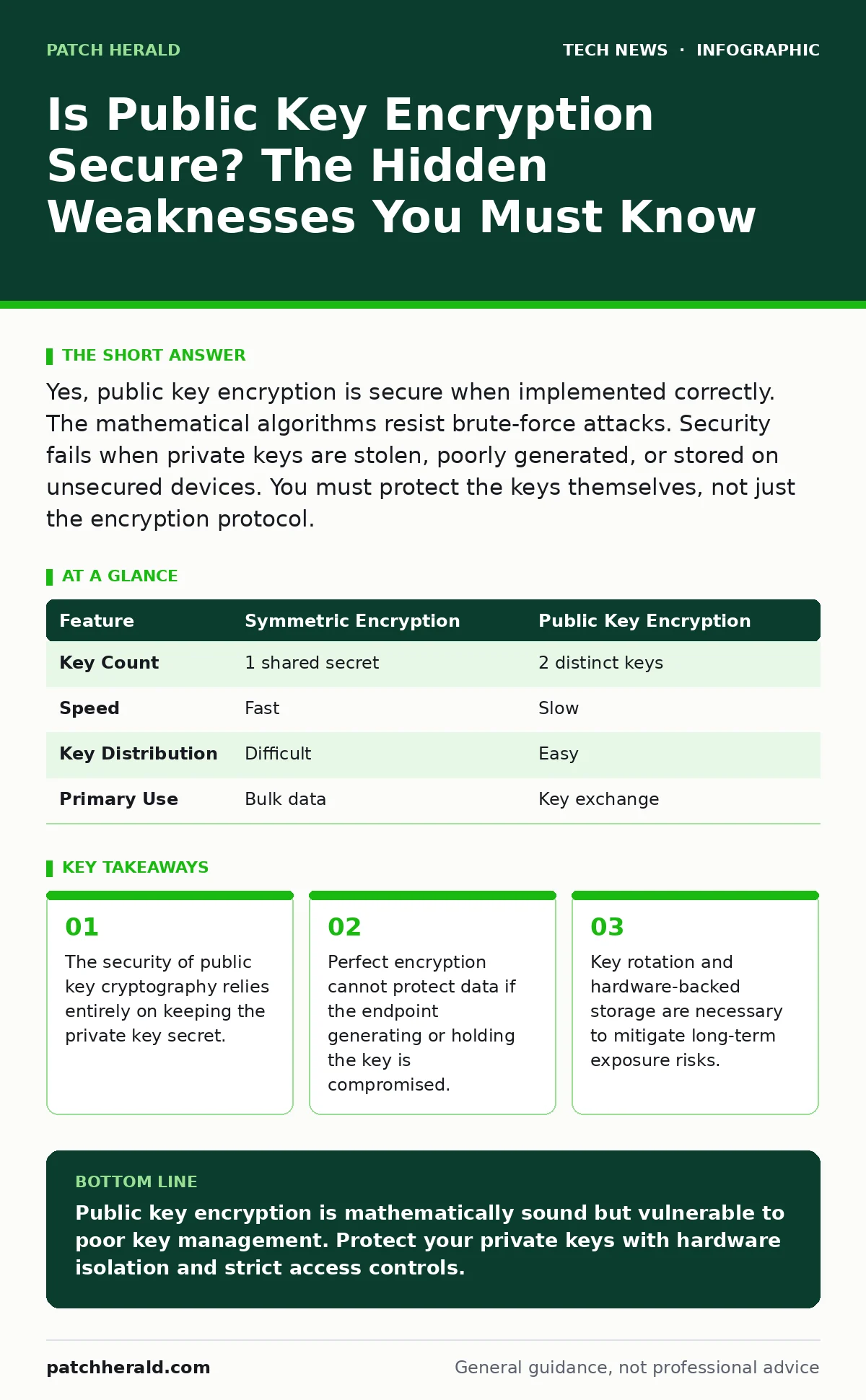
Yes, public key encryption is secure when implemented correctly. The mathematical algorithms resist brute-force attacks. Security fails when private keys are stolen, poorly generated, or stored on unsecured devices. You must protect the keys themselves, not just the encryption protocol.
Is public key encryption secure against modern attacks?
Public key encryption is secure against current computational capabilities when used with standard algorithms like RSA or Elliptic Curve Cryptography. The security depends on the difficulty of solving specific mathematical problems, such as integer factorization or discrete logarithms. You can trust the encryption process itself. The protocol ensures that only the holder of the private key can decrypt the message. This asymmetry allows secure communication over untrusted networks.
The assumption is that an attacker cannot reverse the math within a reasonable timeframe. Current classical computers lack the processing power to break properly sized keys. You do not need to worry about the algorithm failing. You must worry about how the keys are handled. The math works. The implementation often does not.
What makes public key cryptography different from symmetric encryption?
Public key cryptography uses two distinct keys: one public and one private. Symmetric encryption uses a single shared secret. Public key systems solve the problem of key distribution. You can share your public key with anyone. They use it to encrypt data. Only your private key can unlock it. This eliminates the need to securely exchange a secret password before communication begins.
Symmetric encryption is faster and better for large data sets. Public key encryption is slower and computationally expensive. You typically use public keys to exchange a symmetric session key. Then you switch to symmetric encryption for the actual data transfer. This hybrid approach combines security with performance.
| Feature | Symmetric Encryption | Public Key Encryption |
|---|---|---|
| Key Count | 1 shared secret | 2 distinct keys |
| Speed | Fast | Slow |
| Key Distribution | Difficult | Easy |
| Primary Use | Bulk data | Key exchange |
Where does public key security fail in practice?
Public key security fails when the private key is exposed. The strongest algorithm is useless if an attacker steals the private key. This often happens through malware on endpoint devices. If your laptop is infected, the attacker can read the key from memory. They can then decrypt all past and future communications. The encryption held up. The storage did not.
You must assume that any software running on a general-purpose operating system is potentially untrusted. The key must never touch the main memory in plaintext. Use hardware-backed storage. This limits the attack surface. It forces attackers to physically access the device to steal the key.
How do you protect private keys from theft?
You protect private keys by restricting access and using hardware isolation. Software-based key storage is vulnerable to memory scraping. Hardware security modules provide a tamper-resistant environment. The key never leaves the hardware boundary. Operations like signing or decryption happen inside the module. Only the result exits. This prevents software malware from capturing the key.
You should also enforce strict access controls. Only authorized processes should request cryptographic operations. Audit logs should track every use of the private key. If a key is suspected to be compromised, revoke it immediately. Generate a new pair. Update the public distribution points. This limits the window of exposure.
Does quantum computing threaten public key encryption?
Quantum computing threatens current public key algorithms. Shor's algorithm can factor large integers efficiently on a quantum machine. This would break RSA and ECC. The threat is not immediate. Practical quantum computers capable of breaking encryption do not exist yet. However, attackers can harvest encrypted data now. They can decrypt it later when quantum technology matures. This is known as harvest now, decrypt later.
You should plan for post-quantum cryptography. New algorithms are being standardized to resist quantum attacks. These algorithms rely on different mathematical problems. Lattice-based cryptography is a leading candidate. You must prepare to migrate your systems. Start auditing your cryptographic inventory. Identify where long-term secrecy is required.
See also: SSH Key Management: Practical Answers to Common Security Questions
What role do certificate authorities play in security?
Certificate authorities validate the identity of key holders. They bind a public key to a specific entity. This prevents man-in-the-middle attacks. Without a certificate authority, anyone could claim to be someone else. You would have no way to verify the public key. The certificate authority signs the certificate. Your system trusts the authority. It then trusts the certificate.
Certificate Transparency logs all issued certificates. This allows for public auditing. If a certificate authority issues a fraudulent certificate, others can detect it. You should monitor these logs for your domains. This adds a layer of oversight. It reduces the risk of rogue certificates going unnoticed.
How should you manage key lifecycles effectively?
You must rotate keys regularly. Long-lived keys increase the risk of exposure. If a key is compromised, the damage is extensive. Short lifecycles limit the impact. Automate key generation and rotation. Manual processes are error-prone. Define clear policies for key expiration. Archive old keys securely. Ensure you can decrypt old data if necessary.
Check for key compromise regularly. Use automated tools to scan for exposed keys in public repositories. If you find a leak, revoke the key. Generate a new pair. Update all systems. This discipline prevents small leaks from becoming major breaches.
What are the common implementation mistakes to avoid?
You must avoid weak random number generation. Keys generated with poor randomness are predictable. Attackers can guess the private key. Use cryptographically secure random number generators. Never use standard library functions for key generation. They are not designed for security.
You must also verify signatures correctly. Timing attacks can exploit subtle differences in verification time. Use constant-time comparison functions. Ensure your implementation does not leak information through side channels. Power consumption or electromagnetic emissions can reveal key bits. Secure the physical environment as well as the software.
Key takeaways
- The security of public key cryptography relies entirely on keeping the private key secret.
- Perfect encryption cannot protect data if the endpoint generating or holding the key is compromised.
- Key rotation and hardware-backed storage are necessary to mitigate long-term exposure risks.
Public key encryption is mathematically sound but vulnerable to poor key management. Protect your private keys with hardware isolation and strict access controls.
Frequently asked questions
Can public key encryption be hacked?
The encryption itself cannot be hacked with current technology. However, attackers can steal the private keys or exploit implementation flaws to bypass the security.
Is public key encryption better than symmetric encryption?
Public key encryption is better for secure key exchange. Symmetric encryption is better for speed. Most systems use both: public keys to share a symmetric key, then symmetric keys for data.
How long should I keep my private keys?
Keep private keys only as long as necessary. Rotate them regularly. Archive old keys securely if you need to decrypt historical data. Delete them when no longer needed.
What is the biggest risk to public key security?
The biggest risk is endpoint compromise. If malware infects the device holding the private key, the encryption is useless. Hardware-backed storage mitigates this risk.
How this guide was produced: written by the Patch Herald editorial team with AI assistance, checked against the public references listed below, and reviewed when the facts change. See our editorial policy or report an error.