
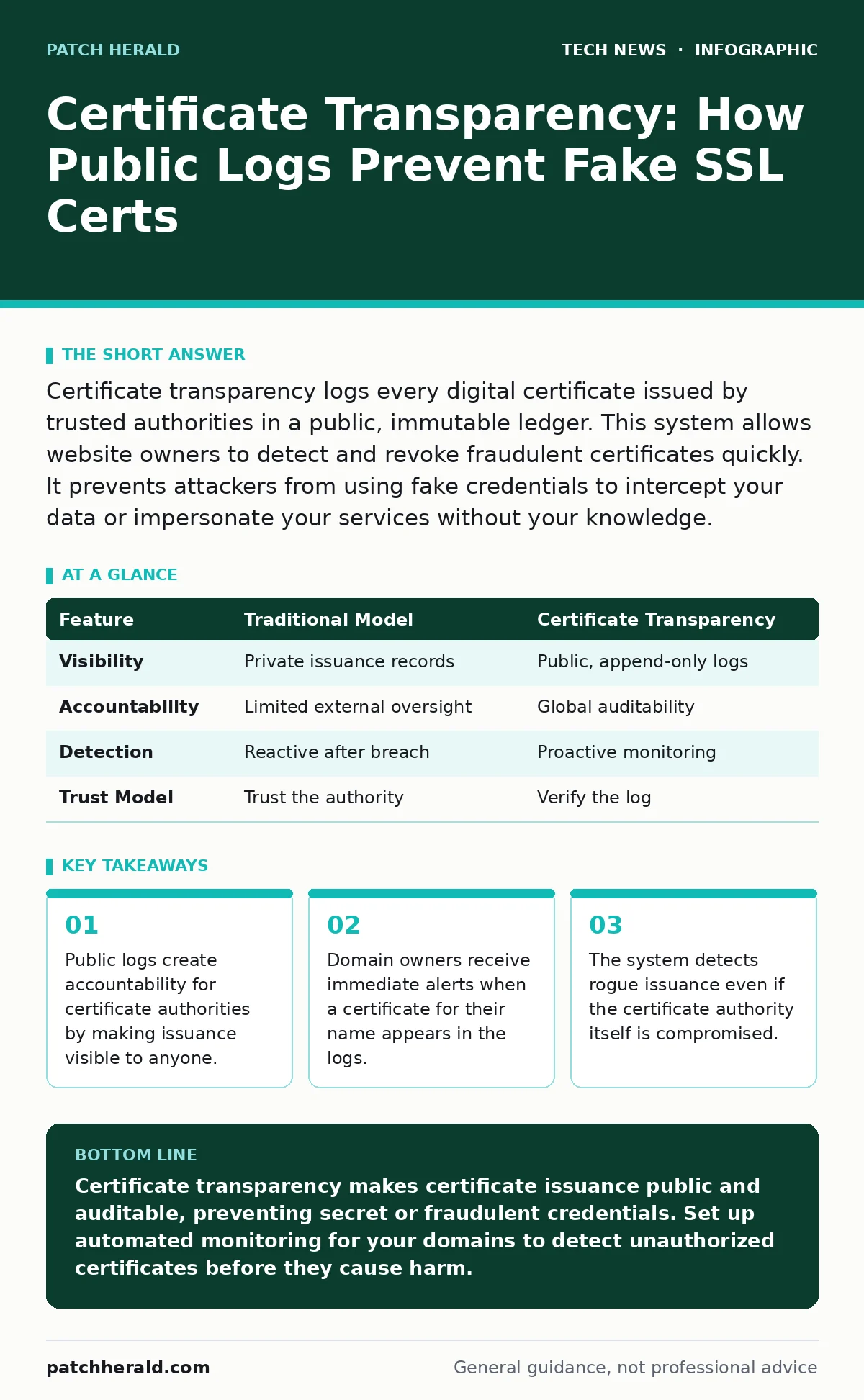
Certificate transparency logs every digital certificate issued by trusted authorities in a public, immutable ledger. This system allows website owners to detect and revoke fraudulent certificates quickly. It prevents attackers from using fake credentials to intercept your data or impersonate your services without your knowledge.
What is certificate transparency?
Certificate transparency is a security framework that monitors and logs every digital certificate issued by trusted certificate authorities. It operates by requiring authorities to publish each new certificate to public, append-only servers called logs. These logs are cryptographically secured, meaning no one can alter or delete entries once they are added. You can audit these logs to verify that a certificate exists and was issued legitimately. This visibility ensures that no certificate can be issued secretly for a domain you control.
Why do we need public logs for certificates?
Certificate authorities have historically operated with limited oversight, allowing them to issue certificates without external verification. If an authority is compromised or acts maliciously, it can create a fake certificate for any website. Without transparency, you would not know this happened until an attack occurred. Public logs change this dynamic by creating a permanent record that anyone can inspect. This record acts as a check against the power of certificate authorities, ensuring they cannot issue credentials in the shadows.
How does the logging process work?
When a certificate authority issues a certificate, it must submit the certificate to multiple independent logs. Each log entry includes the certificate details and a cryptographic signature from the log operator. The authority then provides a proof of inclusion, showing that the certificate appears in the logs. Browsers and other clients can verify this proof to ensure the certificate was properly logged. If a certificate lacks this proof, modern browsers may refuse to trust it, preventing its use in secure connections.
Who monitors these public logs?
Domain owners and their security teams monitor the logs for any certificates issued under their domain names. Automated tools scan the logs continuously, looking for matches against your registered domains. When a match is found, the system sends an alert to the domain owner. This allows you to react immediately if an unauthorized certificate appears. You do not need to manually check the logs yourself, as these monitoring services handle the heavy lifting. This proactive approach stops attacks before they reach your users.
What happens if a certificate is not logged?
Modern web browsers enforce certificate transparency requirements for most certificate types. If a certificate is not present in the public logs, the browser will display a security warning to the user. This warning prevents the connection from proceeding, effectively neutralizing the certificate. Attackers cannot use unlogged certificates to perform man-in-the-middle attacks on modern browsers. This enforcement mechanism ensures that certificate authorities comply with transparency rules. It raises the cost of issuing fraudulent certificates by making them useless against updated clients.
See also: Malicious Bot Traffic: What It Is and How to Stop It
Can certificate transparency detect compromised authorities?
Yes, certificate transparency can reveal when a certificate authority has been compromised. If an attacker gains access to an authority’s signing keys, they can issue certificates for any domain. These fraudulent certificates must be logged, where they will trigger alerts for the legitimate domain owners. The domain owner can then request revocation of the compromised certificates. This process limits the window of opportunity for attackers. It transforms a silent breach into a visible event that can be addressed quickly.
How does this relate to other security measures?
Certificate transparency complements other security practices by adding a layer of external verification. While software updates keep your systems patched, transparency ensures your identity remains valid. It works alongside AES encryption to protect data in transit, but focuses on the trust chain rather than the encryption itself. You should also consider network access control to limit who can connect to your resources. Transparency does not replace these measures but adds a critical check on the issuance of trust credentials.
| Feature | Traditional Model | Certificate Transparency |
|---|---|---|
| Visibility | Private issuance records | Public, append-only logs |
| Accountability | Limited external oversight | Global auditability |
| Detection | Reactive after breach | Proactive monitoring |
| Trust Model | Trust the authority | Verify the log |
What are the limitations of this system?
Certificate transparency does not protect against every type of attack. It cannot stop an attacker who already has valid, logged certificates for your domain. It also does not prevent phishing attacks that use legitimate certificates on look-alike domains. The system relies on the integrity of the log operators themselves. If a log operator is compromised, the integrity of the logs could be at risk. However, the use of multiple independent logs mitigates this risk significantly. You must still practice good hygiene with API key security and remote work security to protect your assets.
How can I implement monitoring today?
Start by identifying all domains and subdomains under your control. Subscribe to a certificate transparency monitoring service that covers these names. Configure alerts to send notifications to your security team or email address. Regularly review these alerts to ensure they are not being ignored. Integrate these alerts into your incident response plan so you know exactly who to contact. This setup requires minimal ongoing effort but provides significant protection against identity theft. It is a low-cost measure with high visibility into your trust posture.
Does this affect guest networks?
Certificate transparency primarily affects public-facing services and websites. It does not directly impact guest Wi-Fi networks or internal device connections. However, if your organization hosts public services accessible via the internet, transparency applies to those endpoints. You should ensure that any public-facing service uses certificates that are properly logged. This maintains consistency in your security posture across all public interfaces. Internal networks remain separate from this public auditing process.
Key takeaways
- Public logs create accountability for certificate authorities by making issuance visible to anyone.
- Domain owners receive immediate alerts when a certificate for their name appears in the logs.
- The system detects rogue issuance even if the certificate authority itself is compromised.
Certificate transparency makes certificate issuance public and auditable, preventing secret or fraudulent credentials. Set up automated monitoring for your domains to detect unauthorized certificates before they cause harm.
Frequently asked questions
Do I need certificate transparency for internal websites?
No, certificate transparency is designed for public-facing websites that require trust from external browsers. Internal sites can use private certificate authorities without logging.
Can attackers bypass certificate transparency?
Attackers cannot bypass transparency if the certificate authority follows the rules. However, they can use look-alike domains or social engineering to trick users, which transparency does not prevent.
How long are certificates kept in the logs?
Entries in certificate transparency logs are permanent and cannot be deleted. This creates a historical record of all issued certificates, allowing for long-term auditing and investigation.
What if my certificate authority fails to log a certificate?
Modern browsers will not trust certificates that lack proof of inclusion in the logs. This forces the authority to comply with transparency requirements to maintain compatibility with standard web clients.
How this guide was produced: written by the Patch Herald editorial team with AI assistance, checked against the public references listed below, and reviewed when the facts change. See our editorial policy or report an error.