Begin by inventorying all cryptographic dependencies and prioritizing systems handling long-term data. Adopt hybrid encryption schemes that combine current standards with quantum-resistant algorithms. Validate interoperability through rigorous testing before full deployment. Maintain a strict update cycle as standards evolve.
Assessing Your Cryptographic Inventory
You cannot protect what you cannot see. Before touching any configuration, you must map every instance where encryption occurs in your environment. This includes data at rest, data in transit, and digital signatures. Many organizations overlook embedded cryptography in third-party libraries or firmware. These hidden dependencies often lag behind public updates.
Start by identifying which algorithms are currently in use. Look for RSA, ECC (Elliptic Curve Cryptography), and SHA-2. These are the targets for quantum attacks. Document where each is used. Is it securing a database? Authenticating an API? Signing a software update? This map becomes your roadmap. Without it, you risk leaving critical vectors exposed.
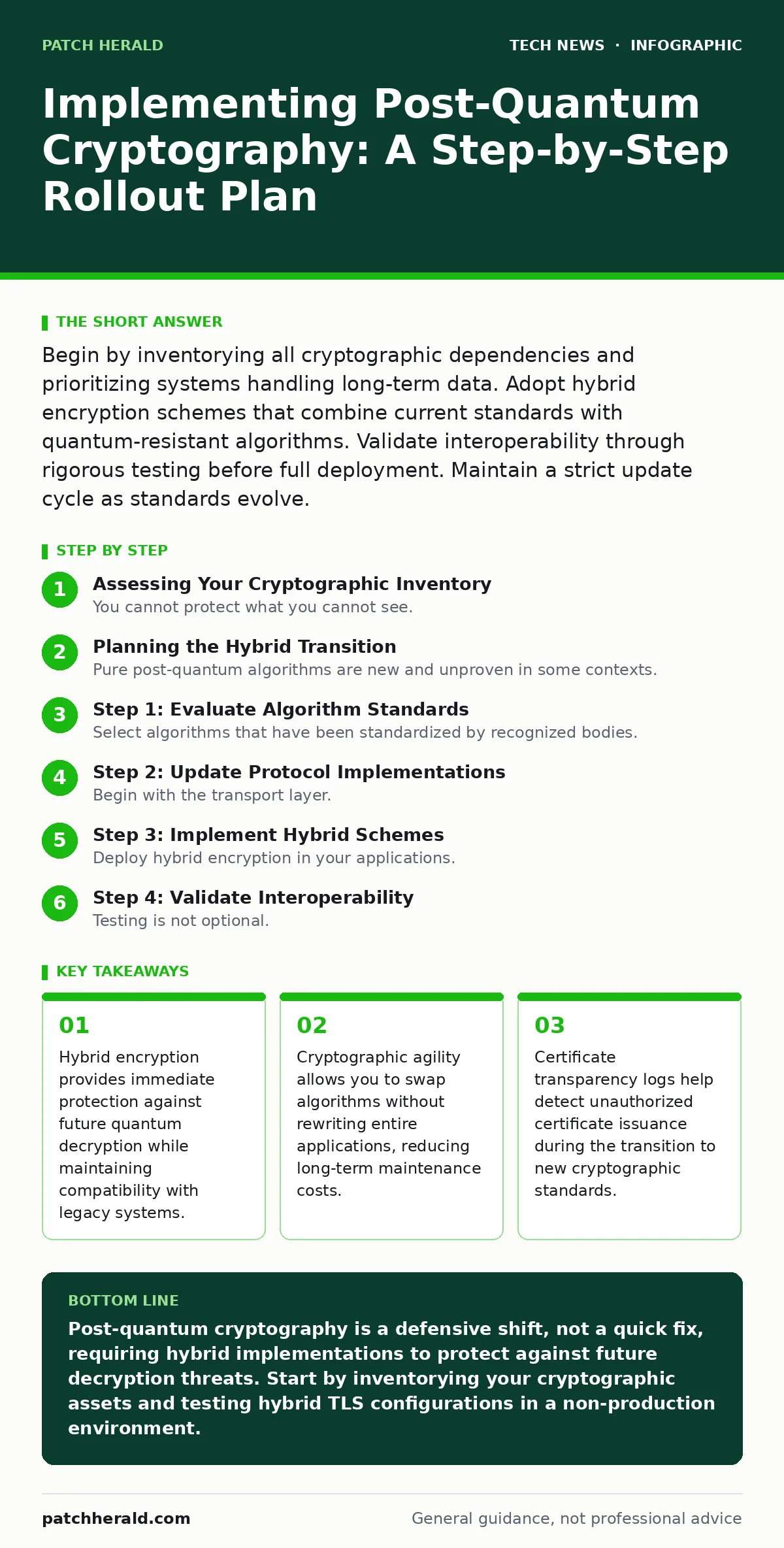
Planning the Hybrid Transition
Pure post-quantum algorithms are new and unproven in some contexts. Relying solely on them introduces unknown risks. The standard approach is hybrid encryption. This method combines a traditional algorithm with a post-quantum one. If one fails, the other may still hold. It also ensures interoperability with clients that have not yet upgraded.
You must decide which systems get priority. Systems handling data with a long shelf life are most at risk. An attacker can steal encrypted data today and decrypt it later when a quantum computer is available. This is known as harvest now, decrypt later. Prioritize these high-value targets first. Do not attempt a big-bang switch. It creates operational chaos.
Step 1: Evaluate Algorithm Standards
Select algorithms that have been standardized by recognized bodies. The National Institute of Standards and Technology has finalized several modules. Look for CRYSTALS-Kyber for key encapsulation and CRYSTALS-Dilithium for digital signatures. Do not invent your own math. Custom algorithms rarely withstand scrutiny. Stick to public, peer-reviewed standards.
Check if your current hardware supports these algorithms. Some post-quantum schemes require more memory or processing power. If your servers are old, you may need to upgrade infrastructure first. This is a hidden cost many overlook. Plan for increased bandwidth as well. Post-quantum keys and signatures are larger than their classical counterparts.
Step 2: Update Protocol Implementations
Begin with the transport layer. TLS is the backbone of internet security. You need to enable post-quantum key exchange in your TLS configurations. This often involves updating your web servers and load balancers. Ensure they support the new cipher suites. Test this in a staging environment first. Breaking TLS connectivity stops business immediately.
Next, address certificate authorities. Your certificates must support the new signature algorithms. If your CA does not support post-quantum signatures, you cannot issue valid certificates. You may need to switch providers or wait for them to update. This dependency can delay your rollout. Check your CA’s roadmap early.
Step 3: Implement Hybrid Schemes
Deploy hybrid encryption in your applications. This means your code generates both a classical key and a post-quantum key. It combines them to encrypt the session key. This ensures that even if a quantum computer breaks the classical part, the post-quantum part remains secure. It also ensures that if the post-quantum algorithm has a flaw, the classical part protects you.
This step requires careful coding. You must handle key management correctly. If you manage keys poorly, the strength of the algorithm does not matter. Integrate with your existing key management system. Ensure it can store and rotate larger keys. Refer to our guide on API key security for best practices on handling sensitive credentials during this transition.
See also: Difference Between Operating System and Kernel: Core Functions Explained
Step 4: Validate Interoperability
Testing is not optional. You must verify that your servers can talk to your clients. If your client software does not support post-quantum ciphers, the connection will fail. You need a fallback mechanism. This is where hybrid schemes shine. They allow a connection to succeed even if one side lacks full support.
Use automated testing tools to scan your endpoints. Check for supported cipher suites. Verify that the handshake completes successfully. Look for errors in the logs. Any failure indicates a misconfiguration or a lack of support. Fix these issues before moving to production. Do not assume compatibility. Assume incompatibility until proven otherwise.
Verification Checklist
Use this list to confirm your implementation is correct.
- All critical systems use hybrid encryption schemes.
- TLS configurations support post-quantum key exchange.
- Certificates are signed with post-quantum algorithms.
- Key management systems can handle larger key sizes.
- Interoperability tests pass with major clients.
- Logging captures cryptographic errors for analysis.
- Backup procedures account for larger data sizes.
Maintaining Cryptographic Agility
The post-quantum landscape will change. New vulnerabilities will be found. New algorithms will be standardized. You need cryptographic agility. This is the ability to change algorithms quickly without rewriting code. Design your systems to load cryptographic modules dynamically. This allows you to swap out a broken algorithm in hours, not months.
Monitor security advisories closely. Subscribe to updates from standards bodies. When a flaw is found in a post-quantum algorithm, you must be ready to switch. This requires a disciplined update process. Test new versions in staging. Validate them. Then deploy. This is not a one-time project. It is an ongoing operational requirement.
Managing Legacy Systems
Not all systems can be upgraded. Some legacy hardware or software may not support post-quantum algorithms. You must isolate these systems. Use network segmentation to limit their exposure. Do not connect them directly to the internet. Use gateways that perform the cryptographic translation. This adds complexity but protects the vulnerable core.
Consider the lifecycle of these systems. If they cannot be secured, plan to decommission them. The risk of leaving a quantum-vulnerable system connected is too high. Evaluate the cost of replacement versus the risk of breach. Often, the risk is higher. Refer to our guide on network access control for strategies to isolate legacy assets effectively.
Long-Term Upkeep and Monitoring
Your job does not end at deployment. You must monitor your cryptographic health. Use certificate transparency logs to detect unauthorized certificates. These logs record every certificate issued by major authorities. If you see a certificate for your domain that you did not request, investigate immediately. This could indicate a compromise of your private key or the CA.
Regularly audit your configurations. Ensure that weak algorithms are disabled. As post-quantum algorithms mature, you may drop the classical part of the hybrid scheme. This reduces overhead. But only do this when you are confident in the post-quantum algorithm’s security. Stay informed. The standards will evolve. Your systems must evolve with them.
Key takeaways
- Hybrid encryption provides immediate protection against future quantum decryption while maintaining compatibility with legacy systems.
- Cryptographic agility allows you to swap algorithms without rewriting entire applications, reducing long-term maintenance costs.
- Certificate transparency logs help detect unauthorized certificate issuance during the transition to new cryptographic standards.
Post-quantum cryptography is a defensive shift, not a quick fix, requiring hybrid implementations to protect against future decryption threats. Start by inventorying your cryptographic assets and testing hybrid TLS configurations in a non-production environment.
Frequently asked questions
Do I need to replace all my servers to support post-quantum cryptography?
Not necessarily. Many post-quantum algorithms are software-only. However, they require more memory and processing power. Older servers may struggle with the performance overhead.
How long will it take to implement post-quantum cryptography?
It depends on your environment. A small organization might take months. A large enterprise with legacy systems could take years. Start early. The complexity of legacy integration is the main bottleneck.
Can I use post-quantum cryptography for email?
Yes. Email protocols like PGP and S/MIME can be updated to support post-quantum algorithms. However, you need both sender and recipient to support the new algorithms. Hybrid modes help during the transition.
What happens if a post-quantum algorithm is broken?
You switch to a different algorithm. This is why cryptographic agility is critical. If your systems are rigid, you will face a major refactor. If they are agile, you simply update the module.
How this guide was produced: written by the Patch Herald editorial team with AI assistance, checked against the public references listed below, and reviewed when the facts change. See our editorial policy or report an error.