
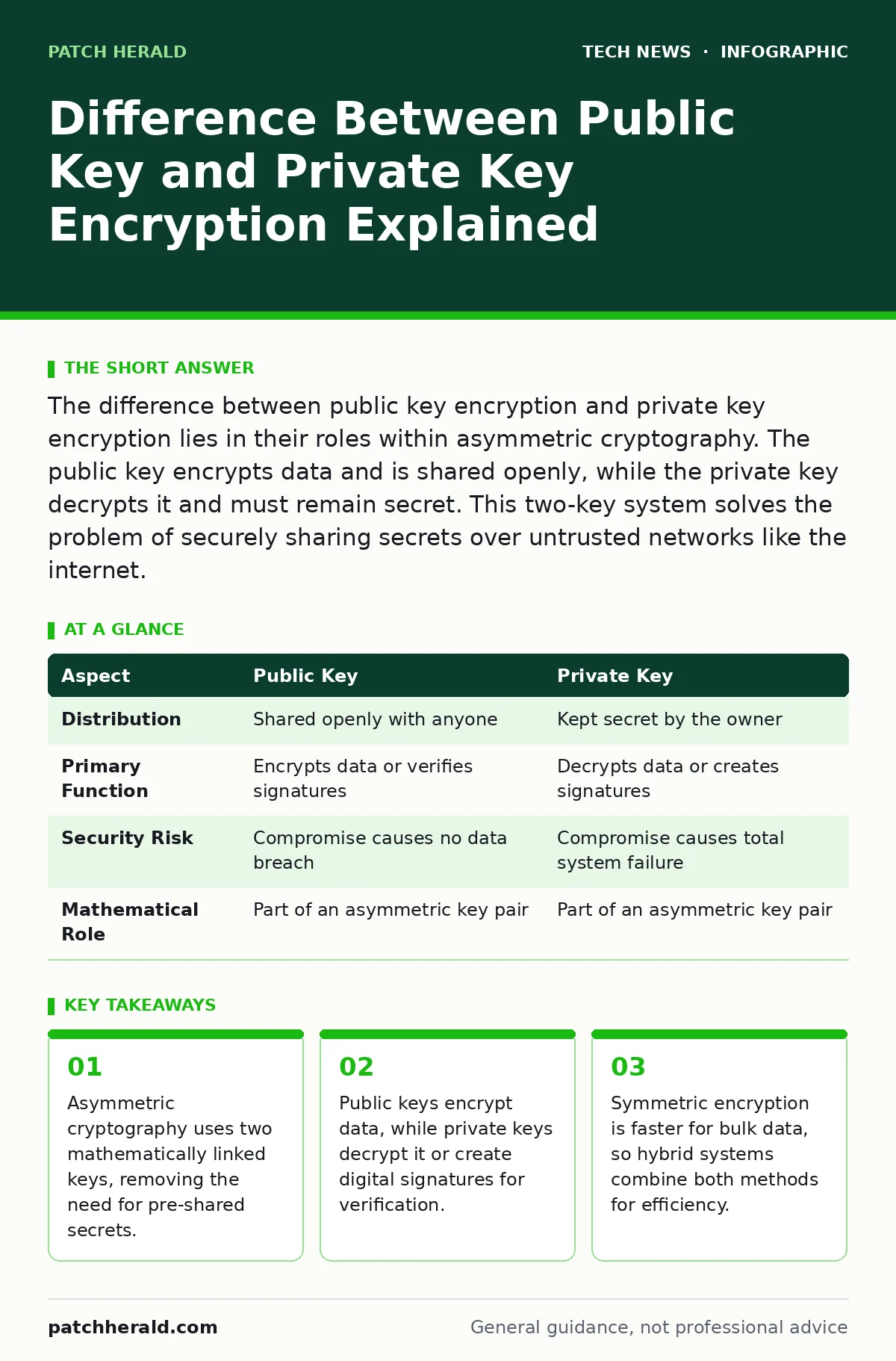
The difference between public key encryption and private key encryption lies in their roles within asymmetric cryptography. The public key encrypts data and is shared openly, while the private key decrypts it and must remain secret. This two-key system solves the problem of securely sharing secrets over untrusted networks like the internet.
How Asymmetric Cryptography Solves the Key Distribution Problem
Public key encryption and private key encryption function as two halves of a single mathematical operation. You do not use one or the other in isolation; you use both together to establish trust. The core difference is that the public key is designed to be distributed freely, while the private key must never leave its owner's secure environment.
Imagine a lockbox with a special mechanism. Anyone can slide the box shut with a public key, but only the person holding the matching private key can open it. This design allows you to send sensitive information to someone without ever meeting them to exchange a secret password. The security relies on the computational difficulty of deriving the private key from the public key, a problem that current algorithms cannot solve in a reasonable timeframe.
| Aspect | Public Key | Private Key |
|---|---|---|
| Distribution | Shared openly with anyone | Kept secret by the owner |
| Primary Function | Encrypts data or verifies signatures | Decrypts data or creates signatures |
| Security Risk | Compromise causes no data breach | Compromise causes total system failure |
| Mathematical Role | Part of an asymmetric key pair | Part of an asymmetric key pair |
The Mechanics of Encryption and Decryption
When you send an encrypted message, the sender uses your public key to transform readable text into ciphertext. This ciphertext appears as random noise to anyone who intercepts it. Only your private key can reverse this transformation. If you try to decrypt the message with a different private key, the data remains unreadable. This ensures that only the intended recipient can access the information, even if the transmission channel is completely monitored.
This process differs from symmetric encryption, which uses a single shared secret for both locking and unlocking. Symmetric methods are faster but require a secure channel to share the initial secret. Asymmetric methods solve the distribution problem but are computationally expensive. Most modern systems use a hybrid approach. They use asymmetric cryptography to exchange a temporary symmetric key, then switch to symmetric encryption for the bulk of the data transfer.
Digital Signatures and Identity Verification
Encryption is only one function of key pairs. The reverse operation creates digital signatures. You use your private key to sign a document, and others use your public key to verify that signature. This proves two things: the document came from you and it has not been altered since you signed it. This mechanism is the foundation of trust in software distribution and secure web browsing.
What People Usually Get Wrong About Keys
Many users confuse the direction of operations. They believe the private key encrypts and the public key decrypts. While this is true for signing, it is the opposite of standard encryption. In encryption, the public key locks the data, and the private key opens it. In signing, the private key locks the hash, and the public key unlocks it to verify. Confusing these directions leads to failed implementations and security gaps.
Another common error is assuming that a public key is insecure because it is public. The public key is not a secret; it is a verification tool. Compromising a public key does not allow an attacker to decrypt your past messages or impersonate you. The real danger lies in protecting the private key. If an attacker obtains your private key, they can decrypt your communications and forge signatures that appear to come from you.
Performance Trade-offs and Hybrid Systems
Asymmetric algorithms are significantly slower than symmetric ones. Encrypting a large database with a private key pair would take impractical amounts of time. This is why systems like TLS use hybrid encryption. The initial handshake uses public key cryptography to authenticate the server and exchange a session key. Once the session key is established, the connection switches to symmetric encryption for the remainder of the session. This combines the security of key distribution with the speed of symmetric processing.
This trade-off affects how you configure network security. If you force pure asymmetric encryption for all data, you will experience severe latency. Understanding this helps you interpret performance issues in remote desktop security or web traffic. The bottleneck is rarely the network itself, but the cryptographic overhead of the handshake phase.
See also: Difference Between Operating System and Kernel: Core Functions Explained · Can IP Addresses Be Traced? How Visibility Works
Managing Key Lifecycles and Revocation
Keys are not static. They expire, get compromised, or become obsolete as computing power increases. You must have a plan for key rotation. When a private key is suspected of being compromised, you must revoke the corresponding certificate. This prevents attackers from using the old key to impersonate you. Certificate Revocation Lists and Online Certificate Status Protocol check whether a public key is still valid.
This lifecycle management is critical for IoT security, where devices may remain in the field for years. If a device uses a hardcoded private key, a single compromise can affect the entire fleet. You must design systems that support remote key updates to maintain long-term security.
Practical Steps for Implementation
You do not need to generate keys manually for most business operations. Web servers, email systems, and development tools handle key generation automatically. Your role is to ensure the underlying infrastructure is secure. Use strong algorithms and key lengths that resist current and near-future attacks. Avoid deprecated methods that have known vulnerabilities.
Monitor your certificate expiration dates. A expired certificate breaks trust and can halt business operations. Integrate certificate monitoring into your existing network monitoring tools. This prevents unexpected outages caused by silent expirations. For developers, use established libraries for cryptographic operations. Do not write custom cryptography code, as subtle errors can introduce severe vulnerabilities.
Key takeaways
- Asymmetric cryptography uses two mathematically linked keys, removing the need for pre-shared secrets.
- Public keys encrypt data, while private keys decrypt it or create digital signatures for verification.
- Symmetric encryption is faster for bulk data, so hybrid systems combine both methods for efficiency.
Frequently asked questions
Can I use the same key pair for encryption and signing?
You can, but it is not recommended. Using separate key pairs for encryption and signing limits the damage if one key is compromised and simplifies audit trails.
What happens if I lose my private key?
You cannot recover the data encrypted with the corresponding public key. The private key is the only way to decrypt that data, so loss results in permanent data unavailability.
Is public key encryption secure against quantum computers?
Current public key algorithms are vulnerable to future quantum computers. Organizations are transitioning to post-quantum cryptography to address this emerging threat.
Do I need a certificate authority for public keys?
For public internet services, yes. A certificate authority verifies your identity and binds your public key to your domain, enabling browser trust. For internal tools, self-signed certificates may suffice.
How this guide was produced: written by the Patch Herald editorial team with AI assistance, checked against the public references listed below, and reviewed when the facts change. See our editorial policy or report an error.