
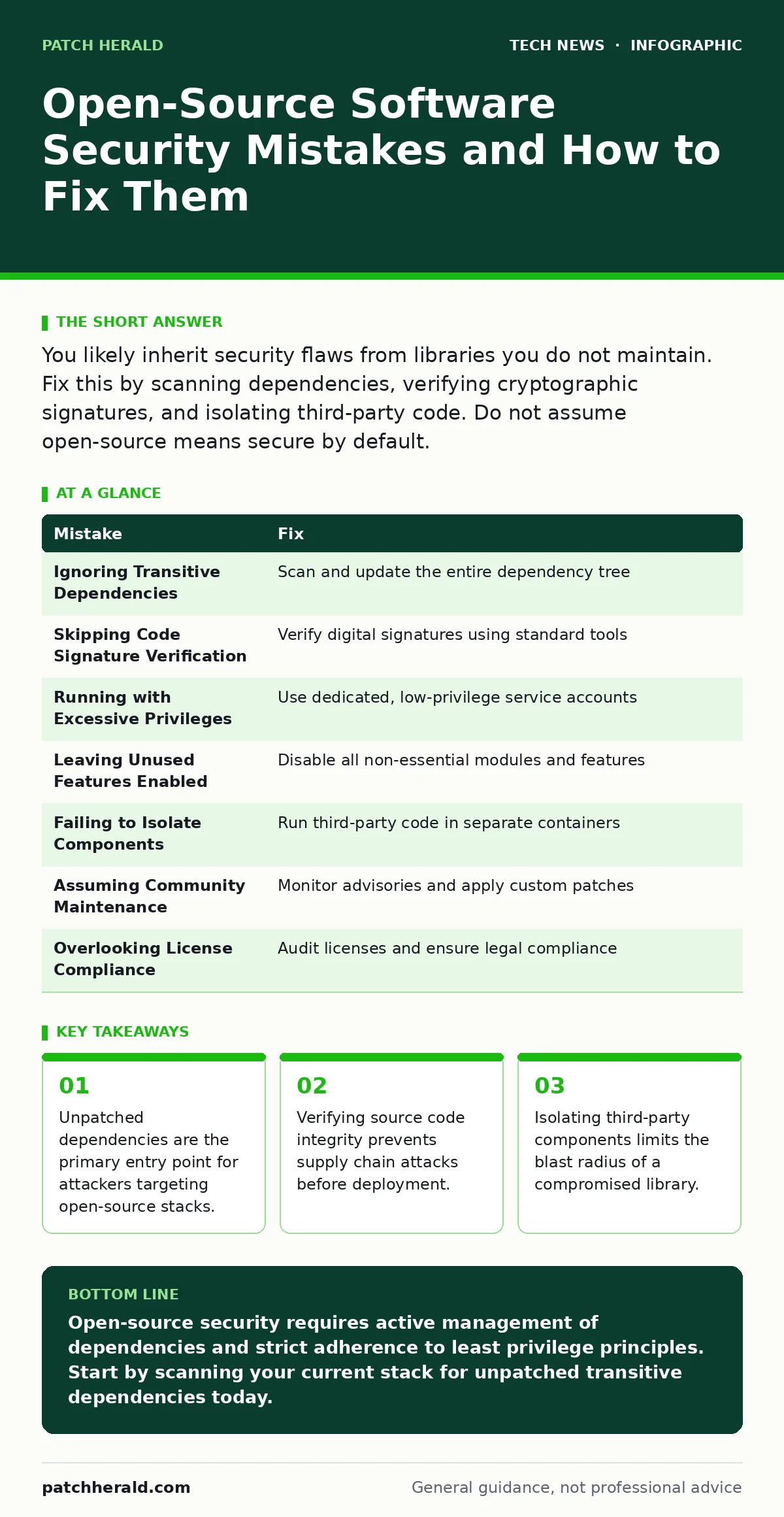
You likely inherit security flaws from libraries you do not maintain. Fix this by scanning dependencies, verifying cryptographic signatures, and isolating third-party code. Do not assume open-source means secure by default.
Mistake 1: Ignoring Transitive Dependencies
You might patch the software you directly install, but you often overlook the libraries those programs rely on. These transitive dependencies form a deep tree of code that you do not see or manage directly.
Why it hurts:
A vulnerability in a nested library can compromise your entire application. Attackers target these lower-level components because they are shared across thousands of projects. Fixing the top-level application does nothing if the underlying component remains vulnerable.
The fix:
Use a software composition analysis tool to map every dependency. Configure automated alerts for new vulnerabilities in your entire dependency tree. Update these libraries as soon as patches are available, even if your main application functions correctly.
Mistake 2: Skipping Code Signature Verification
Many administrators download open-source binaries or archives without checking if the publisher signed them. This step confirms that the code has not been altered since the developer released it.
Why it hurts:
An attacker can intercept downloads or compromise a mirror site to inject malicious code. If you do not verify the cryptographic signature, you cannot distinguish between legitimate code and tampered versions. This is a common vector for supply chain attacks.
The fix:
Always verify the digital signature of the software against the developer’s published public key. Use standard tools like GPG to validate the integrity of the archive. If a signature fails or is missing, discard the file and find a trusted source.
Mistake 3: Running Services with Excessive Privileges
It is tempting to run open-source services as the root user or with full administrative rights to avoid permission errors. This grants the process unrestricted access to the operating system.
Why it hurts:
If an attacker exploits a bug in the service, they immediately gain full control of the server. This violates the principle of least privilege, which restricts access rights to only what is necessary. High-privilege execution turns a minor flaw into a total system compromise.
The fix:
Create a dedicated user account with minimal permissions for each service. Configure the application to run under this constrained account. Regularly audit file permissions to ensure the service cannot write to system directories or access unrelated data.
Mistake 4: Neglecting to Disable Unused Features
Open-source software often ships with many features enabled by default to satisfy diverse use cases. You may only need one function, but the rest remain active and exposed.
Why it hurts:
Every enabled feature adds to the attack surface. Unused modules contain code that is not tested or monitored in your specific environment. Attackers scan for known vulnerabilities in these inactive components to gain initial access.
The fix:
Review the default configuration and disable every feature you do not explicitly need. Remove unnecessary modules if the architecture allows it. This reduces the number of potential entry points and simplifies your security monitoring.
Mistake 5: Failing to Isolate Third-Party Components
You often integrate open-source libraries directly into your core application logic without separation. This tight coupling makes it difficult to contain issues within the external code.
Why it hurts:
A memory leak or buffer overflow in a third-party library can crash your entire application. Worse, it can allow an attacker to execute arbitrary code in your main process. Without isolation, the failure of one component brings down the whole system.
The fix:
Run third-party components in separate containers or processes. Use application programming interfaces to communicate between your core logic and external libraries. This containment strategy ensures that a compromise in one part does not spread to the rest.
See also: Difference Between Public Key and Private Key Encryption Explained · Load Balancers Types: How Traffic Distribution Protects Your Systems
Mistake 6: Assuming Community Maintenance Equals Security
Many projects have active communities but lack dedicated security teams. Contributors may prioritize new features over addressing subtle security flaws.
Why it hurts:
Vulnerabilities may remain unpatched for long periods if no one identifies them. You cannot rely on the project maintainers to prioritize your specific security needs. This gap leaves your systems exposed to known exploits that have not yet received a fix.
The fix:
Monitor the project’s security advisories and issue trackers closely. Consider forking the project if critical vulnerabilities remain unaddressed. Apply your own patches or workarounds until an official fix is released.
Mistake 7: Overlooking License Compliance Risks
Using open-source software involves legal obligations that can impact your security posture. Some licenses require you to disclose source code changes, which may reveal internal logic.
Why it hurts:
Disclosing proprietary modifications can help attackers understand your defenses. Furthermore, non-compliance can lead to legal disputes that distract from security efforts. Ignoring license terms creates operational and security risks simultaneously.
The fix:
Audit the licenses of all open-source components before integration. Ensure your usage complies with the terms, especially regarding code disclosure. Use tools to track license changes and assess their impact on your security strategy.
| Mistake | Fix |
|---|---|
| Ignoring Transitive Dependencies | Scan and update the entire dependency tree |
| Skipping Code Signature Verification | Verify digital signatures using standard tools |
| Running with Excessive Privileges | Use dedicated, low-privilege service accounts |
| Leaving Unused Features Enabled | Disable all non-essential modules and features |
| Failing to Isolate Components | Run third-party code in separate containers |
| Assuming Community Maintenance | Monitor advisories and apply custom patches |
| Overlooking License Compliance | Audit licenses and ensure legal compliance |
Key takeaways
- Unpatched dependencies are the primary entry point for attackers targeting open-source stacks.
- Verifying source code integrity prevents supply chain attacks before deployment.
- Isolating third-party components limits the blast radius of a compromised library.
Open-source security requires active management of dependencies and strict adherence to least privilege principles. Start by scanning your current stack for unpatched transitive dependencies today.
Frequently asked questions
How often should I update open-source libraries?
Update them as soon as security patches are released. Delaying updates leaves your system vulnerable to known exploits that attackers actively scan for.
Can I trust open-source software from major vendors?
Vendor backing does not guarantee security. You must still verify signatures and monitor for vulnerabilities, as major projects also suffer from supply chain attacks.
What is the first step in securing open-source software?
Create a complete inventory of all open-source components in your environment. You cannot secure what you do not know you are using.
How this guide was produced: written by the Patch Herald editorial team with AI assistance, checked against the public references listed below, and reviewed when the facts change. See our editorial policy or report an error.