
The secure software development lifecycle is not a final security audit. It is a continuous process of integrating security checks into every phase of building software. Misunderstanding this leads to missed vulnerabilities and higher remediation costs. You must embed security practices from the initial design phase through deployment and maintenance to reduce risk effectively.
Misreading: Security Is a Final Quality Gate
Correct reading: Security is a continuous process integrated into every phase of development. Treating security as a final checkpoint before release creates a bottleneck that delays products and increases the cost of fixing defects. Vulnerabilities found late in the cycle require more effort to resolve because they are deeply embedded in the codebase. Integrating security practices from the start allows developers to address issues when they are small and easy to fix. This approach aligns with the principle of least privilege access, ensuring that only necessary permissions are granted throughout the system.
Imagine a team that builds an application for three months without any security review. They then spend two weeks running automated scans before launch. This method misses logic errors that tools cannot detect. Suppose a developer writes code that assumes user input is always valid. An automated scanner might not flag this as a vulnerability. A human reviewer during the design phase would catch this assumption. Early integration prevents these costly oversights.
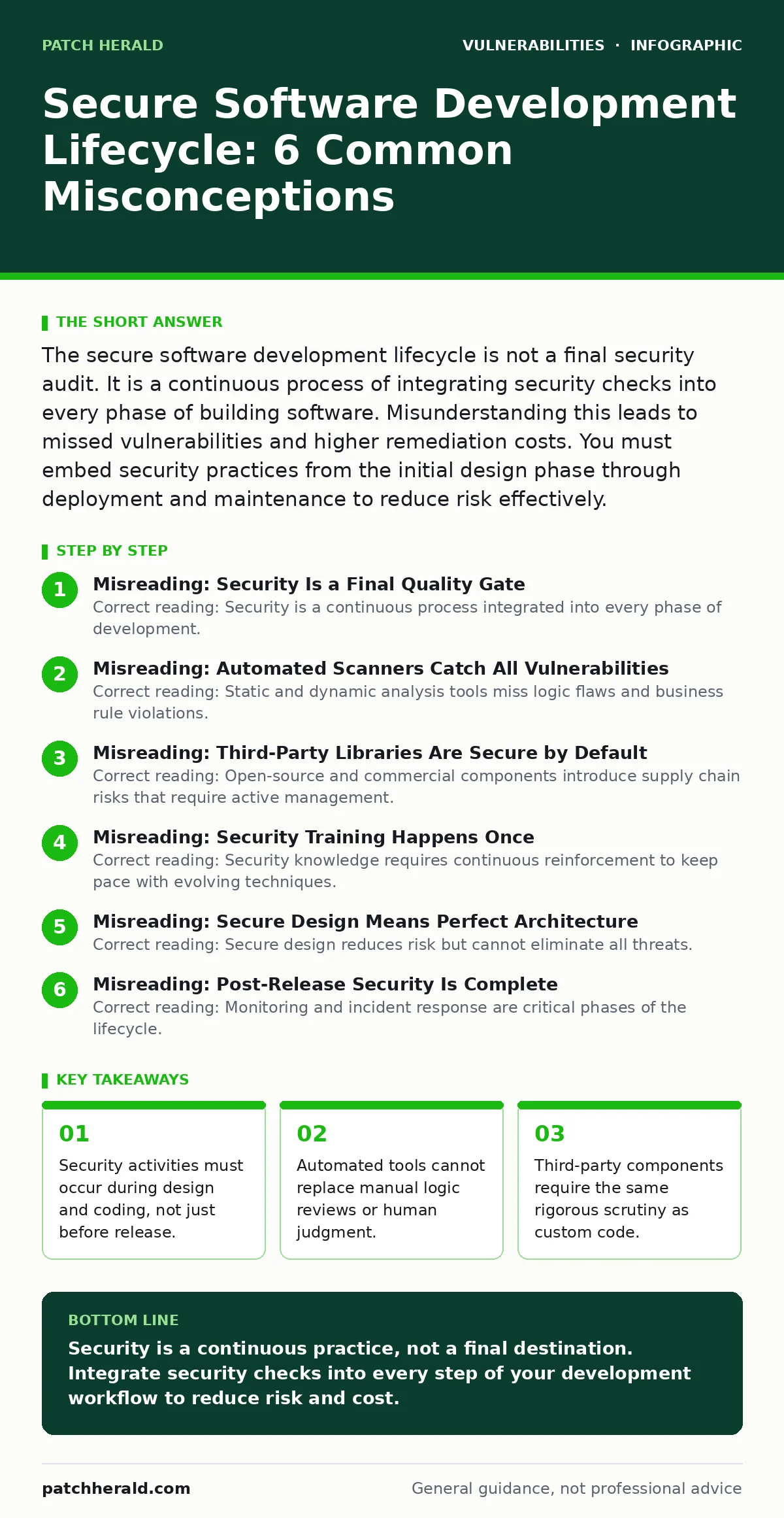
Misreading: Automated Scanners Catch All Vulnerabilities
Correct reading: Static and dynamic analysis tools miss logic flaws and business rule violations. Automated scanners identify known patterns, such as buffer overflows or common coding errors. They cannot understand the intent of the code or the business context. Developers must perform manual code reviews to catch issues like prototype pollution, where malicious data alters object prototypes. Automated tools provide a baseline, but human expertise is required to evaluate complex interactions and decision paths. Relying solely on automation creates a false sense of security.
Consider a feature that calculates financial transactions. An automated tool might verify that the input is a number. It cannot determine if the calculation logic allows for integer overflow vulnerabilities that could corrupt data. A human reviewer understands the business rules and can spot this gap. Combining automated scanning with manual review ensures broader coverage. This dual approach reduces the risk of missing critical defects that automated tools overlook.
Misreading: Third-Party Libraries Are Secure by Default
Correct reading: Open-source and commercial components introduce supply chain risks that require active management. Developers often assume that widely used libraries are secure because many eyes have reviewed them. This assumption fails when a library contains hidden vulnerabilities or when it is compromised by attackers. You must track dependencies and monitor for newly discovered weaknesses. Understanding CWE weakness categories helps you identify the types of flaws common in third-party code. Regular updates and rigorous testing of external components are necessary to maintain security.
Suppose your application uses a popular logging library. An attacker discovers a flaw in that library that allows remote code execution. If you do not monitor for updates, your application remains vulnerable. Using out-of-band patches can help mitigate such risks when official updates are delayed. You must treat third-party code with the same scrutiny as your own custom code. This includes verifying the integrity of downloaded packages and restricting network access for components that do not need it.
Misreading: Security Training Happens Once
Correct reading: Security knowledge requires continuous reinforcement to keep pace with evolving techniques. Training developers once a year does not prevent mistakes in daily coding tasks. Security practices must be embedded in the workflow through regular reminders and practical exercises. Developers need to understand how their code can be exploited, such as through cross-site request forgery (CSRF) attacks. This involves manipulating users into performing actions they did not intend. Continuous learning ensures that developers recognize these patterns and implement proper safeguards.
Imagine a developer who learned about input validation five years ago. They may not be aware of newer bypass techniques or updated best practices. Regular workshops and code reviews help reinforce current standards. Integrating security topics into daily stand-ups keeps the subject relevant. This approach makes security a habit rather than an occasional event. Continuous education reduces the likelihood of introducing new vulnerabilities through outdated knowledge.
Misreading: Secure Design Means Perfect Architecture
Correct reading: Secure design reduces risk but cannot eliminate all threats. No system is immune to every possible attack vector. Designers must prioritize protections based on the value of the assets and the likelihood of exploitation. This involves identifying critical components and applying stronger controls to them. Exposed admin panels are a common mistake where sensitive interfaces are left accessible to the public. Proper design ensures that administrative functions are protected by strong authentication and network restrictions.
Suppose you design a system with perfect encryption for data in transit. This does not protect data at rest if the storage backend is misconfigured. Secure design requires a holistic view of the entire system, including infrastructure and configuration. You must assume that some defenses will fail and implement layers of protection. This defense-in-depth strategy limits the impact of a breach. Recognizing that perfection is impossible helps you focus on high-impact controls.
See also: Bug Bounty Programs: How External Researchers Secure Your Code · Out-of-Band Patches: Meaning, Risks, and Deployment Reality
Misreading: Post-Release Security Is Complete
Correct reading: Monitoring and incident response are critical phases of the lifecycle. Deploying an application is not the end of security responsibilities. Attackers constantly probe for new entry points and weaknesses. You must monitor logs, analyze traffic patterns, and respond to anomalies promptly. Bug bounty programs can help identify issues that internal teams missed, but they are not a substitute for active monitoring. Continuous improvement based on real-world data ensures that the application remains secure over time.
Imagine a scenario where a new vulnerability is discovered in a component your application uses. If you do not have a process for rapid assessment and patching, your system remains at risk. Establishing clear procedures for incident response ensures that your team can react quickly. This includes isolating affected systems, analyzing the impact, and communicating with stakeholders. Treating security as an ongoing cycle rather than a one-time project maintains protection against emerging threats.
Key takeaways
- Security activities must occur during design and coding, not just before release.
- Automated tools cannot replace manual logic reviews or human judgment.
- Third-party components require the same rigorous scrutiny as custom code.
Security is a continuous practice, not a final destination. Integrate security checks into every step of your development workflow to reduce risk and cost.
Frequently asked questions
How do I start implementing a secure development lifecycle?
Begin by defining security requirements for each project phase. Identify key roles and responsibilities for security tasks. Integrate automated scanning tools into your build pipeline to catch basic issues early.
What is the biggest mistake teams make?
Teams often treat security as a compliance checkbox rather than a risk management practice. This leads to superficial implementations that fail to address real threats. Focus on understanding the specific risks your application faces.
Can small teams afford a full security lifecycle?
Yes, by prioritizing high-impact activities. You do not need expensive tools or large teams. Focus on code reviews, dependency management, and basic configuration hygiene. These practices provide significant protection with minimal overhead.
How do I handle third-party code risks?
Maintain an inventory of all third-party components. Monitor for security advisories and update dependencies regularly. Use automated tools to detect known vulnerabilities in your software supply chain.
How this guide was produced: written by the Patch Herald editorial team with AI assistance, checked against the public references listed below, and reviewed when the facts change. See our editorial policy or report an error.