
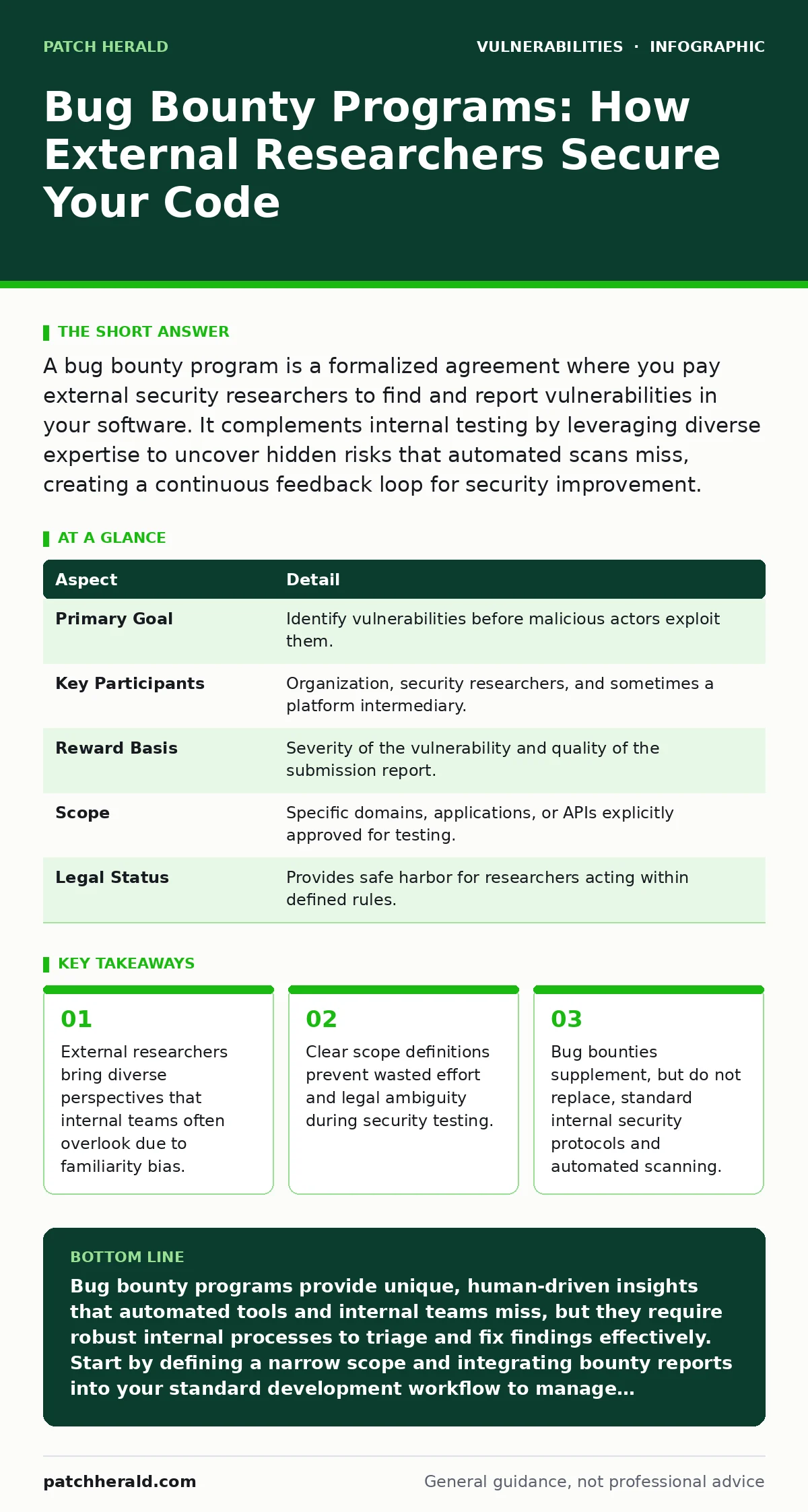
A bug bounty program is a formalized agreement where you pay external security researchers to find and report vulnerabilities in your software. It complements internal testing by leveraging diverse expertise to uncover hidden risks that automated scans miss, creating a continuous feedback loop for security improvement.
The Crowdsourced Security Analogy
Imagine you own a large, complex warehouse. You have a dedicated security team that knows every corridor and blind spot. They are excellent at stopping known threats. However, they have walked these halls every day for years. They have developed blind spots based on habit. Now, imagine hiring hundreds of independent explorers from around the world to look for loose floorboards, weak locks, or hidden doors.
They approach the structure with fresh eyes, using tools and techniques your internal team never considered. This is the core mechanism of a bug bounty program. It leverages the collective intelligence of the global security community to identify weaknesses that internal audits consistently miss.
Defining the Mechanism
A bug bounty program is a financial incentive model. You publicly invite security researchers to test your digital assets for vulnerabilities. When a researcher finds a valid security flaw, they submit a detailed report. You verify the issue, fix it, and pay a predetermined reward. This shifts the dynamic from adversarial hacking to cooperative discovery. The researcher gains recognition and income. You gain a deeper understanding of your attack surface. This model relies on trust and clear communication protocols. Without these, the program creates more noise than value.
The Problem of Internal Blind Spots
Internal security teams are vital, but they suffer from inherent limitations. They know the system architecture too well. This familiarity creates cognitive bias. They test what they expect to break, not what an outsider might target. Automated scanning tools suffer from a similar constraint. They check for known patterns. They cannot detect logic flaws or complex business rule violations. A bug bounty program introduces human creativity into the testing process. Researchers look for unexpected interactions between system components. They attempt to break the system in ways that defy standard documentation. This human element catches subtle issues that scripts ignore.
| Aspect | Detail |
|---|---|
| Primary Goal | Identify vulnerabilities before malicious actors exploit them. |
| Key Participants | Organization, security researchers, and sometimes a platform intermediary. |
| Reward Basis | Severity of the vulnerability and quality of the submission report. |
| Scope | Specific domains, applications, or APIs explicitly approved for testing. |
| Legal Status | Provides safe harbor for researchers acting within defined rules. |
Core Components of a Successful Program
A functional program requires precise structural elements. The first is the scope. You must define exactly which systems are fair game. This prevents accidental disruption of critical production environments. The second is the triage process. You need a reliable method to verify reports quickly. False positives waste time. True positives require immediate attention.
The third is the reward structure. Payments must align with the effort required to find the bug. Low payouts attract low-effort submissions. High payouts for trivial issues drain your budget. The final component is communication. You must acknowledge receipt of reports and provide status updates. Silence drives researchers away to other targets.
Integration with Existing Defences
Bug bounties do not operate in a vacuum. They fit into a broader security strategy. They complement static application security testing (SAST) and dynamic application security testing (DAST). These automated tools catch syntax errors and common misconfigurations. Bounties catch logic errors and business flow violations. For instance, an automated scan might miss a scenario where a user can access another user’s data due to flawed permission checks.
A researcher will find this. You must also consider how bounties interact with other security layers. If your cloud firewalls are misconfigured, researchers will find it quickly. This is not a failure of the bounty program. It is a validation of its effectiveness. The bounty highlights gaps that your perimeter defenses failed to close.
See also: Out-of-Band Patches: Meaning, Risks, and Deployment Reality · CWE Weakness Categories: Meaning, Definition, and Practical Use
Common Misconceptions and Pitfalls
Many organizations view bug bounties as a silver bullet. This is a dangerous assumption. A program does not fix your code. It only finds the broken parts. You still need skilled engineers to apply out-of-band patches when critical flaws are found. Another misconception is that bounties replace internal security hiring. They do not. They augment it.
If your internal team is understaffed, a bounty program will overwhelm you with reports you cannot process. You must have the capacity to triage and remediate. Additionally, some believe that offering a bounty prevents all legal liability. It does not. You must have explicit legal terms that grant researchers permission to test. Without this, even well-meaning researchers could be accused of unauthorized access.
The Hidden Costs of Participation
The financial cost is obvious. You pay for every valid bug. The hidden costs are often higher. Reputation risk is significant. If a researcher finds a critical flaw and discloses it because you ignored their report, the public narrative turns against you. Operational drag is another factor. Your engineering team must pause other work to fix security issues.
This creates friction between security and development teams. You must manage this workflow carefully. Prioritize fixes based on risk, not just the size of the bounty. A low-severity bug that is easy to fix might take priority over a high-severity bug that requires a major architectural change. This balance keeps your development pipeline moving while maintaining security.
Where Bounties Fit in the Lifecycle
Security is a continuous process, not a one-time event. Bug bounties provide ongoing validation. They catch regressions. New code often breaks old security controls. Researchers will find these new entry points. They also help you understand emerging threats. For example, a researcher might exploit a novel form of cross-site request forgery (CSRF) that your current filters do not recognize.
This insight allows you to update your defenses proactively. You should also consider how bounties interact with supply chain risks. If your application relies on third-party libraries, a researcher might find a prototype pollution vulnerability in a dependent package. This highlights the need for strict dependency management alongside your bounty program.
Key takeaways
- External researchers bring diverse perspectives that internal teams often overlook due to familiarity bias.
- Clear scope definitions prevent wasted effort and legal ambiguity during security testing.
- Bug bounties supplement, but do not replace, standard internal security protocols and automated scanning.
Bug bounty programs provide unique, human-driven insights that automated tools and internal teams miss, but they require robust internal processes to triage and fix findings effectively. Start by defining a narrow scope and integrating bounty reports into your standard development workflow to manage operational load.
Frequently asked questions
Do bug bounty programs guarantee my software is secure?
No program guarantees complete security. They significantly reduce the likelihood of undiscovered vulnerabilities but cannot eliminate all risks.
How do I verify if a bug report is valid?
You need a technical team to reproduce the reported issue in a controlled environment. Automation can help prioritize, but human verification is necessary for complex logic flaws.
What if a researcher finds a critical vulnerability?
Treat it as an emergency. Isolate the affected component if possible, develop a fix immediately, and communicate transparently with the researcher about your progress.
Can I run a bug bounty program for free?
You can run an "unpaid" program where researchers report bugs for recognition only. However, this attracts far fewer participants and lower-quality reports compared to paid programs.
How this guide was produced: written by the Patch Herald editorial team with AI assistance, checked against the public references listed below, and reviewed when the facts change. See our editorial policy or report an error.