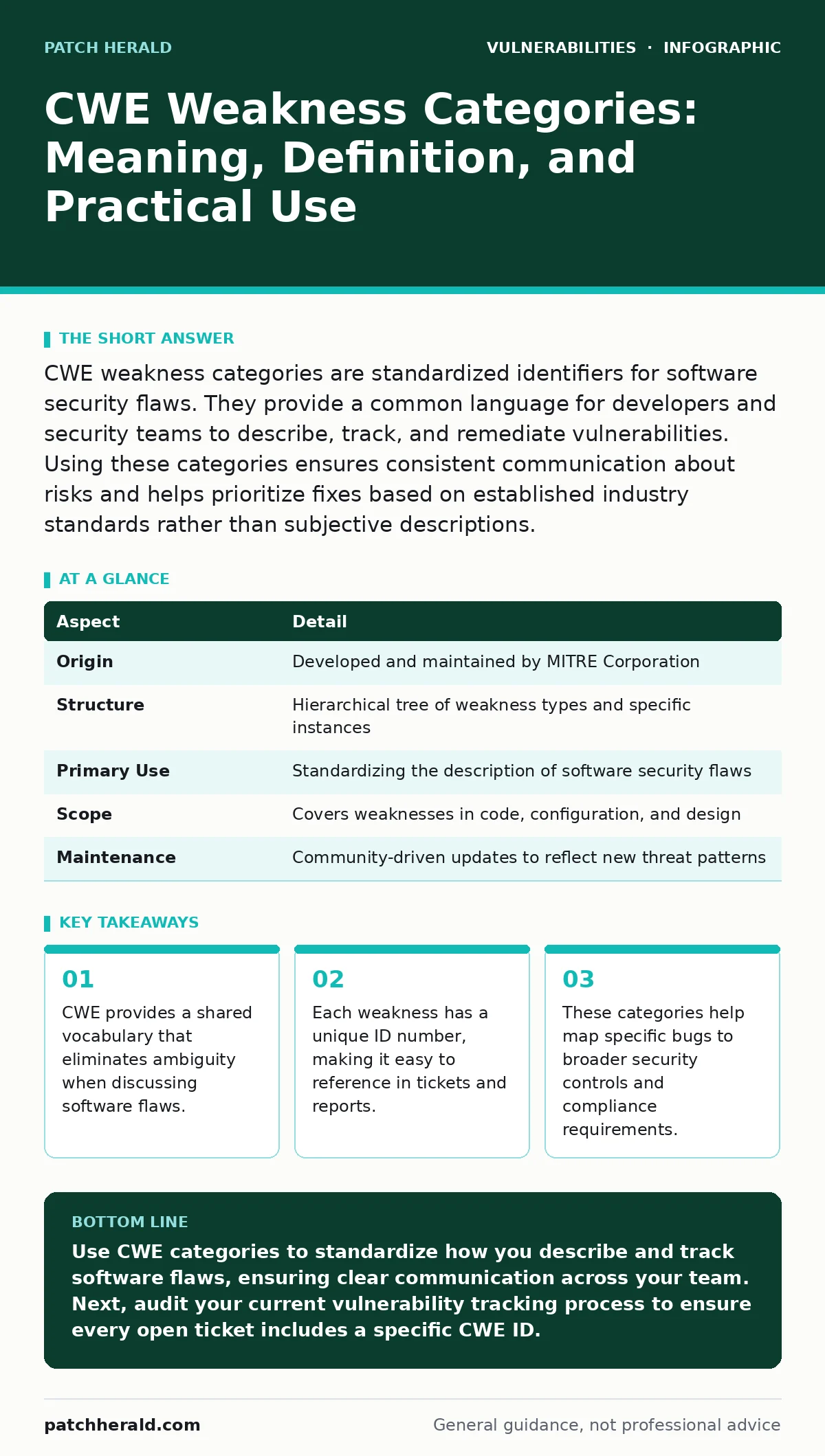
CWE weakness categories are standardized identifiers for software security flaws. They provide a common language for developers and security teams to describe, track, and remediate vulnerabilities. Using these categories ensures consistent communication about risks and helps prioritize fixes based on established industry standards rather than subjective descriptions.
The Filing Cabinet Analogy
Imagine a library where every book is misfiled. One librarian calls a missing book a "theft," another calls it a "misplacement," and a third simply notes it is "gone." Resolving the issue becomes a debate about definitions rather than a search for the book. Now imagine a system where every missing book is tagged with a specific code indicating exactly how it went missing. This allows staff to spot patterns, such as books disappearing only from a specific shelf due to a broken lock.
Software security works the same way. Without a standard naming convention, a developer might describe a buffer overflow as a "memory crash," while a security auditor calls it a "heap corruption." These are technically the same underlying flaw, but the different names prevent the team from recognizing they are fighting the same problem. The Common Weakness Enumeration (CWE) solves this by providing that standardized filing system. It assigns a unique number and a precise definition to each type of weakness.
What CWE Actually Is
The Common Weakness Enumeration is a community-developed list of software weakness types. It is maintained by the MITRE Corporation, a not-for-profit organization that operates research and development centers for the U.S. government. The list is not a product or a tool; it is a dictionary. It does not tell you how to fix a bug, nor does it scan your code for errors. Instead, it provides the terminology needed to describe the error once you have found it.
Each entry in the CWE database has a unique identifier, such as CWE-79. This number remains constant even if the description is updated. This stability is vital for long-term tracking. If you find a flaw today and tag it with a CWE ID, you can look back five years and see exactly what that tag meant. It also allows different security tools to speak the same language. A static analysis tool might output a CWE ID, and your ticketing system can use that same ID to categorize the work item.
| Aspect | Detail |
|---|---|
| Origin | Developed and maintained by MITRE Corporation |
| Structure | Hierarchical tree of weakness types and specific instances |
| Primary Use | Standardizing the description of software security flaws |
| Scope | Covers weaknesses in code, configuration, and design |
| Maintenance | Community-driven updates to reflect new threat patterns |
How Categories Are Used Day to Day
In practice, you use CWE categories to translate technical findings into actionable business terms. When a security scan identifies a problem, the report often includes a CWE ID. You take this ID and create a work item for your development team. Instead of writing a vague description like "fix the login issue," you write "Remediate CWE-287: Improper Authentication." This tells the developer exactly what class of problem they are solving.
This standardization also helps with prioritization. Not all weaknesses are equally dangerous. Some CWEs are associated with high-impact exploits, while others are minor configuration errors. By knowing the CWE, you can consult established severity ratings. This allows you to focus your limited resources on the weaknesses that pose the greatest risk to your organization. It turns a mountain of raw data into a manageable list of priorities.
The Hidden Cost of Vague Descriptions
The most common mistake teams make is ignoring the specific ID in favor of a generic label. They might tag a vulnerability as "Security Issue" or "Bug." This seems harmless in the moment, but it creates a hidden cost over time. You lose the ability to aggregate data. If you have fifty "Security Issues," you do not know if they are all the same problem or fifty different problems.
This lack of granularity prevents you from seeing systemic issues. If you tag ten vulnerabilities as CWE-125: Out-of-bounds Read, you realize your team has a fundamental misunderstanding of memory management. You can then schedule specific training on that topic. If you had just called them "memory bugs," you would miss this pattern. The specific CWE ID reveals the root cause, not just the symptom.
What People Usually Get Wrong
Many organizations confuse CWE with CVSS. The Common Vulnerability Scoring System (CVSS) provides a numerical score for the severity of a vulnerability. CWE describes the type of weakness. They are different tools for different jobs. You need the CWE to understand what the flaw is, and you need the CVSS to understand how bad it is. Using one without the other leaves you with incomplete information.
Another common error is assuming that fixing a specific instance fixes the category. If you patch one SQL injection flaw, you have not fixed SQL injection as a weakness in your application. You must audit the codebase for other instances of CWE-89. The CWE category helps you broaden your search. It reminds you that this is a pattern, not an isolated incident. This mindset shift is what separates reactive patching from proactive security engineering.
See also: Bug Bounty Programs: How External Researchers Secure Your Code · Out-of-Band Patches: Meaning, Risks, and Deployment Reality
Connecting to Related Security Concepts
Understanding CWE categories helps you navigate other complex security topics. For instance, when dealing with integer overflow vulnerabilities, knowing the specific CWE helps you distinguish between a simple calculation error and a security exploit. Similarly, when reviewing dependency confusion attacks, you can map the weakness to specific supply chain vulnerabilities in the CWE hierarchy.
These categories also clarify the nature of cross-site request forgery (CSRF). It is not just a "login issue"; it is a specific failure in session management. This precision is vital when designing bug bounty programs. Clear CWE definitions ensure that researchers and your internal team are discussing the same flaw. It reduces friction and speeds up the resolution process.
Furthermore, these standards help you identify risks like accidental data disclosure. By categorizing the weakness, you can determine if it stems from misconfiguration or a coding error. This distinction changes how you prevent it in the future. It also helps you understand the limitations of out-of-band patches when a vendor releases a fix for a specific CWE. You know exactly what the patch addresses and what it leaves open.
The Value of a Common Language
The true value of CWE lies in its universality. It allows you to communicate with vendors, auditors, and developers without translation errors. When you speak in CWE IDs, you are speaking a global dialect of security. This reduces the time spent clarifying requirements and increases the time spent fixing code.
It also future-proofs your security program. As new attack techniques emerge, the CWE database is updated to include them. By adopting this framework now, you ensure that your internal processes can absorb new knowledge without rebuilding your terminology from scratch. You are not just fixing bugs; you are building a culture of precise communication. This precision is the foundation of a mature security posture. It allows you to measure progress, identify trends, and make informed decisions about risk.
Key takeaways
- CWE provides a shared vocabulary that eliminates ambiguity when discussing software flaws.
- Each weakness has a unique ID number, making it easy to reference in tickets and reports.
- These categories help map specific bugs to broader security controls and compliance requirements.
Use CWE categories to standardize how you describe and track software flaws, ensuring clear communication across your team. Next, audit your current vulnerability tracking process to ensure every open ticket includes a specific CWE ID.
Frequently asked questions
Is CWE the same as CVE?
No, CVE is an identifier for a specific vulnerability instance, while CWE is a category for the type of weakness. CVE tells you where the bug is; CWE tells you what kind of bug it is.
Who maintains the CWE database?
The MITRE Corporation maintains the database with input from the global security community. It is an open standard that anyone can use without licensing fees.
Should I use CWE for hardware vulnerabilities?
Yes, CWE includes categories for hardware and firmware weaknesses. It is not limited to software code and covers a wide range of technical domains.
How often is the CWE database updated?
The database is updated regularly to reflect new research and emerging trends. You should check for new releases periodically to ensure your internal mappings are current.
How this guide was produced: written by the Patch Herald editorial team with AI assistance, checked against the public references listed below, and reviewed when the facts change. See our editorial policy or report an error.