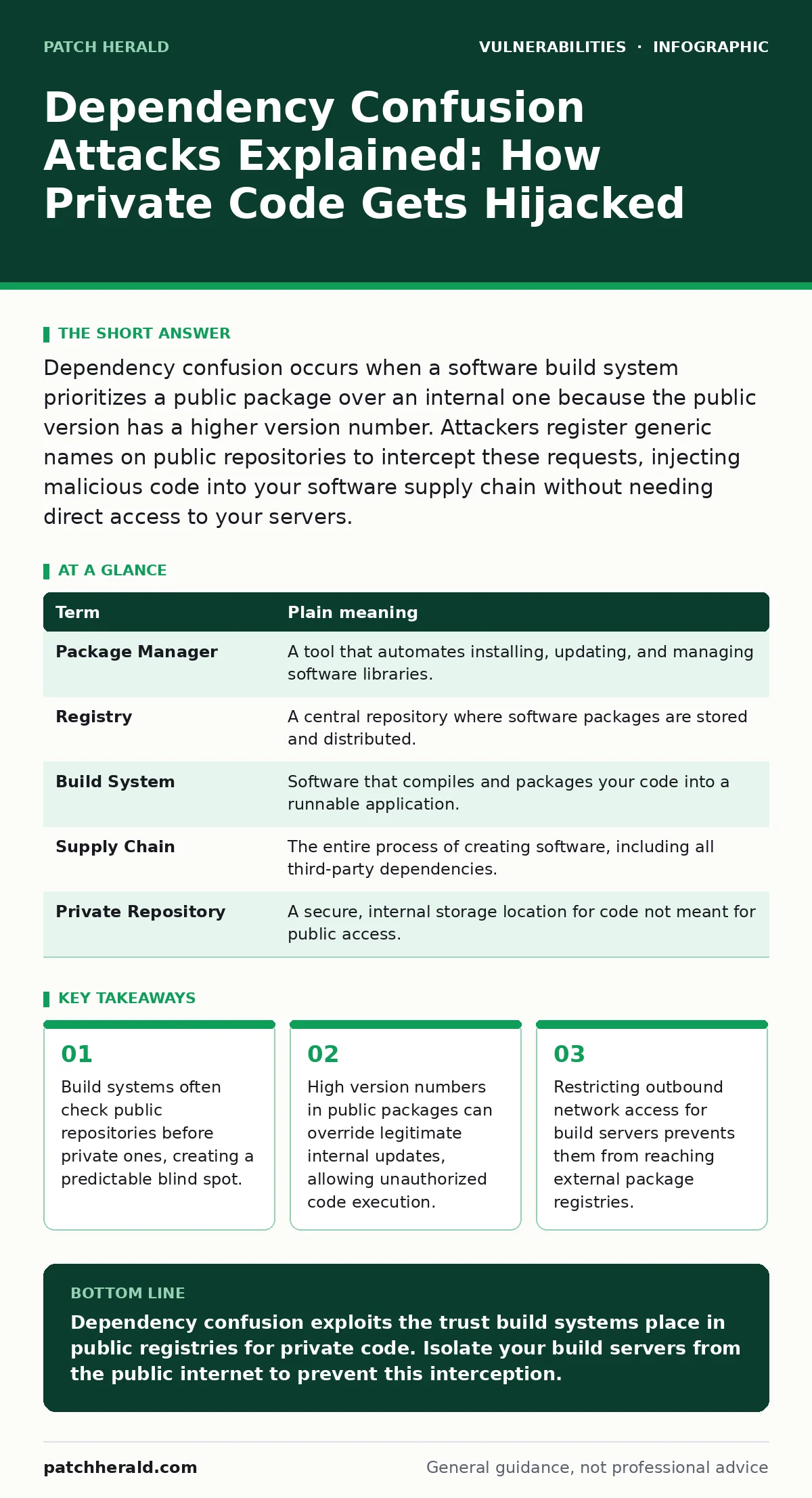
Dependency confusion occurs when a software build system prioritizes a public package over an internal one because the public version has a higher version number. Attackers register generic names on public repositories to intercept these requests, injecting malicious code into your software supply chain without needing direct access to your servers.
The Warehouse Analogy
Imagine you run a large warehouse that uses specialized parts. You have a private supplier who ships these parts directly to your loading dock. This supplier is trusted, but their shipping labels are simple and unencrypted. You also have a public marketplace where anyone can sell similar parts. Your warehouse manager is instructed to always use the part with the highest version number, assuming higher numbers mean newer, better quality.
An attacker sees this workflow. They cannot break into your private supplier’s facility, nor can they hack your warehouse directly. Instead, they go to the public marketplace and list a part with the exact same name as your private component, but with a much higher version number. When your manager checks for updates, the public marketplace responds faster or appears first. The manager grabs the public part, thinking it is the latest update from your private supplier. The part looks identical, but it contains a hidden mechanism that steals inventory once installed.
How The Mechanism Works
In software development, this scenario plays out with package managers. These are tools that automatically download and install libraries of code your application needs. Many organizations use a mix of public repositories, like npm or PyPI, and private internal repositories for proprietary code. The vulnerability arises because many build systems are configured to check public sources first or treat public and private sources as equal peers.
The attacker registers a generic package name on a public registry. They then publish a malicious version with a high version number, such as 999.999.999. When your internal build server requests an update for that package, it may query the public registry. If the public registry returns a valid response with a higher version number than your internal private package, the build system downloads the malicious code. This happens without authentication because the public registry does not require special credentials to download public packages.
| Term | Plain meaning |
|---|---|
| Package Manager | A tool that automates installing, updating, and managing software libraries. |
| Registry | A central repository where software packages are stored and distributed. |
| Build System | Software that compiles and packages your code into a runnable application. |
| Supply Chain | The entire process of creating software, including all third-party dependencies. |
| Private Repository | A secure, internal storage location for code not meant for public access. |
Why Standard Defenses Fail
You might assume that strong authentication solves this problem. However, the attack bypasses authentication entirely. The build system is not logging into the public registry with your private credentials. It is making an anonymous request to a public service. The public service happily serves the package because it is public. The deception lies in the name collision and the version numbering scheme, not in stolen passwords.
This is why monitoring out-of-band patches is insufficient. Patching the operating system or the application server does not fix the logic error in the build configuration. The flaw exists in how the build system resolves package names. Even if you implement role-based access control for your developers, the build server itself often runs with broad permissions to fetch dependencies. The server trusts the network response, not the intent of the request.
The Hidden Cost of Convenience
The primary driver of this vulnerability is convenience. Developers want fast builds. Checking a local or internal cache is slow if it is not optimized. Checking a public CDN is fast and reliable. By defaulting to public sources, organizations prioritize speed over security. The hidden cost is that you are implicitly trusting the integrity of the public namespace for your private components.
This mirrors the risks seen in exposed admin panels. Just as an open admin panel invites unauthorized control, an open dependency resolution strategy invites unauthorized code injection. The attack surface is not your firewall; it is the configuration of your dependency resolution logic. You are effectively broadcasting to the world that you are looking for specific package names, inviting anyone to create a matching trap.
Simple Safety Habits
You can mitigate this risk by changing how your build systems resolve packages. The most effective method is to isolate your build environment. If your build servers cannot reach the public internet, they cannot be tricked by public registries. They will only see your internal private repository. This is a form of network segmentation that removes the attack vector entirely.
Another approach is to rename your private packages. If your private package is named "internal-utils", an attacker cannot register that name on a public registry because it is too specific or already claimed. However, this is a management burden. A more robust technical control is to configure your package manager to prefer private sources explicitly. You can set the private repository as the only source, or ensure it is checked before public ones.
Try This Now
- Audit your build configurations to see if they query public package registries for private components.
- Implement network restrictions on build servers to block outbound traffic to public registries unless explicitly allowed.
- Review your package naming conventions to ensure private packages have unique identifiers that cannot be easily mimicked on public platforms.
Understanding the Broader Context
This attack highlights a shift in threat models. Attackers no longer need to break into your network. They only need to trick your automated processes. This is similar to cross-site request forgery (CSRF) in web applications, where an attacker tricks a browser into performing an unwanted action. In both cases, the system trusts the source of the request or the resolution of the name.
While integer overflow vulnerabilities or prototype pollution affect the code itself, dependency confusion affects the delivery of the code. It is a supply chain issue. Understanding CWE weakness categories helps classify this as a trust boundary violation. You are trusting an external resolver to make correct decisions about internal assets.
Key takeaways
- Build systems often check public repositories before private ones, creating a predictable blind spot.
- High version numbers in public packages can override legitimate internal updates, allowing unauthorized code execution.
- Restricting outbound network access for build servers prevents them from reaching external package registries.
Dependency confusion exploits the trust build systems place in public registries for private code. Isolate your build servers from the public internet to prevent this interception.
Frequently asked questions
Does using a VPN protect against dependency confusion?
No, a VPN encrypts traffic but does not change the order in which package managers check repositories. The build system will still request the package from the public registry if configured to do so.
Can I just scan my code for malicious packages?
Scanning helps, but it is reactive. You need to prevent the malicious package from being downloaded in the first place by controlling network access and repository priorities.
Are only large companies vulnerable to this?
Any organization that uses private repositories alongside public ones is at risk. Small teams often have simpler build configurations that are more likely to default to public sources.
How do I know if I have been compromised?
Look for unusual network traffic from your build servers to public registries, especially for packages with high version numbers that do not match your internal releases.
How this guide was produced: written by the Patch Herald editorial team with AI assistance, checked against the public references listed below, and reviewed when the facts change. See our editorial policy or report an error.