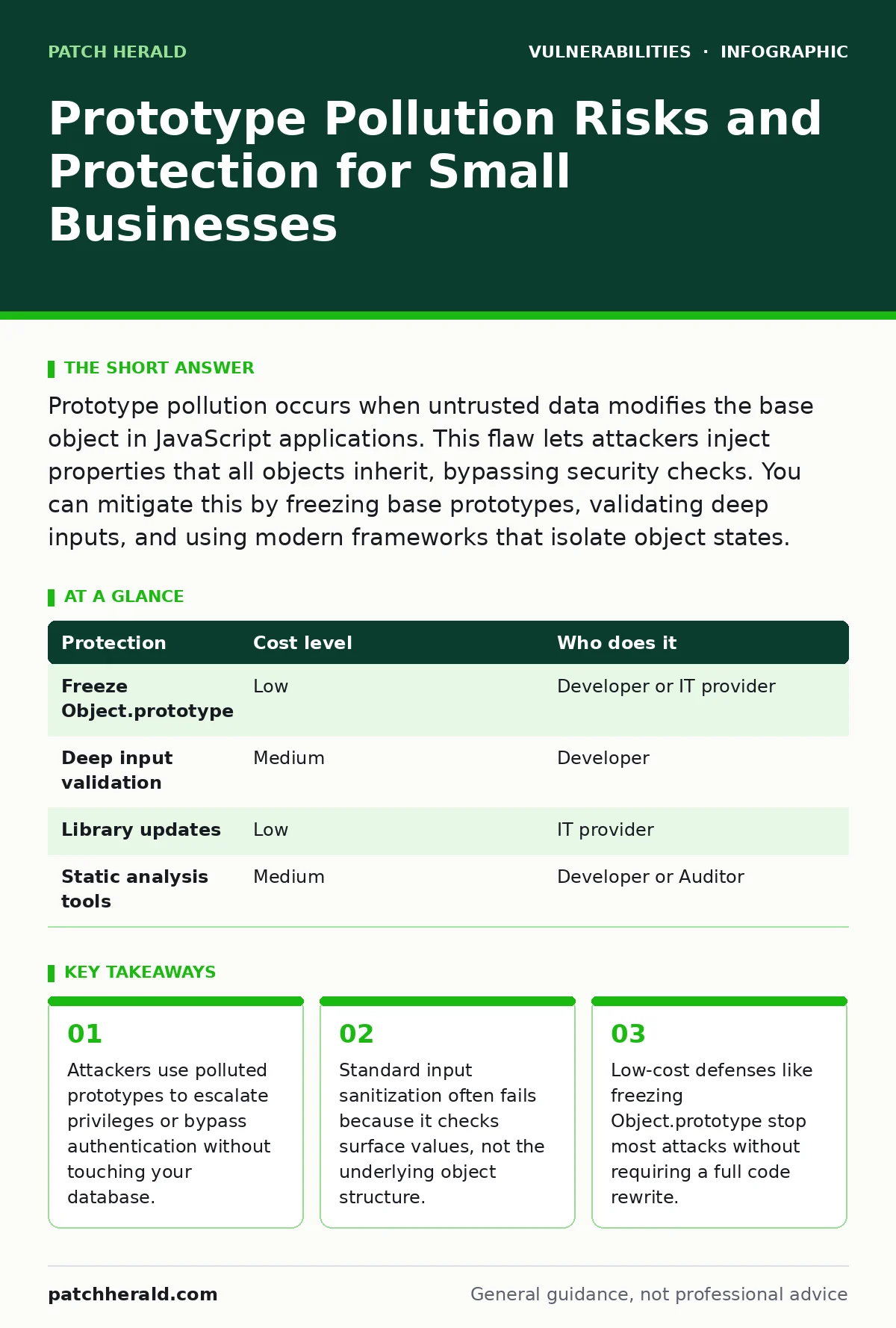
Prototype pollution occurs when untrusted data modifies the base object in JavaScript applications. This flaw lets attackers inject properties that all objects inherit, bypassing security checks. You can mitigate this by freezing base prototypes, validating deep inputs, and using modern frameworks that isolate object states.
The Mechanics of Object Inheritance
JavaScript relies on a mechanism called prototypal inheritance. Every object in JavaScript links to a parent object, eventually reaching a base object known as Object.prototype. This base object defines default behaviors for all objects. When you access a property on an object, JavaScript first checks the object itself. If it does not find the property, it looks up the chain to the prototype.
Prototype pollution exploits this lookup chain. An attacker injects a property into the base prototype itself. Once that property exists on the prototype, every object in the application inherits it. This happens silently. The code does not crash. It simply behaves differently because it sees a new property it did not create.
This is distinct from typical injection flaws. In a standard injection, the attacker targets a specific variable. In prototype pollution, the attacker targets the foundation of the language runtime. The damage is global and persistent within that process memory.
Why Small Organizations Are Exposed
Small businesses often rely on open-source libraries to build applications quickly. These libraries handle data merging, deep copying, or JSON parsing. Many popular libraries have historically contained flaws that allow prototype pollution. When you use a library that merges user input into a configuration object, you inherit its risks.
You may not write the vulnerable code yourself, but you deploy it. Small teams often lack dedicated security engineers to audit third-party dependencies. You trust the library to handle data safely. If the library merges userInput into config without checking for special keys like __proto__ or constructor, the application becomes vulnerable.
This exposure is compounded by the use of server-side JavaScript. Node.js runs on your servers. If a web application running on Node.js is polluted, the attacker gains a foothold in the server environment. They can modify how the server handles requests, logs data, or connects to databases. This makes the attack far more dangerous than client-side issues.
Hidden Costs and Unexpected Consequences
The immediate risk is privilege escalation. An attacker can set isAdmin to true, as seen in the example above. However, the consequences often extend beyond simple access control. Attackers can inject properties that break application logic. They might set a property that causes the application to skip validation steps entirely.
Consider the impact on logging. If an attacker injects a property that forces the logger to ignore certain events, they can operate undetected. This is a silent failure mode. You do not see an error. You see normal operation, but the security controls are effectively disabled. This makes detection extremely difficult.
Another hidden cost is the loss of data integrity. Polluted prototypes can alter how data is serialized or compared. An equality check might return true when it should return false. This can lead to incorrect business decisions based on corrupted data states. The application appears to work, but it is making wrong choices. This aligns with the broader concerns found in CWE weakness categories regarding improper input validation.
Low-Cost Protections for Your Stack
You do not need expensive tools to mitigate this risk. The first step is to freeze the base prototype. In JavaScript, you can use Object.freeze(Object.prototype). This prevents any new properties from being added to the base object. If an attacker tries to pollute the prototype, the operation fails silently or throws an error.
This measure stops most direct pollution attempts. It does not fix vulnerable libraries, but it blocks the effect. You should apply this at the start of your application lifecycle. It is a small code change with a high security return. It acts as a safety net for libraries you cannot audit.
Second, validate all external input deeply. Do not trust JSON data from users. Use a schema validator that rejects unknown keys. If your application expects a name and email field, reject any object that contains __proto__ or constructor. This requires effort in your input handling code, but it is effective.
| Protection | Cost level | Who does it |
|---|---|---|
| Freeze Object.prototype | Low | Developer or IT provider |
| Deep input validation | Medium | Developer |
| Library updates | Low | IT provider |
| Static analysis tools | Medium | Developer or Auditor |
What to Ask Your IT Provider
If you outsource your development or maintenance, you must verify that they understand this risk. Do not assume they are aware. Many providers focus on network security and ignore application-level logic flaws. You need to ask specific questions about their code review process.
Ask them how they handle third-party dependencies. Do they check for known vulnerabilities in libraries? Do they have a process for updating libraries when a new threat emerges? This is similar to managing out-of-band patches for critical systems. You need a rapid response plan for library updates, not just operating system updates.
Ask them if they use static analysis tools. These tools scan code for patterns that indicate prototype pollution risks. They can find vulnerable merge functions before you deploy them. If they do not use these tools, ask why. Manual code review is error-prone and slow for large codebases.
Integrating with Broader Security
Prototype pollution is one piece of a larger puzzle. It often works in conjunction with other flaws. For example, an attacker might use a cross-site request forgery (CSRF) attack to force a user to submit malicious data. If your application is vulnerable to pollution, that forged request can compromise the server.
You must also consider how you store and share code. Public code repository leaks can expose your source code to attackers. If they can see your code, they can identify which libraries you use and whether you have frozen your prototypes. Keep your source code private and audit access regularly.
Furthermore, ensure your input validation is robust against integer overflow vulnerabilities if your application handles numerical data. While different from pollution, these flaws often stem from the same root cause: trusting user input without strict boundaries. A holistic approach to input handling protects you from multiple threat vectors.
Maintenance and Monitoring
Protection is not a one-time task. Libraries change. New vulnerabilities are discovered. You must maintain a process for updating your dependencies. Subscribe to security advisories for the libraries you use. This allows you to patch before an attacker exploits the flaw.
Monitor your application logs for unusual behavior. Look for errors related to property assignment or unexpected object states. While pollution often fails silently, some environments log failed freeze operations. These logs can be early warnings of an attack attempt.
Regularly audit your code for direct use of dangerous functions. Functions that merge objects or parse JSON are high-risk. Ensure they are wrapped in validation layers. If you find code that directly assigns properties from user input to an object, refactor it immediately.
Key takeaways
- Attackers use polluted prototypes to escalate privileges or bypass authentication without touching your database.
- Standard input sanitization often fails because it checks surface values, not the underlying object structure.
- Low-cost defenses like freezing Object.prototype stop most attacks without requiring a full code rewrite.
Frequently asked questions
Does using a modern framework prevent prototype pollution?
Modern frameworks often include safeguards, but they are not immune. If you use custom logic or older libraries within a modern framework, you can still be vulnerable. Always verify that your specific implementation freezes prototypes or validates inputs.
Can I detect a prototype pollution attack after it happens?
Detection is difficult because the attack often leaves no obvious trace. You may see unexpected behavior or privilege escalation. Regular audits and static analysis are better for prevention than post-incident detection.
Is this risk limited to web applications?
No. Any application running JavaScript, including server-side Node.js apps and desktop apps using Electron, is at risk. The vulnerability exists in the language runtime, not just the web browser.
Should I stop using JavaScript for my business apps?
No. JavaScript is widely used and supported. The risk can be managed with proper coding practices and validation. Avoiding the language entirely is unnecessary if you implement the protections described here.
How this guide was produced: written by the Patch Herald editorial team with AI assistance, checked against the public references listed below, and reviewed when the facts change. See our editorial policy or report an error.