Typosquatting is not limited to simple misspellings or small sites. Attackers use algorithmic confusion, lookalike characters, and expired domains to mimic your brand. It evades traditional filters because the content often appears legitimate, requiring proactive domain monitoring and user education to mitigate.
Myth: Typosquatting Only Targets Big Tech Companies
Reality: Small and mid-sized organizations are frequent targets because they often lack the resources for continuous domain monitoring. Large corporations employ automated systems that detect and register common misspellings of their brand names before attackers can act. Smaller entities rarely have this luxury, leaving hundreds of potential variations open for registration.
Attackers prioritize targets where the cost of entry is low and the likelihood of a successful payout is high. A small business with a loyal customer base offers a predictable stream of victims who expect to pay for services or support. The assumption that you are too small to notice is a dangerous miscalculation.
Myth: It Is Just About Simple Misspellings
Reality: Modern typosquatting relies on sophisticated algorithmic prediction models that anticipate how users type under stress or distraction. These models account for keyboard layouts, common phonetic errors, and transposed letters. A simple swap of adjacent keys is the least sophisticated method available to an attacker.
Attackers also exploit visual similarity between characters from different scripts. This technique, known as a homograph attack, uses Unicode characters that look identical to standard Latin letters but belong to different character sets. For example, a Cyrillic 'a' may appear indistinguishable from a Latin 'a' in many web browsers. This bypasses simple string-matching filters that only check for ASCII characters.
Myth: Users Will Notice the Wrong URL
Reality: Human attention is a scarce resource, particularly when users are rushing to complete a transaction or access a service. The brain relies on pattern recognition rather than character-by-character verification when reading URLs. If the visual structure matches the expected brand, the user proceeds without scrutiny.
This cognitive shortcut is exploited by attackers who register domains that differ by only one or two characters. The difference is often too subtle to catch during a quick glance. Even security-aware users fall for this when they are tired, distracted, or using a mobile device with a small screen. The design of modern browsers, which hide the full URL behind a simplified address bar, further reduces visibility.
Myth: Legitimate Domains Are Safe Once Registered
Reality: Domain registration is a recurring expense, not a one-time purchase. If a business fails to renew a domain that it previously owned, it becomes available for anyone to register. Attackers monitor expiring domains for high-value brand names and register them immediately upon release.
This creates a scenario where a former legitimate site is now controlled by a malicious actor. The domain may retain its previous search engine ranking and backlinks, giving it an aura of legitimacy. Users who visited the site in the past may return, expecting the same service, only to encounter a phishing page or malware download. This is distinct from OAuth consent phishing, which exploits application permissions rather than domain ownership.
Myth: Security Software Blocks Typosquatting Sites
Reality: Endpoint protection and traditional antivirus solutions focus on known malicious signatures and behaviors. They often cannot distinguish between a legitimate website and a typosquatting site that hosts similar content. If the attacker hosts a convincing replica of your login page, the software sees only standard web traffic.
The content on a typosquatting site is often static or dynamically generated to mimic the target. Without specific intelligence about the malicious domain, security tools treat it as benign. This is why cyber hygiene practices must include user training. Users must learn to verify the exact URL before entering credentials, regardless of what their security software indicates.
See also: Dumpster Diving Mistakes That Expose Your Business Data · Malicious Bot Traffic: What It Is and How to Stop It
Myth: Buying All Misspellings Is the Solution
Reality: Registering every possible variation of your brand name is financially unsustainable and technically incomplete. There are thousands of potential combinations, including different top-level domains, hyphenated versions, and phonetic approximations. The cost of renewal alone can become prohibitive.
Furthermore, this approach does not stop homograph attacks or the hijacking of expired domains. It creates a false sense of security while attackers find new angles. A more effective strategy involves continuous monitoring of new domain registrations and expired domains for similarities to your brand. This allows you to take legal action or request takedowns when threats emerge, rather than trying to pre-emptively block every possibility.
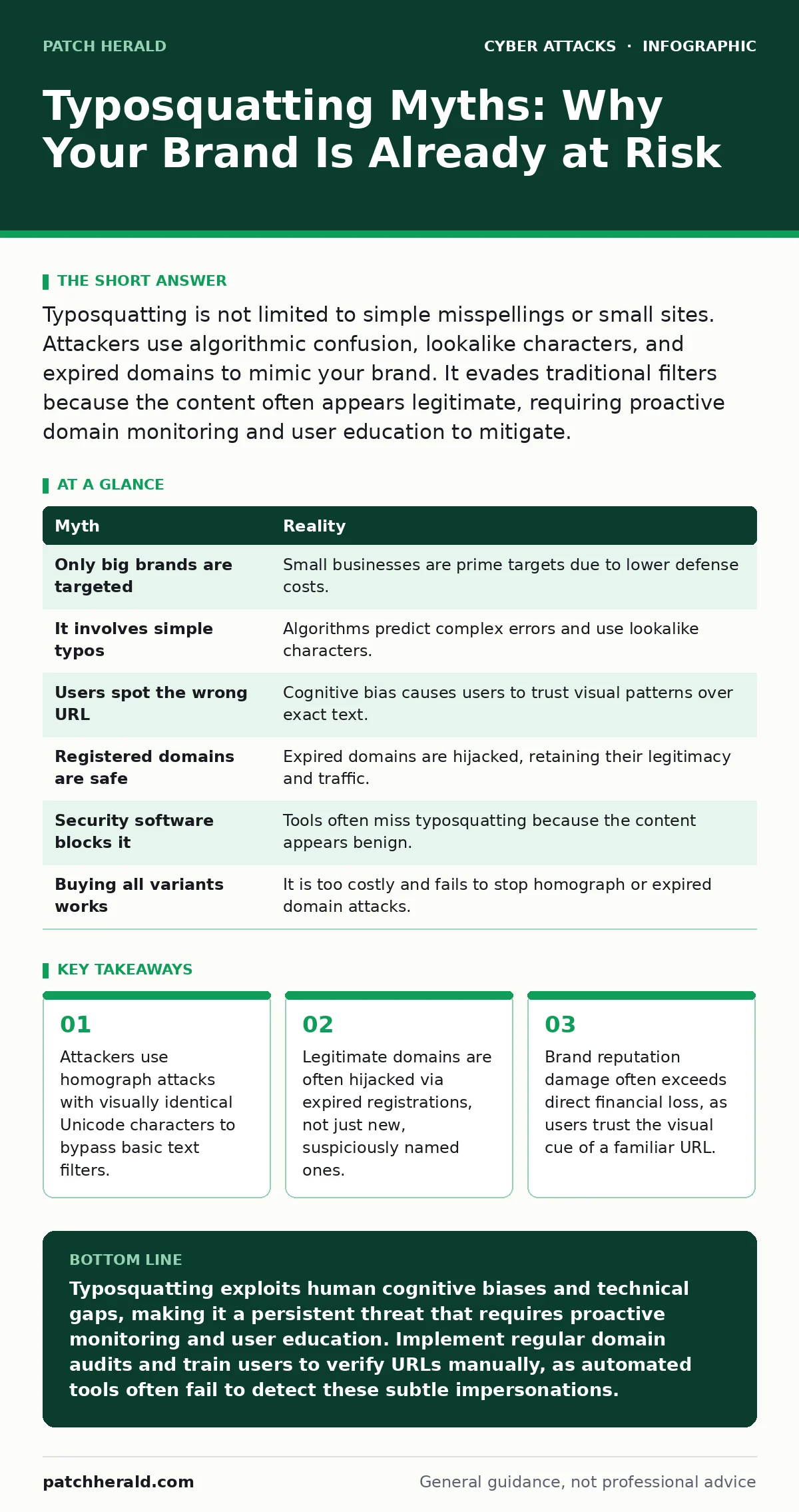
| Myth | Reality |
|---|---|
| Only big brands are targeted | Small businesses are prime targets due to lower defense costs. |
| It involves simple typos | Algorithms predict complex errors and use lookalike characters. |
| Users spot the wrong URL | Cognitive bias causes users to trust visual patterns over exact text. |
| Registered domains are safe | Expired domains are hijacked, retaining their legitimacy and traffic. |
| Security software blocks it | Tools often miss typosquatting because the content appears benign. |
| Buying all variants works | It is too costly and fails to stop homograph or expired domain attacks. |
Myth: Typosquatting Is Only About Stealing Passwords
Reality: While credential theft is a common goal, typosquatting serves many other malicious purposes. Attackers use these domains to distribute malware, host illegal content, or run fraudulent advertising campaigns. They may also use the domain to launch further attacks, such as Bluetooth attacks or vishing campaigns, using the brand’s reputation as a cover.
The domain itself is a weapon. It can be used to spam users, harvest data, or even launch dictionary attacks against other services. The flexibility of the domain means the attacker can change the payload without changing the address. This makes it a versatile tool in the attacker’s arsenal, not just a phishing front.
Key takeaways
- Attackers use homograph attacks with visually identical Unicode characters to bypass basic text filters.
- Legitimate domains are often hijacked via expired registrations, not just new, suspiciously named ones.
- Brand reputation damage often exceeds direct financial loss, as users trust the visual cue of a familiar URL.
Typosquatting exploits human cognitive biases and technical gaps, making it a persistent threat that requires proactive monitoring and user education. Implement regular domain audits and train users to verify URLs manually, as automated tools often fail to detect these subtle impersonations.
Frequently asked questions
How can I tell if a website is a typosquatting attempt?
Look closely at the URL for subtle differences in spelling, character shape, or domain extension. If the site looks slightly off or requests unusual permissions, it may be a fake.
Does using HTTPS prevent typosquatting?
No. Attackers can obtain SSL certificates for their
How this guide was produced: written by the Patch Herald editorial team with AI assistance, checked against the public references listed below, and reviewed when the facts change. See our editorial policy or report an error.