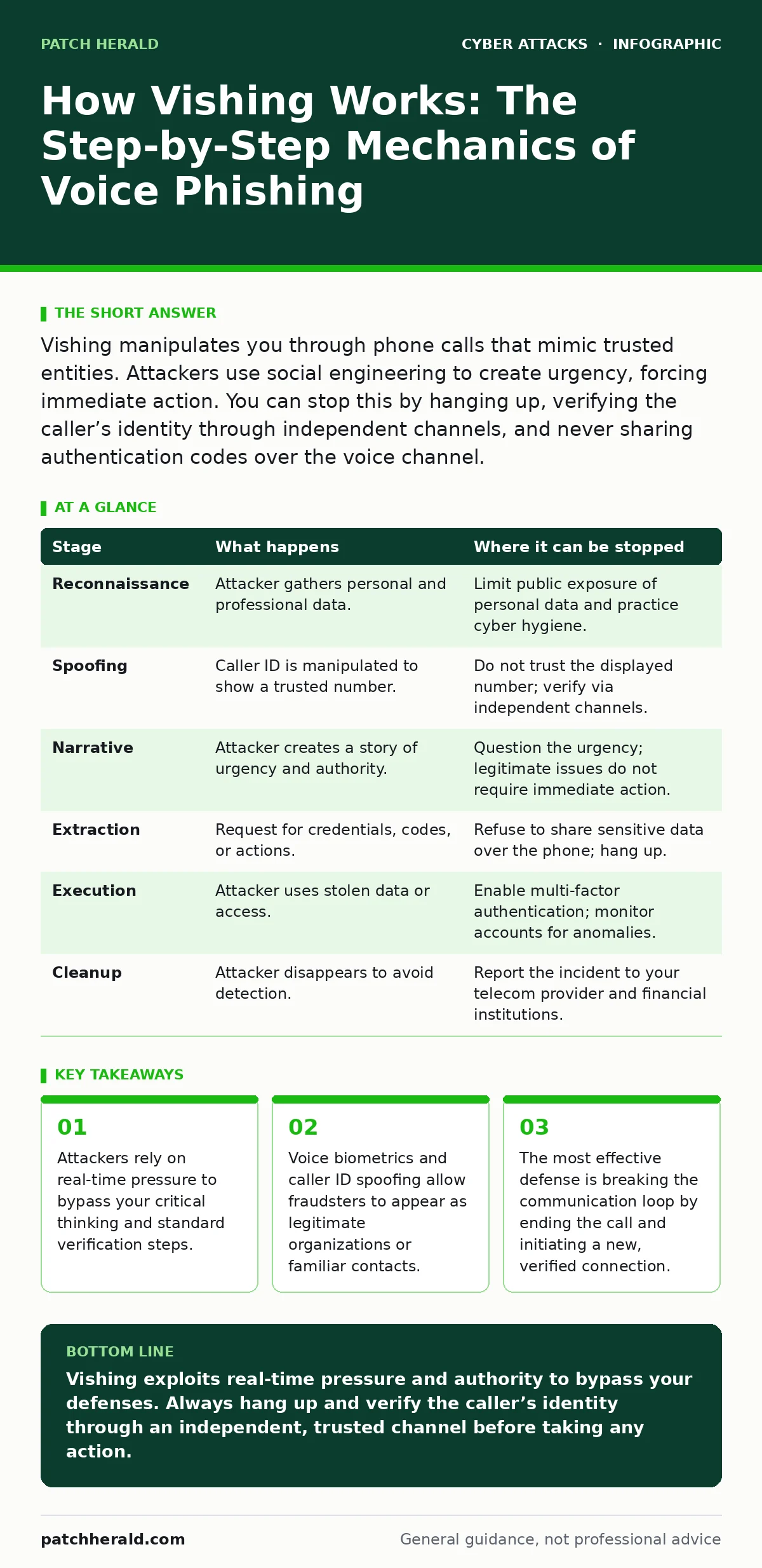
Vishing manipulates you through phone calls that mimic trusted entities. Attackers use social engineering to create urgency, forcing immediate action. You can stop this by hanging up, verifying the caller’s identity through independent channels, and never sharing authentication codes over the voice channel.
The Psychology of Urgency
Vishing, or voice phishing, is a social engineering attack conducted over telephone lines. Unlike email-based phishing, which allows time for reflection, voice attacks demand immediate engagement. The attacker relies on the human tendency to comply with perceived authority figures or urgent requests. This psychological pressure is the primary weapon, not technical exploitation.
The goal is to induce a state of anxiety or confusion. When you are stressed, your cognitive capacity for risk assessment decreases. The attacker exploits this window to extract sensitive information or coerce you into performing actions that compromise your security. Understanding this dynamic is the first step in recognizing the attack.
Stage 1: Reconnaissance and Target Selection
Before the first call is made, the attacker gathers information. They may use public records, social media profiles, or data from previous breaches to identify high-value targets. This stage is often silent and invisible to the victim. The attacker looks for individuals with access to financial systems, administrative privileges, or personal data.
They also determine the best time to call. Calling during busy work hours or personal stress periods increases the likelihood of a rushed response. This preparation ensures that when the call connects, the narrative is tailored to your specific context. Generic scripts are less effective than personalized ones. The attacker uses this data to build credibility and reduce suspicion.
Stage 2: Caller ID Spoofing
The attacker manipulates the signaling data sent to your phone to display a trusted number. This technique, known as caller ID spoofing, makes the call appear to originate from a bank, a government agency, or even a colleague. The displayed number is not the true source of the call. It is a mask designed to lower your defenses.
Many people trust calls from known numbers without verification. This trust is the flaw the attacker exploits. Even if the number looks correct, it can be forged. The technical infrastructure of the global telephone network allows for this manipulation. Recognizing that the displayed ID is not proof of identity is critical. You must verify the caller through a separate channel.
Stage 3: The Initial Contact and Narrative
The call begins with a scripted narrative designed to establish authority and urgency. The attacker may claim there is an issue with your account, a missed payment, or a legal notice. They use professional language and specific details gathered during reconnaissance to sound authentic. The tone is often calm but firm, implying that failure to act will have negative consequences.
This stage tests your reaction. If you show hesitation, the attacker may escalate the urgency. They might threaten account closure, legal action, or immediate financial loss. The narrative is crafted to make you feel that the caller is helping you resolve a problem. In reality, they are creating the problem to solve it on their terms. This dynamic shifts the power balance in their favor.
Stage 4: Information Extraction or Coercion
Once the narrative is established, the attacker moves to the objective. They may ask for verification codes, passwords, or personal identification numbers. Alternatively, they may instruct you to perform actions on your computer or phone. This could include downloading remote access software or transferring funds. The request is framed as a necessary step to resolve the alleged issue.
The attacker relies on the momentum created in the previous stages. You are already engaged and anxious. The request seems logical within the context of the story. However, legitimate organizations will never ask for full authentication credentials over the phone. They will not ask you to install software to verify your identity. This stage is where the actual compromise occurs. Resisting the pressure to provide information is the key defense.
See also: Dumpster Diving Mistakes That Expose Your Business Data · Malicious Bot Traffic: What It Is and How to Stop It
Stage 5: Execution and Exfiltration
If you comply, the attacker gains access to your accounts or data. They may use the information to make unauthorized transactions, steal identities, or pivot to other systems within your organization. The exfiltration is often immediate to minimize the chance of detection. The attacker may also set up persistent access points for future exploitation.
This stage is irreversible in many cases. Once credentials are shared, the attacker controls the account. The damage can spread quickly if the compromised account has broad permissions. The attacker may use the stolen data to target other contacts, expanding the scope of the attack. The speed of execution is designed to outpace your ability to react.
Stage 6: Cleanup and Disappearance
After achieving their goal, the attacker disconnects and disappears. They may delete call logs, change their spoofed numbers, or move to a new set of targets. This cleanup makes tracing the source difficult. The attacker relies on the chaos and confusion you are experiencing to avoid immediate countermeasures.
You may be left with a sense of relief if the attacker claimed to have resolved the issue. This false resolution is part of the manipulation. It prevents you from immediately checking your accounts or reporting the incident. The attacker counts on this delay to complete their objectives. Breaking this cycle requires independent verification of your account status.
| Stage | What happens | Where it can be stopped |
|---|---|---|
| Reconnaissance | Attacker gathers personal and professional data. | Limit public exposure of personal data and practice cyber hygiene. |
| Spoofing | Caller ID is manipulated to show a trusted number. | Do not trust the displayed number; verify via independent channels. |
| Narrative | Attacker creates a story of urgency and authority. | Question the urgency; legitimate issues do not require immediate action. |
| Extraction | Request for credentials, codes, or actions. | Refuse to share sensitive data over the phone; hang up. |
| Execution | Attacker uses stolen data or access. | Enable multi-factor authentication; monitor accounts for anomalies. |
| Cleanup | Attacker disappears to avoid detection. | Report the incident to your telecom provider and financial institutions. |
Interrupting the Attack Chain
Vishing can be interrupted at several points. The most effective interruption is ending the call before providing any information. This breaks the psychological hold the attacker has established. You regain control by disengaging from the pressured environment.
Verifying the caller’s identity through an independent channel is the next step. Use a known, trusted phone number or website to contact the organization. Do not use the number provided by the caller. This verification confirms whether the issue is real or fabricated. If the issue is real, you can resolve it securely. If it is fabricated, you have avoided the trap.
Implementing zero trust security principles helps mitigate the damage if an attack succeeds. This approach assumes no user or device is trusted by default. It limits the scope of what an attacker can do with stolen credentials. Regular training on social engineering tactics also prepares you to recognize these attacks.
Long-Term Defense Strategies
Defense against vishing is not just about reacting to calls. It involves building a culture of verification and skepticism. Employees and family members should be educated on the tactics used by attackers. Understanding the mechanics of the attack reduces its effectiveness.
Technical controls also play a role. Call screening tools can help identify suspicious calls, but they are not foolproof. Human judgment remains the primary defense. Regularly reviewing account statements and security settings helps detect any unauthorized activity early. Combining technical tools with human awareness creates a layered defense.
Remember that no single measure provides complete protection. The goal is to increase the difficulty and cost for the attacker. By understanding how vishing works, you can recognize the signs and respond appropriately. This knowledge is your strongest asset in the face of social engineering attacks.
Key takeaways
- Attackers rely on real-time pressure to bypass your critical thinking and standard verification steps.
- Voice biometrics and caller ID spoofing allow fraudsters to appear as legitimate organizations or familiar contacts.
- The most effective defense is breaking the communication loop by ending the call and initiating a new, verified connection.
Vishing exploits real-time pressure and authority to bypass your defenses. Always hang up and verify the caller’s identity through an independent, trusted channel before taking any action.
Frequently asked questions
Can vishing happen on VoIP calls?
Yes, vishing can occur on any voice communication channel, including VoIP, mobile phones, and landlines. The attack relies on social engineering, not the underlying technology.
How do I verify a caller’s identity?
Hang up and call the organization using a known, trusted phone number from their official website or your account statements. Do not use any number provided by the caller.
Is caller ID spoofing illegal?
In many jurisdictions, malicious caller ID spoofing is illegal. However, it is technically easy to perform, and enforcement varies. You cannot rely on the legality of the act for protection.
What should I do if I already shared information?
Immediately change your passwords, enable multi-factor authentication, and contact your financial institutions to freeze or monitor your accounts. Report the incident to your telecom provider and relevant authorities.
How this guide was produced: written by the Patch Herald editorial team with AI assistance, checked against the public references listed below, and reviewed when the facts change. See our editorial policy or report an error.