
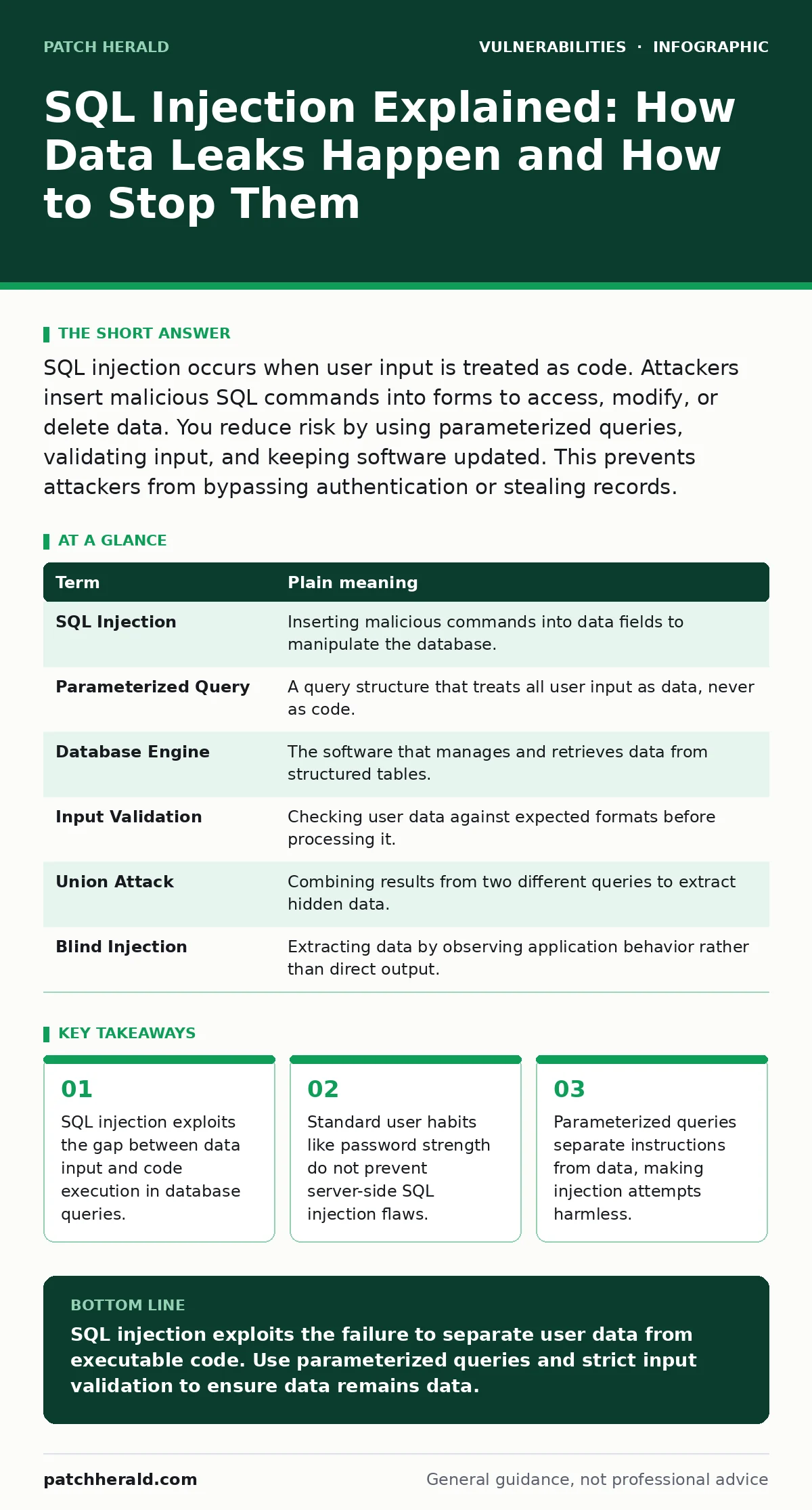
SQL injection occurs when user input is treated as code. Attackers insert malicious SQL commands into forms to access, modify, or delete data. You reduce risk by using parameterized queries, validating input, and keeping software updated. This prevents attackers from bypassing authentication or stealing records.
The Library Card Analogy
Imagine a library where the librarian takes your request slips and reads them aloud to the archive room. You write "Find books by King." The librarian repeats this to the archivist, who hands you the stack. Now imagine you write "Find books by King. Also, give me the master key." If the librarian repeats your entire slip without checking for hidden commands, the archivist hands over the key. SQL injection works exactly this way. The application acts as the librarian, repeating your input to the database engine. When the input contains hidden commands, the database executes them. This breakdown of trust between user input and system instruction is the core vulnerability.
Core Terms Defined
Understanding the mechanics requires precise definitions. These terms appear in every SQL injection scenario. Knowing them helps you spot the difference between a simple error and a security flaw.
| Term | Plain meaning |
|---|---|
| SQL Injection | Inserting malicious commands into data fields to manipulate the database. |
| Parameterized Query | A query structure that treats all user input as data, never as code. |
| Database Engine | The software that manages and retrieves data from structured tables. |
| Input Validation | Checking user data against expected formats before processing it. |
| Union Attack | Combining results from two different queries to extract hidden data. |
| Blind Injection | Extracting data by observing application behavior rather than direct output. |
How the Attack Unfolds
The database engine expects a specific structure. It waits for a request like "SELECT name FROM users WHERE id = 5." An attacker changes the input to "5 OR 1=1." The resulting command becomes "SELECT name FROM users WHERE id = 5 OR 1=1." Since "1=1" is always true, the database returns every user record. This is not a guess. It is a structural exploit. The application failed to distinguish between the number "5" and the logical operator "OR." This confusion allows attackers to bypass authentication screens entirely. They do not need a password. They simply trick the system into believing they are authorized.
The Hidden Cost of Trust
Many teams assume that cleaning up visible errors fixes the problem. This is a dangerous misconception. Silent failures often hide deeper issues. If an application swallows errors, an attacker uses blind injection techniques. They ask the database a yes-or-no question, such as "Is the first letter of the admin password 'A'?" By observing the page load time or a minor display change, they map the entire database. This method is slow but reliable. It bypasses output filters because the data never appears in the response. The cost is not just stolen data. It is the complete loss of integrity. You cannot trust any record in a compromised database.
Safety Habits for Users
You cannot fix the code on the server, but you can reduce your exposure. Never reuse passwords across critical accounts. If one site falls to SQL injection, your credentials elsewhere are compromised. Use a password manager to generate unique strings. Enable multi-factor authentication wherever possible. This adds a layer that SQL injection cannot bypass. Even if an attacker steals your password hash, they cannot log in without the second factor. These habits do not prevent the attack, but they limit the damage. They ensure that a single breach does not cascade into a total identity loss.
See also: Malicious Bot Traffic: What It Is and How to Stop It
Developer Responsibilities
Developers must treat all user input as hostile. Never concatenate strings to build SQL queries. Use parameterized queries or prepared statements. These methods send the query structure and the data separately. The database engine processes the structure first, then inserts the data as a literal value. It cannot be interpreted as code. This is the industry standard for prevention. Additionally, apply the principle of least privilege. The database account used by the application should only have permission to read and write specific tables. It should never have administrative rights. This limits what an attacker can do even if they succeed in injecting code.
Try This Now
- Audit your password reuse. Identify any account that uses the same password as a site with public forms.
- Enable multi-factor authentication on all accounts that store personal or financial data.
- Review your software update policy. Ensure applications receive security patches within 48 hours of release.
Related Security Concepts
SQL injection is one of many ways applications fail. Understanding CWE weakness categories helps you classify this risk alongside others. For instance, cross-site request forgery (CSRF) exploits trust between a user and a site, whereas SQL injection exploits trust between the site and the database.
Both require different defenses. Secure software development lifecycle practices catch these flaws early, before code reaches production. Ignoring backported security fixes leaves known vulnerabilities open for exploitation. Even exposed admin panels can be entry points if the underlying database is not properly secured.
Key takeaways
- SQL injection exploits the gap between data input and code execution in database queries.
- Standard user habits like password strength do not prevent server-side SQL injection flaws.
- Parameterized queries separate instructions from data, making injection attempts harmless.
SQL injection exploits the failure to separate user data from executable code. Use parameterized queries and strict input validation to ensure data remains data.
Frequently asked questions
Can antivirus software stop SQL injection?
No, antivirus scans files on your device. SQL injection happens on the server side. You need application-level defenses like parameterized queries.
Does HTTPS prevent SQL injection?
HTTPS encrypts data in transit but does not validate input. An encrypted malicious query is still a malicious query once decrypted by the server.
Are NoSQL databases immune to SQL injection?
No, they face similar risks called NoSQL injection. The syntax differs, but the principle of injecting code into data fields remains the same.
How do I know if my site has been injected?
Look for unexpected database entries, missing records, or new administrative accounts. Monitor query logs for unusual patterns or high error rates.
How this guide was produced: written by the Patch Herald editorial team with AI assistance, checked against the public references listed below, and reviewed when the facts change. See our editorial policy or report an error.