
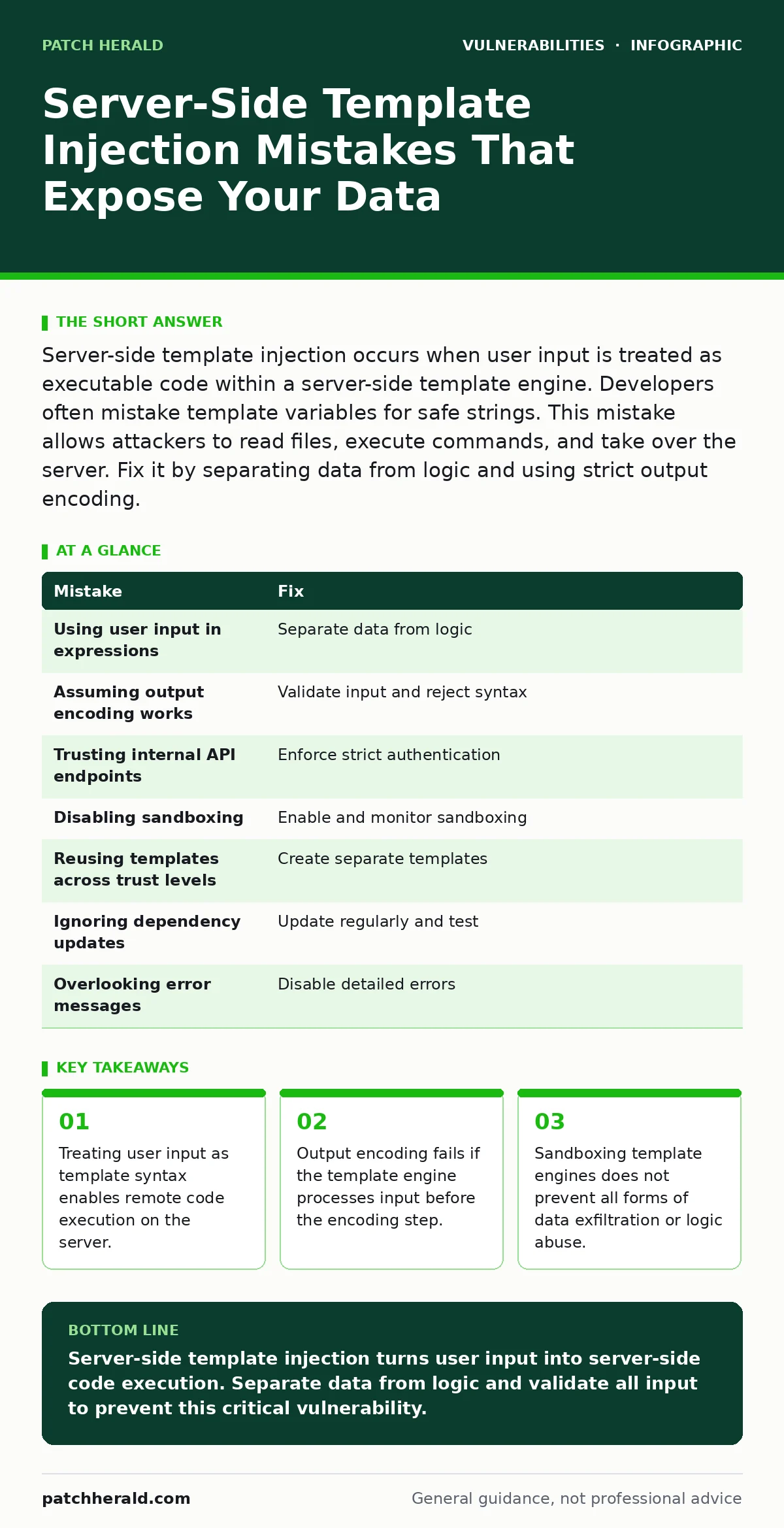
Server-side template injection occurs when user input is treated as executable code within a server-side template engine. Developers often mistake template variables for safe strings. This mistake allows attackers to read files, execute commands, and take over the server. Fix it by separating data from logic and using strict output encoding.
Mistake 1: Using User Input Directly in Template Expressions
Template engines allow developers to embed logic within HTML or text. When you insert raw user input into these expressions, the engine evaluates the input as code. This evaluation happens on the server before any output is sent to the browser. The attacker controls the syntax that the server executes.
Why it hurts:
The server executes arbitrary code defined by the attacker. This bypasses standard web application firewalls because the payload looks like valid template syntax. The attacker can read sensitive files, modify database records, or install backdoors. The damage occurs before the response reaches the user’s browser.
The fix:
Separate data from logic completely. Never concatenate user input into template expressions. Use dedicated data-binding mechanisms that treat input as plain text. Verify that the template engine does not evaluate variables passed from untrusted sources. This approach ensures the server processes structure, not user-defined logic.
Mistake 2: Assuming Output Encoding Prevents Code Execution
Many developers rely on HTML encoding to prevent cross-site scripting. They assume that escaping special characters stops injection attacks. This assumption fails with server-side template injection. The template engine processes the code before the HTML encoder runs. The server executes the malicious template logic first.
Why it hurts:
Encoding protects the client, not the server. The attacker’s code runs on the backend infrastructure. The server may crash, leak data, or perform unauthorized actions. The encoded output is irrelevant because the harm has already occurred. You lose visibility into what the server actually executed.
The fix:
Do not rely on output encoding for security. Implement input validation that rejects template syntax characters. Use a strict allowlist for acceptable input formats. Ensure the template engine is configured to reject complex expressions. This defense-in-depth strategy protects the server logic itself.
Mistake 3: Trusting Internal API Endpoints for Template Rendering
Some applications use internal APIs to render templates for email notifications or reports. Developers often skip authentication for these internal calls. They assume only trusted services will invoke the rendering endpoint. Attackers can discover these endpoints through directory traversal or error messages.
Why it hurts:
An attacker can send crafted requests to the internal rendering service. The service executes the malicious template with the application’s privileges. This grants the attacker access to internal resources. The breach originates from a trusted internal path, making detection difficult.
The fix:
Enforce strict authentication and authorization on all rendering endpoints. Treat internal APIs as external-facing interfaces. Validate the source of every rendering request. Use service-to-service authentication tokens. This ensures that only authorized components can trigger template execution.
Mistake 4: Disabling Sandboxing in Production Environments
Template engines often include sandboxing features to restrict access. Developers disable these features to improve performance or simplify debugging. They assume the application logic prevents dangerous operations. This creates a false sense of security. The sandbox is the last line of defense against malicious input.
Why it hurts:
Without sandboxing, the attacker can access the file system, network, and environment variables. The application runs with the permissions of the server process. A single injection flaw becomes a full system compromise. The attacker can pivot to other systems on the network.
The fix:
Enable sandboxing in all production environments. Configure the sandbox to restrict file and network access. Monitor sandbox violations closely. Treat any violation as a security incident. This limits the impact of a successful injection to the template engine’s isolated context.
Mistake 5: Reusing Templates Across Different Trust Levels
Developers often reuse template files for both internal and external content. They assume the context of use determines safety. This practice ignores the data source. If an external user can influence the data passed to an internal template, the injection risk remains. The template structure does not change based on the user’s trust level.
Why it hurts:
The attacker exploits the shared template logic. The server processes external input through an internal template. This bypasses context-specific security controls. The application treats untrusted data as trusted because of the template’s origin. The breach leverages the application’s own reusability patterns.
The fix:
Create separate templates for different trust levels. Never share template logic between trusted and untrusted data paths. Validate data at the boundary of each trust level. Enforce strict type checking before rendering. This separation ensures that untrusted input never reaches sensitive template logic.
See also: Malicious Bot Traffic: What It Is and How to Stop It
Mistake 6: Ignoring Dependency Updates for Template Engines
Template engines evolve to fix security flaws. Developers often pin versions to avoid breaking changes. They ignore updates that address injection vulnerabilities. This practice leaves the application exposed to known exploits. The template engine’s code executes on the server, making updates critical.
Why it hurts:
Known vulnerabilities remain exploitable indefinitely. Attackers scan for outdated template engine versions. They exploit published proof-of-concept code. The application becomes a low-hanging fruit for automated attacks. The delay in updating increases the window of exposure.
The fix:
Maintain a regular update cycle for all dependencies. Test updates in a staging environment before deployment. Monitor security advisories for template engine vendors. Apply patches promptly. This reduces the risk of exploitation from known vulnerabilities. See how managing dependency confusion attacks can further secure your supply chain.
Mistake 7: Overlooking Error Messages in Template Rendering
Template engines generate detailed error messages when they encounter syntax errors. Developers leave these messages enabled in production. They assume the errors are harmless. Attackers use these messages to map the template engine’s capabilities. The errors reveal the engine’s version and configuration.
Why it hurts:
The attacker learns the exact template syntax supported by the server. They craft precise payloads that bypass simple filters. The error messages provide feedback on what works and what fails. This accelerates the attack process. The application leaks internal architecture details.
The fix:
Disable detailed error messages in production. Log errors internally without exposing them to the user. Use generic error responses for template failures. Monitor logs for unusual template errors. This prevents attackers from using error feedback to refine their attacks. Consider how SQL injection prevention also relies on obscuring database error details.
| Mistake | Fix |
|---|---|
| Using user input in expressions | Separate data from logic |
| Assuming output encoding works | Validate input and reject syntax |
| Trusting internal API endpoints | Enforce strict authentication |
| Disabling sandboxing | Enable and monitor sandboxing |
| Reusing templates across trust levels | Create separate templates |
| Ignoring dependency updates | Update regularly and test |
| Overlooking error messages | Disable detailed errors |
Key takeaways
- Treating user input as template syntax enables remote code execution on the server.
- Output encoding fails if the template engine processes input before the encoding step.
- Sandboxing template engines does not prevent all forms of data exfiltration or logic abuse.
Server-side template injection turns user input into server-side code execution. Separate data from logic and validate all input to prevent this critical vulnerability.
Frequently asked questions
How does server-side template injection differ from cross-site scripting?
Cross-site scripting executes code in the user’s browser. Server-side template injection executes code on the server. The latter has broader system access and higher impact.
Can a web application firewall stop server-side template injection?
Web application firewalls may miss these attacks. The payloads often look like valid template syntax. Firewalls struggle to distinguish between legitimate and malicious template logic.
Should I disable template engines in my application?
Template engines are useful for rendering dynamic content. Do not disable them unless necessary. Instead, secure them by separating data from logic and enforcing strict input validation.
How do I test for server-side template injection?
Use automated security scanning tools that detect template injection patterns. Perform manual testing by injecting template syntax into input fields. Monitor server logs for unusual template execution errors.
How this guide was produced: written by the Patch Herald editorial team with AI assistance, checked against the public references listed below, and reviewed when the facts change. See our editorial policy or report an error.