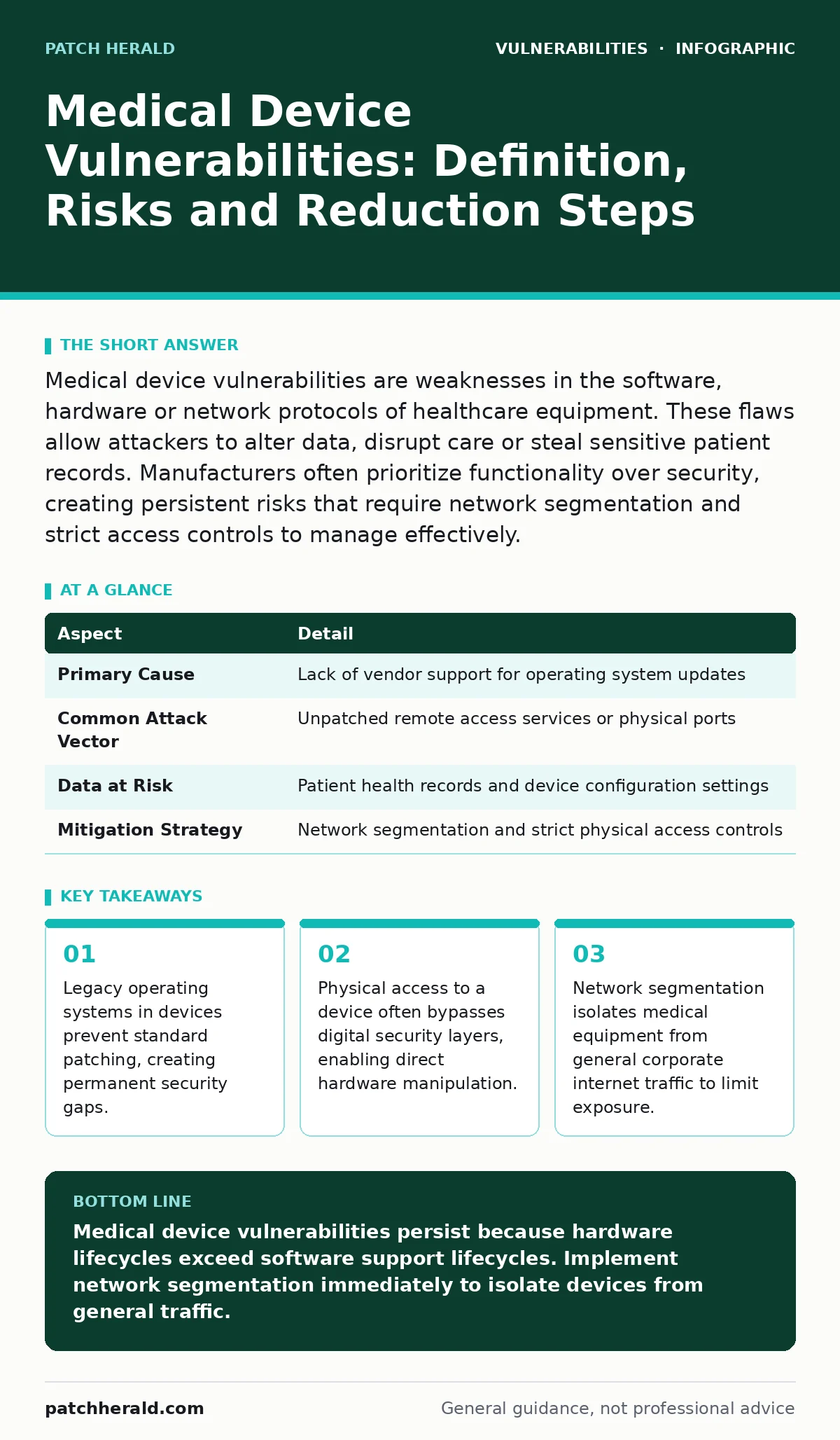
Medical device vulnerabilities are weaknesses in the software, hardware or network protocols of healthcare equipment. These flaws allow attackers to alter data, disrupt care or steal sensitive patient records. Manufacturers often prioritize functionality over security, creating persistent risks that require network segmentation and strict access controls to manage effectively.
What Medical Device Vulnerabilities Actually Are
Medical device vulnerabilities are specific weaknesses in the software, firmware or network configuration of healthcare equipment. Unlike standard office computers, these devices often run embedded systems designed for reliability rather than security. The weakness exists when the device accepts input it was not designed to handle or fails to verify the identity of a connecting user.
These vulnerabilities turn a life-saving tool into a potential entry point for attackers. The device may broadcast diagnostic data over an unencrypted network. It may allow remote code execution through an open port. The result is not just a data leak but a threat to physical safety.
| Aspect | Detail |
|---|---|
| Primary Cause | Lack of vendor support for operating system updates |
| Common Attack Vector | Unpatched remote access services or physical ports |
| Data at Risk | Patient health records and device configuration settings |
| Mitigation Strategy | Network segmentation and strict physical access controls |
How These Weaknesses Enter the System
Vulnerabilities enter the system through design choices made years before deployment. Manufacturers often embed general-purpose operating systems into imaging machines or infusion pumps. These operating systems contain known flaws that standard software updates would fix. However, the medical device certification process is slow and costly.
Updating the firmware requires re-certification by regulatory bodies. This creates a disincentive for vendors to release patches. Consequently, the device runs with known holes for decades. Attackers exploit these static weaknesses because the target environment rarely changes. The lack of change makes the attack surface predictable and stable.
Who Faces the Greatest Risk
Clinics and hospitals face the most direct risk because they host the physical devices. Small practices often lack dedicated security teams to monitor network traffic. They rely on default configurations that assume the device is secure by default. This assumption fails against automated scanning tools that look for open ports.
Patients face the risk of data exposure and care disruption. Their health records contain sensitive information that criminals sell on dark markets. More dangerously, an attacker could alter the dosage settings on an infusion pump. The patient suffers the physical consequence of the digital intrusion. The trust in medical technology erodes when safety is compromised.
Staff members face operational pressure during an incident. When a device is isolated due to a suspected breach, clinical workflows halt. Technicians must manually perform tasks that the device usually automates. This increases human error and delays critical care decisions. The burden falls on the clinical staff to maintain safety under duress.
Common Forms of Device Weaknesses
Many vulnerabilities stem from weak authentication mechanisms. Devices often use default passwords that are printed on the hardware or in the manual. Attackers use these known credentials to gain administrative access. Once inside, they can install malicious software or exfiltrate data. This form of weakness is similar to exposed admin panels in web applications.
Another common form is the use of insecure communication protocols. Older devices transmit data in plain text across the network. Any device on the same network segment can read this traffic. Modern networks use encryption to protect data in transit. Legacy medical equipment often lacks the processing power to support strong encryption standards.
Hardcoded credentials in the firmware represent a deeper flaw. Developers embed passwords directly into the device code to simplify setup. These credentials cannot be changed by the user. Even if the administrator changes the login screen password, the backdoor remains. This is akin to prototype pollution in web applications, where the core logic is compromised.
What People Usually Get Wrong
Many organizations believe that air-gapping provides complete protection. An air gap means the device is not connected to any network. However, attackers can use USB drives or Bluetooth connections to bridge the gap. Physical access to the device allows an attacker to install keyloggers or modify firmware directly. Isolation reduces risk but does not eliminate it.
Another misconception is that vendor support ends when the device is installed. Many assume the manufacturer will push automatic updates like a smartphone. Medical devices rarely support over-the-air updates. The update process often requires manual intervention and downtime. This creates a false sense of security if the staff does not actively manage patches.
Some teams focus only on digital defenses and ignore physical security. They encrypt data but leave the device in an unlocked room. An attacker with physical access can reset the device to factory defaults. This bypasses all digital security measures. Physical security is the first line of defense for embedded systems.
See also: Home Router Security: Hardening Your Network Edge
How to Reduce the Risk Effectively
Network segmentation is the most effective technical control. Place medical devices on a separate virtual local area network. This prevents lateral movement from a compromised office computer to the medical device. Use firewalls to restrict traffic to only the necessary ports and protocols. This mirrors the strategy used in external attack surface scanning to identify and limit exposure.
Implement strict access controls for physical and digital access. Lock server rooms and device cabinets. Require multi-factor authentication for administrative accounts. Limit the number of people who can configure the device. Regular audits should verify that no unauthorized devices are connected to the medical network.
Monitor network traffic for anomalies. Look for unusual data transfers or connections to unknown external addresses. This helps detect breaches early. Since you cannot always patch the device, you must detect when someone is exploiting the known vulnerabilities. This approach complements understanding server-side template injection risks in web applications, where input validation is key.
Long-Term Security Strategies
Plan for hardware replacement before the end of life. When a vendor stops providing security fixes, the device becomes a liability. Budget for upgrades that include modern security features. Do not keep running unsupported equipment just to save costs. The risk of a breach outweighs the cost of replacement.
Work with vendors to include security requirements in contracts. Demand that new devices support modern encryption and authentication standards. Require a clear process for reporting vulnerabilities. This shifts some responsibility back to the manufacturer. It also ensures you have visibility into the security posture of your equipment.
Regularly train staff on security hygiene. Teach them to recognize phishing attempts that target medical professionals. Train them to report unusual device behavior. Human error is often the weakest link in the security chain. Education reinforces the technical controls you have implemented. This holistic approach mirrors the need to understand cross-site request forgery (CSRF) protections in web design.
Key takeaways
- Legacy operating systems in devices prevent standard patching, creating permanent security gaps.
- Physical access to a device often bypasses digital security layers, enabling direct hardware manipulation.
- Network segmentation isolates medical equipment from general corporate internet traffic to limit exposure.
Medical device vulnerabilities persist because hardware lifecycles exceed software support lifecycles. Implement network segmentation immediately to isolate devices from general traffic.
Frequently asked questions
Can medical devices be patched like regular computers?
Most medical devices cannot receive automatic updates. Patching often requires manual firmware installation and regulatory re-certification, which vendors avoid.
Does turning off Wi-Fi make the device safe?
Disabling Wi-Fi reduces remote attack vectors but does not protect against physical access or attacks via wired network connections.
How do I know if my device has known vulnerabilities?
Check the manufacturer's security advisories and use vulnerability databases. Compare the device firmware version against known flaw lists.
Is encryption enough to protect patient data on devices?
Encryption protects data at rest and in transit but does not prevent attackers from exploiting software flaws to disrupt device function or steal keys.
How this guide was produced: written by the Patch Herald editorial team with AI assistance, checked against the public references listed below, and reviewed when the facts change. See our editorial policy or report an error.