
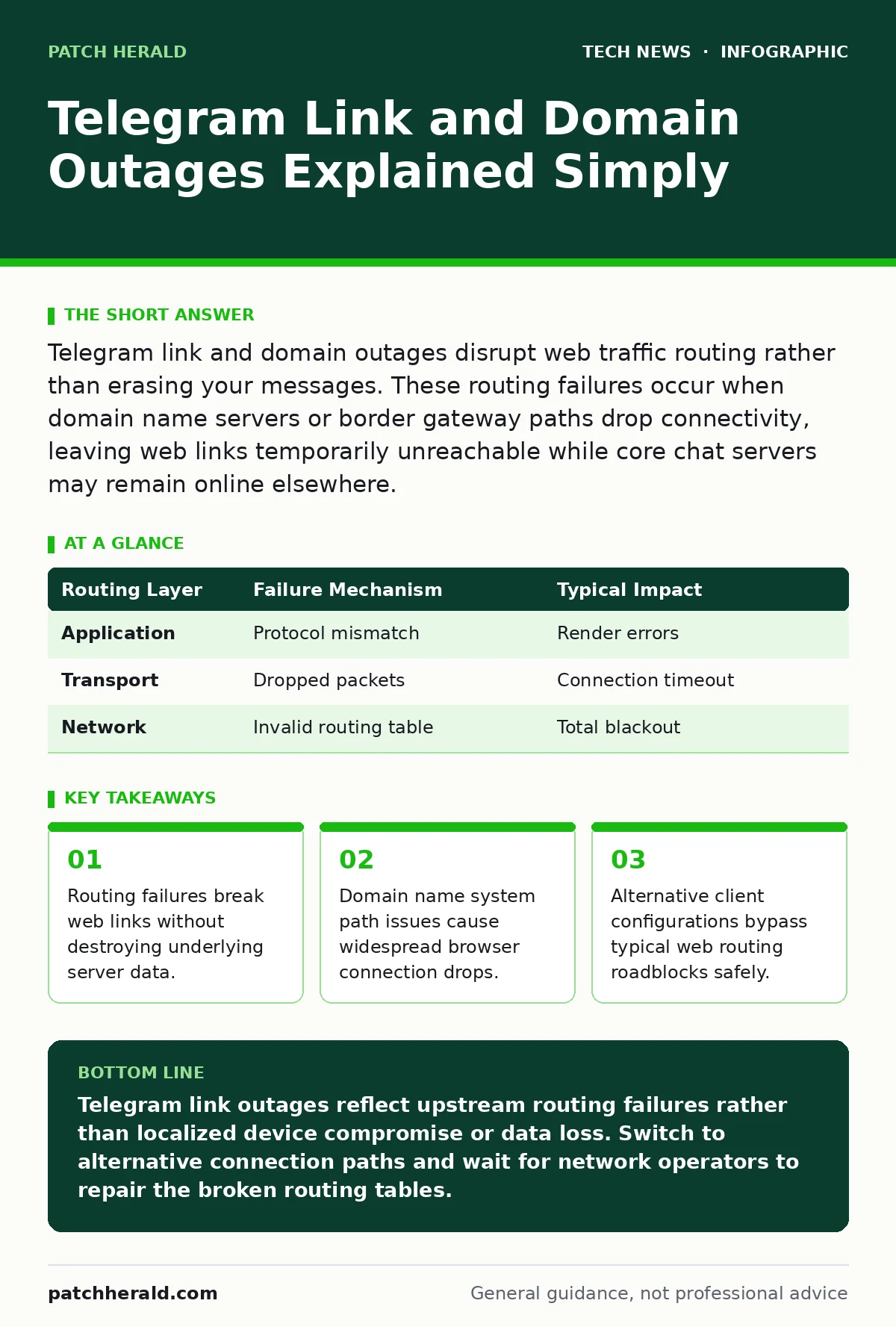
Telegram link and domain outages disrupt web traffic routing rather than erasing your messages. These routing failures occur when domain name servers or border gateway paths drop connectivity, leaving web links temporarily unreachable while core chat servers may remain online elsewhere.
Why do Telegram links suddenly stop working in web browsers?
Telegram links stop working in web browsers because upstream routing paths or regional internet service providers drop packets destined for specific web addresses. Web browsers rely on continuous connection streams to render external pages. Network partitions sever these connection streams instantly. 3 distinct layers control how a browser reaches an online destination.
Network engineers classify these layers into application protocols, transport mechanisms, and physical cabling. Link failures usually happen at the transport layer where routers manage packet delivery. Traffic drops leave users staring at blank error screens while local hardware functions normally.
How do domain name system routing failures affect messaging platforms?
Domain name system routing failures affect messaging platforms by cutting off the translation service that turns human-readable web addresses into numeric internet protocol addresses. 4 separate root servers and regional resolvers handle these translation queries. Resolver caches often hold stale data during an outage.
Clients cannot locate the correct server endpoints when resolver tables fail to update. Service providers manage these translation records across distributed database clusters. Database synchronization errors frequently trigger widespread lookup failures across multiple regions simultaneously.
What causes border gateway protocol paths to drop external traffic?
Border gateway protocol paths drop external traffic when autonomous systems announce incorrect route configurations or experience hardware failures along major internet transit corridors. Autonomous systems represent large networks operated by major telecommunication carriers. Misconfigurations spread rapidly across global routing tables before network operators can intervene.
Routing tables store the optimal paths for data packets moving between networks. Erroneous announcements force traffic into dead ends. Network operators rely on automated filters to catch these routing anomalies, but propagation delays still cause temporary access blackouts.
| Routing Layer | Failure Mechanism | Typical Impact |
|---|---|---|
| Application | Protocol mismatch | Render errors |
| Transport | Dropped packets | Connection timeout |
| Network | Invalid routing table | Total blackout |
Can mobile device security settings protect against broken routing paths?
Mobile device security controls cannot protect against broken routing paths because local hardware settings have no influence over remote internet service provider routing tables. Device security focuses on local application integrity and data encryption. Remote routing failures occur miles away from your handheld hardware.
Applications on your phone depend on functional external networks to fetch remote data payloads. Local defenses stop malicious code execution rather than repairing broken telecommunication links. Understanding this limitation prevents wasted effort spent tweaking local configuration menus.
How do certificate authorities influence link availability during network drops?
Certificate authorities influence link availability during network drops by requiring valid cryptographic validation checks before a browser establishes a secure connection. Cryptographic validation checks verify server identity using public key infrastructure. Outages sometimes block validation servers, halting connection attempts entirely.
Browsers refuse to load pages when they cannot verify security certificates in real time. Security protocols prioritize connection safety over accessibility during validation timeouts. This strict enforcement prevents interception attacks but increases downtime during minor network hiccups.
See also: Do you need website security and how does it protect visitors · Why Is Network Address Translation Important for Small Networks
What hidden costs emerge when relying on single cloud routing providers?
Single cloud routing providers create hidden costs through cascading operational delays and lost customer engagement when infrastructure dependencies fail simultaneously. Operational dependencies lock organizations into rigid traffic paths. Organizations suffer downtime because alternative routing paths require manual intervention.
Engineering teams spend valuable hours troubleshooting external infrastructure rather than building core products. Financial losses accumulate rapidly during prolonged outages. Redundant infrastructure design mitigates these risks but demands significant upfront investment.
How does network access control interact with external link failures?
Network access control interacts with external link failures by blocking local corporate traffic when internal security policies misinterpret public routing drops as unauthorized intrusion attempts. Internal security policies enforce strict boundary rules. False positive security triggers lock users out of local networks.
Security appliances monitor connection attempts for anomalous behavior during network instability. Automated containment rules isolate affected workstations to prevent potential lateral movement. Administrators must manually review security logs to restore normal corporate network operations.
What steps restore access when official web domains go offline?
Official web domains go offline and require alternative connection strategies, such as switching to secondary cellular networks or utilizing open-source software security tools designed for independent routing. 3 recovery actions help bypass regional routing drops safely. Independent routing tools maintain direct messaging connections.
Users should verify status dashboards before changing local network configurations. Changing connection methods often restores communication channels instantly. Patience remains a practical asset while global network operators repair damaged routing tables.
Key takeaways
- Routing failures break web links without destroying underlying server data.
- Domain name system path issues cause widespread browser connection drops.
- Alternative client configurations bypass typical web routing roadblocks safely.
Telegram link outages reflect upstream routing failures rather than localized device compromise or data loss. Switch to alternative connection paths and wait for network operators to repair the broken routing tables.
Frequently asked questions
Are my personal chat messages deleted during a domain outage?
Personal chat messages remain safely stored on remote servers during a domain outage because link failures only disrupt the routing paths used to access those servers.
Why do some users experience outages while others maintain access?
Regional internet service providers use different routing paths and domain name system resolvers, meaning an outage can isolate one geographic area while leaving another fully connected.
Can virtual private networks bypass Telegram domain blocks?
Virtual private networks route your web traffic through alternative remote servers, which frequently bypasses local routing blocks and restores access to offline domains.
How long do typical domain routing outages last?
Most routing outages resolve within a few hours as network engineers correct faulty table announcements and restore normal telecommunication traffic flows.
How this guide was produced: written by the Patch Herald editorial team with AI assistance, checked against the public references listed below, and reviewed when the facts change. See our editorial policy or report an error.