
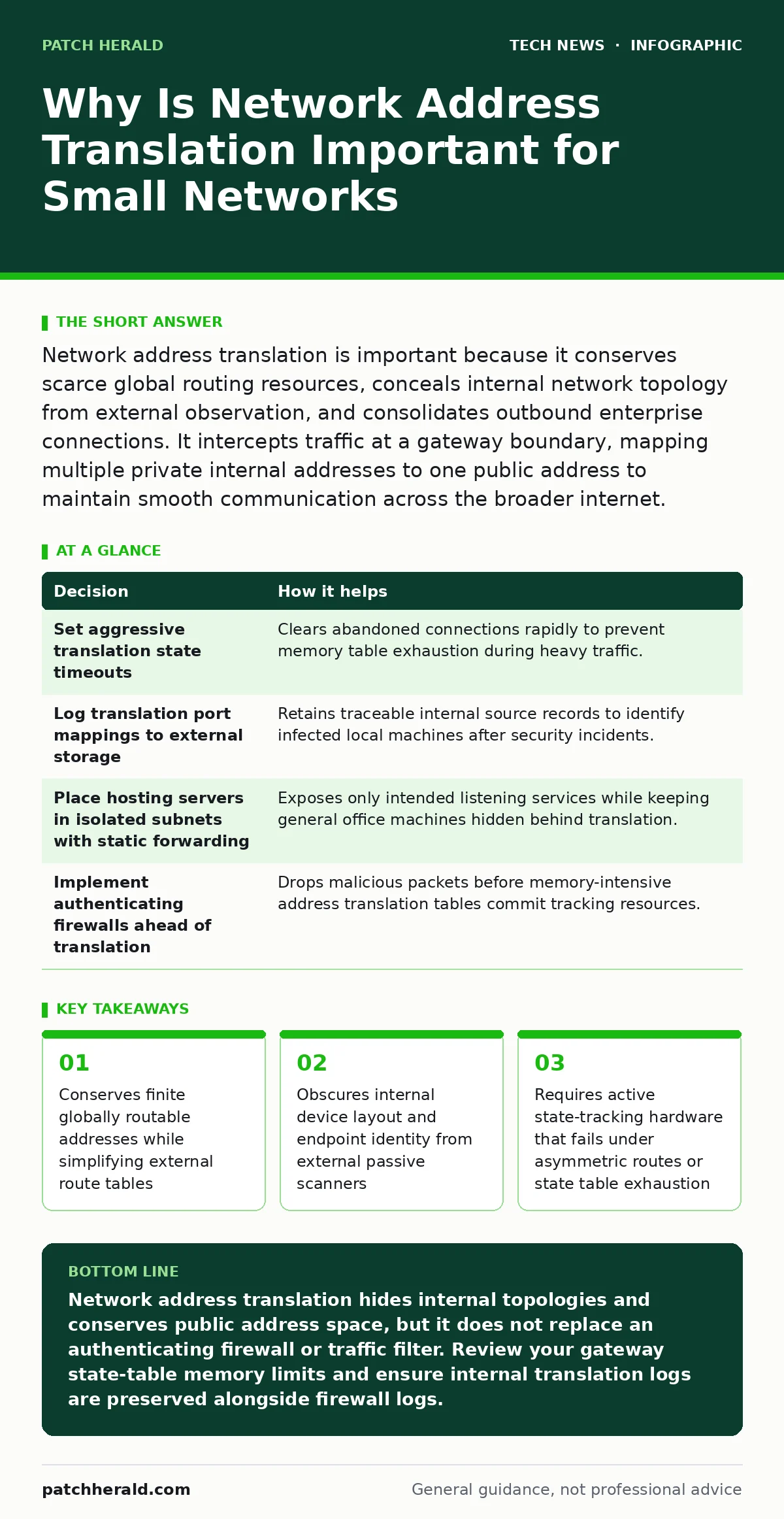
Network address translation is important because it conserves scarce global routing resources, conceals internal network topology from external observation, and consolidates outbound enterprise connections. It intercepts traffic at a gateway boundary, mapping multiple private internal addresses to one public address to maintain smooth communication across the broader internet.
How Address Translation Operates at the Gateway
Network address translation (NAT) is a networking method that alters IP address information in packet headers while transit across a routing device occurs. An IP address functions as a unique numeric identifier for any device on a computer network. When a local workstation initiates a request, the gateway router intercepts those outbound data packets. The router records the source device details, substitutes a globally visible public address into the packet header, assigns an arbitrary translation port, and forwards the data onward.
Packets returning from external destinations carry that assigned port number back to the gateway. Inspection engines consult a dynamic translation memory table, match the return packet to the original sender, rewrite the destination field back to the local address, and dispatch it across internal cabling. Routers discard any incoming traffic that lacks an existing match in the dynamic state table.
Why Is Network Address Translation Important for Organizations?
Network address translation is important because it reconciles internal connectivity needs with global internet scale. The reasons for operating this translation layer rank in clear order of practical weight:
- Preservation of the global routing table: Internet backbone routers cannot sustain routing tables containing hundreds of billions of individual office devices. Translation condenses hundreds of local endpoint routes behind one external routing entry.
- Inbound direct connection mitigation: External actors cannot initiate direct, unsolicited transmission control protocol (TCP) handshakes to private endpoints, because external routers have no path to deliver packets to private blocks.
- Decoupling internal numbering from external providers: Private local addressing remains stable. You can switch upstream internet service carriers without renumbering internal devices or reconfiguring server assignments.
- Conservation of public address space: Multiple internal nodes share a single routable identifier, preventing network expansion from halting due to address exhaustion.
Local systems using translation rely on designated private address spaces defined by standards bodies. These private networks communicate externally only because the intermediate gateway handles public identity representation.
What Goes Wrong Without Address Translation
Direct assignment of publicly routable addresses to every workplace computer creates severe structural liabilities. Without a translation boundary, every network adapter exposes its direct layer-three identifier across every public data exchange. Malicious automated network sweeps detect the operating systems, open sockets, and unpatched internal tools running on workstations immediately.
Loss of this abstraction layer also complicates ordinary enterprise maintenance. If an internet provider reallocates your public subnets, administrators must manually renumber every static printer, office desktop, and internal management board. The publication covers complementary endpoint hardening steps in operating system hardening, which remains necessary whether translation exists or not.
Inter-office operational flexibility also degrades without translation. When 2 organizations merge networks that happen to use duplicate internal address ranges, routing fails entirely. Translation engines solve this overlap by performing bidirectional address rewriting at the interconnecting border.
The Hidden Operational Costs of Address Translation
Translation engines introduce distinct technical drawbacks that many operators fail to anticipate during capacity planning. The gateway must allocate memory to track every active network connection in a state table. If internal computers establish thousands of concurrent outbound sessions, the translation table fills to capacity. Once the state table fills, the router silently drops all subsequent connection attempts from any device on the network.
Voice over IP, peer-to-peer file transfer, and streaming protocols embed raw layer-three IP addresses directly inside the application payload rather than just the network packet header. Standard translation engines modify the header but miss the internal payload data, causing one-way audio or dropped calls. Addressing this failure requires complex protocol inspection software on the router, which increases processing latency and hardware load.
Security monitoring also suffers internal visibility loss downstream. Upstream security devices, web filtering services, and external application logs only see the single public gateway address. Determining which specific employee workstation initiated a abusive or infected request requires cross-referencing external server logs against internal translation history records down to the exact second.
How Translation Relates to Border Defense and Wireless Access
Translation works alongside edge firewalls, but its protective effect remains strictly indirect. A true firewall examines packet headers, application flags, and state flags against an explicit security policy list. Translation simply drops unmapped traffic because the router has no delivery instructions for that traffic in its current memory table.
Direct network access controls require dedicated defense mechanisms. Office Wi-Fi security frameworks like WPA3 encrypt airwave communications and authenticate clients before any local address assignment occurs. Translation only governs what happens once those authenticated packets attempt to traverse the gateway toward external public systems.
Network architecture demands explicit management decisions at every boundary. Use the following decision matrix to balance translation controls with active security layers:
| Decision | How it helps |
|---|---|
| Set aggressive translation state timeouts | Clears abandoned connections rapidly to prevent memory table exhaustion during heavy traffic. |
| Log translation port mappings to external storage | Retains traceable internal source records to identify infected local machines after security incidents. |
| Place hosting servers in isolated subnets with static forwarding | Exposes only intended listening services while keeping general office machines hidden behind translation. |
| Implement authenticating firewalls ahead of translation | Drops malicious packets before memory-intensive address translation tables commit tracking resources. |
Internal services also rely heavily on name mapping through the Domain Name System to bridge these private boundaries gracefully. Internal domain lookups allow workers to find private business resources without publishing proprietary network architectures to the public internet.
See also: Zero Trust Mistakes That Break Security and How to Fix Them · Remote Desktop Security Mistakes: Fix These 7 Common Errors
Actionable Steps for Managing Translation Boundaries
Auditing translation gateways prevents network failure and maintains clear security boundaries throughout company growth:
- Check gateway memory utilization to verify translation state tables operate below operational capacity limits.
- Configure local network adapters to pull addresses exclusively from private address standards blocks.
- Separate internal workstation subnets from publicly accessible server subnets using dedicated routing interfaces.
- Align gateway clock settings using network time synchronization so translation logs match endpoint event logs.
- Disable universal plug-and-play features on edge routers to stop unauthorized local software from opening inbound public ports.
- Review external-facing service configurations to confirm private endpoints do not leak their local addresses inside cleartext application headers.
Applying these maintenance routines protects gateway stability. Consistent operational maintenance keeps border routing fast, stable, and resilient against unexpected spikes in enterprise traffic volume.
Key takeaways
- Conserves finite globally routable addresses while simplifying external route tables
- Obscures internal device layout and endpoint identity from external passive scanners
- Requires active state-tracking hardware that fails under asymmetric routes or state table exhaustion
Network address translation hides internal topologies and conserves public address space, but it does not replace an authenticating firewall or traffic filter. Review your gateway state-table memory limits and ensure internal translation logs are preserved alongside firewall logs.
Frequently asked questions
Does network address translation replace an office firewall?
No, address translation does not replace a firewall. Translation drops unsolicited inbound traffic merely because it lacks a table entry, but it fails to inspect packet contents, block malicious URLs, or stop malicious software running over approved outbound ports.
What is the main difference between static NAT and dynamic NAT?
Static translation permanently maps one private address to one dedicated public address for hosting accessible servers. Dynamic translation shares a single public address across numerous internal devices by altering and tracking port numbers dynamically.
Why do voice and video calls sometimes fail across translation gateways?
Voice protocols often transmit the sender's local private address inside the message payload itself rather than only in the packet header. Because the gateway changes only the outer header, the receiving party attempts to send return audio back to an unroutable private address.
Does IPv6 eliminate the need for network address translation?
IPv6 provides enough public addresses to eliminate the mathematical necessity of translation for conservation purposes. Many organizations still deploy stateful firewalls at IPv6 borders to hide internal network arrangements and drop unsolicited incoming connections.
How this guide was produced: written by the Patch Herald editorial team with AI assistance, checked against the public references listed below, and reviewed when the facts change. See our editorial policy or report an error.