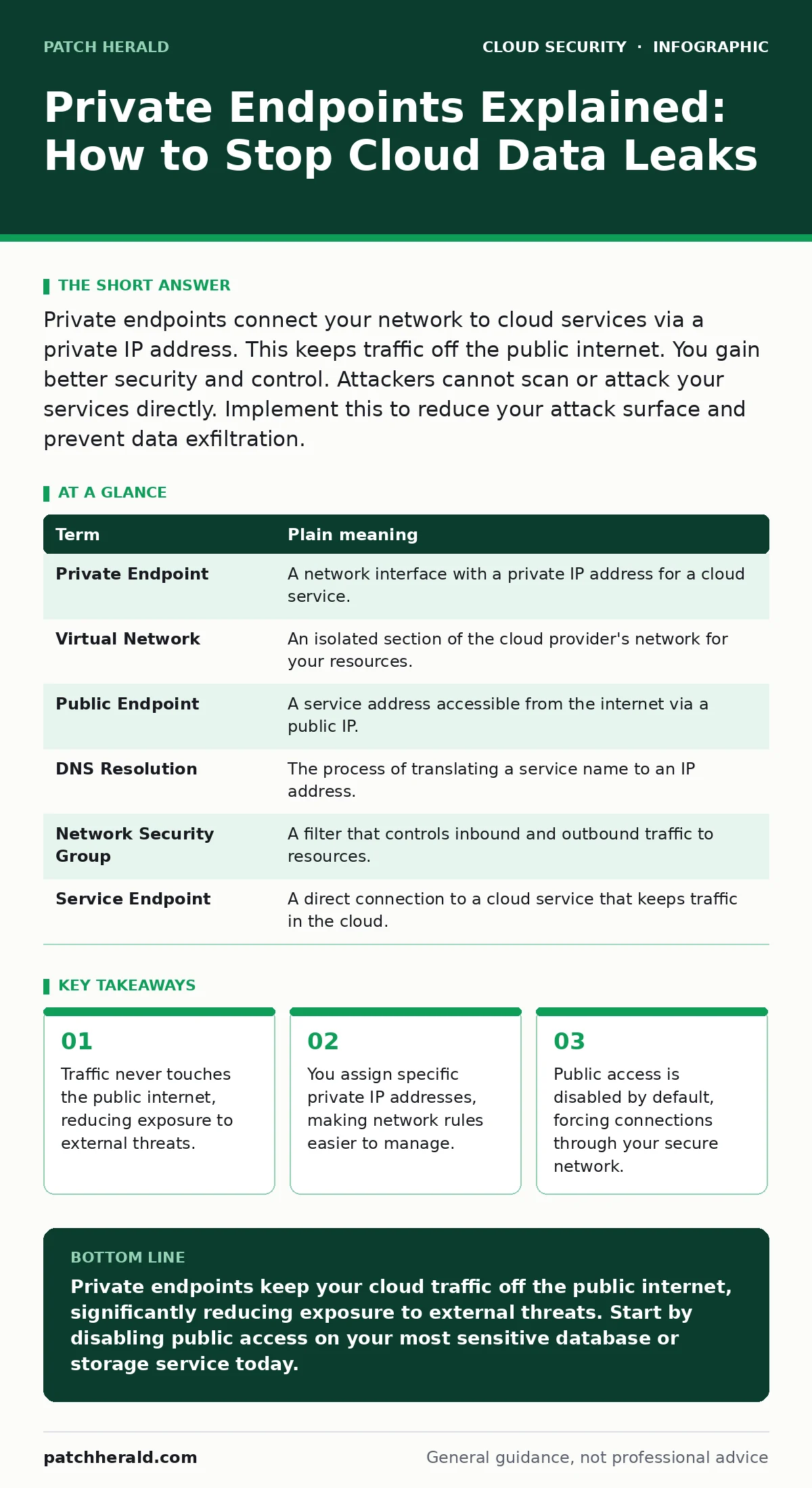
Private endpoints connect your network to cloud services via a private IP address. This keeps traffic off the public internet. You gain better security and control. Attackers cannot scan or attack your services directly. Implement this to reduce your attack surface and prevent data exfiltration.
The Post Office Analogy
Imagine your cloud service is a private office. Normally, anyone can walk up to the front door. This is like a public endpoint. A private endpoint is a secure tunnel. It connects your office directly to your main building. No one can enter from the street. Only staff with badges can use the tunnel. This removes the front door entirely.
Why Public Access Is Risky
Public endpoints expose your service to the entire internet. Attackers scan for open ports and weak configurations. They do not need to guess your password if the service is publicly reachable. They can exploit known vulnerabilities in the software itself. This exposure increases the risk of cloud data exfiltration. Your data leaves your control once it hits the public network.
How Private Endpoints Work
A private endpoint assigns a private IP address to your cloud service. This IP address lives inside your virtual network. When you request data, the traffic stays within your network. It does not route through the public internet backbone. The cloud provider handles the routing. You see only the private IP address. This hides the service from external scanners.
| Term | Plain meaning |
|---|---|
| Private Endpoint | A network interface with a private IP address for a cloud service. |
| Virtual Network | An isolated section of the cloud provider's network for your resources. |
| Public Endpoint | A service address accessible from the internet via a public IP. |
| DNS Resolution | The process of translating a service name to an IP address. |
| Network Security Group | A filter that controls inbound and outbound traffic to resources. |
| Service Endpoint | A direct connection to a cloud service that keeps traffic in the cloud. |
The Hidden Cost of Simplicity
Many teams choose public endpoints for ease of setup. It takes less time to configure. However, this convenience creates a hidden cost. You must manage complex firewall rules to block bad traffic. You must monitor logs for suspicious activity. This effort often leads to cloud misconfigurations. A single mistake opens the door to attackers. Private endpoints simplify security by design.
DNS and Connection Challenges
Private endpoints change how your systems find services. Your applications use domain names to connect. These names must resolve to the private IP address. If your DNS settings are wrong, applications cannot connect. You must update your DNS records. This step is often overlooked. It causes connection failures that look like service outages. Fixing DNS is faster than fixing a security breach.
See also: Cloud Misconfiguration Myths: 6 False Beliefs That Leave Data Exposed · Stop Cloud Data Exfiltration: 4 Measures That Actually Work
Managing Access Control
Private endpoints do not replace identity checks. They only control network access. You still need strong authentication. Users must prove who they are. Combine private endpoints with federated identity. This ensures only authorized users can connect. Even if an attacker reaches the private IP, they cannot log in. Layering security controls reduces risk significantly.
First Steps for Implementation
Start by identifying your most sensitive services. These are the best candidates for private endpoints. Databases and storage accounts are good starting points. Follow these steps to begin.
- Create a private endpoint for your chosen service. Select the specific resource you want to protect.
- Assign a private IP address within your virtual network. Ensure this IP does not conflict with existing resources.
- Update your DNS records to point to the private IP. Test connectivity from a trusted machine. Verify that public access is denied.
Long-Term Security Benefits
Private endpoints provide a stable foundation for security. They reduce the need for complex firewall rules. You spend less time blocking bad traffic. You spend more time building features. This shift improves operational efficiency. It also reduces the risk of human error. Over time, this leads to a more secure environment. You gain confidence in your cloud posture.
Integrating with Other Controls
Private endpoints work best with other security measures. Pair them with cloud firewalls for deeper inspection. Use cloud vulnerability management to find weak spots. Monitor for shadow IT that bypasses your controls. This layered approach creates a strong defense. No single control stops all attacks. Combining them raises the bar for attackers.
Key takeaways
- Traffic never touches the public internet, reducing exposure to external threats.
- You assign specific private IP addresses, making network rules easier to manage.
- Public access is disabled by default, forcing connections through your secure network.
Private endpoints keep your cloud traffic off the public internet, significantly reducing exposure to external threats. Start by disabling public access on your most sensitive database or storage service today.
Frequently asked questions
Do private endpoints slow down my application?
Private endpoints often improve performance. Traffic stays within the cloud provider's network. It avoids the latency of the public internet. Response times can be faster and more consistent.
Can I use private endpoints with third-party services?
Many third-party services support private endpoints. Check the documentation for your specific provider. Some services offer integration via partner networks. This allows secure connections without public exposure.
What happens if I delete a private endpoint?
Deleting the endpoint breaks the connection. Your applications will lose access to the service. You must recreate the endpoint and update DNS. Plan maintenance windows to avoid downtime.
Are private endpoints free?
Most cloud providers charge for the private endpoint resource. There may also be data transfer costs. Check your provider's pricing page. The cost is usually low compared to the security benefit.
How this guide was produced: written by the Patch Herald editorial team with AI assistance, checked against the public references listed below, and reviewed when the facts change. See our editorial policy or report an error.