
Private endpoints do not automatically secure data in transit. They remove public IP addresses from cloud services, forcing traffic through your virtual network. You still must configure identity permissions, encryption, and logging. Misunderstanding this boundary leads to silent data exposure and failed compliance audits.
Misreading: Private endpoints provide complete isolation from the internet
Correct reading: Private endpoints remove the public Internet Protocol address from a cloud service, but they do not create an isolated air gap. The traffic still traverses the provider’s backbone network. Imagine a library that removes its front door but keeps the hallway open to the street. The entry point changes, but the path remains exposed to backbone-level interception if encryption fails. You must still enforce Transport Layer Security encryption for data in transit. The endpoint ensures the packet enters your virtual network, not that the content inside is safe.
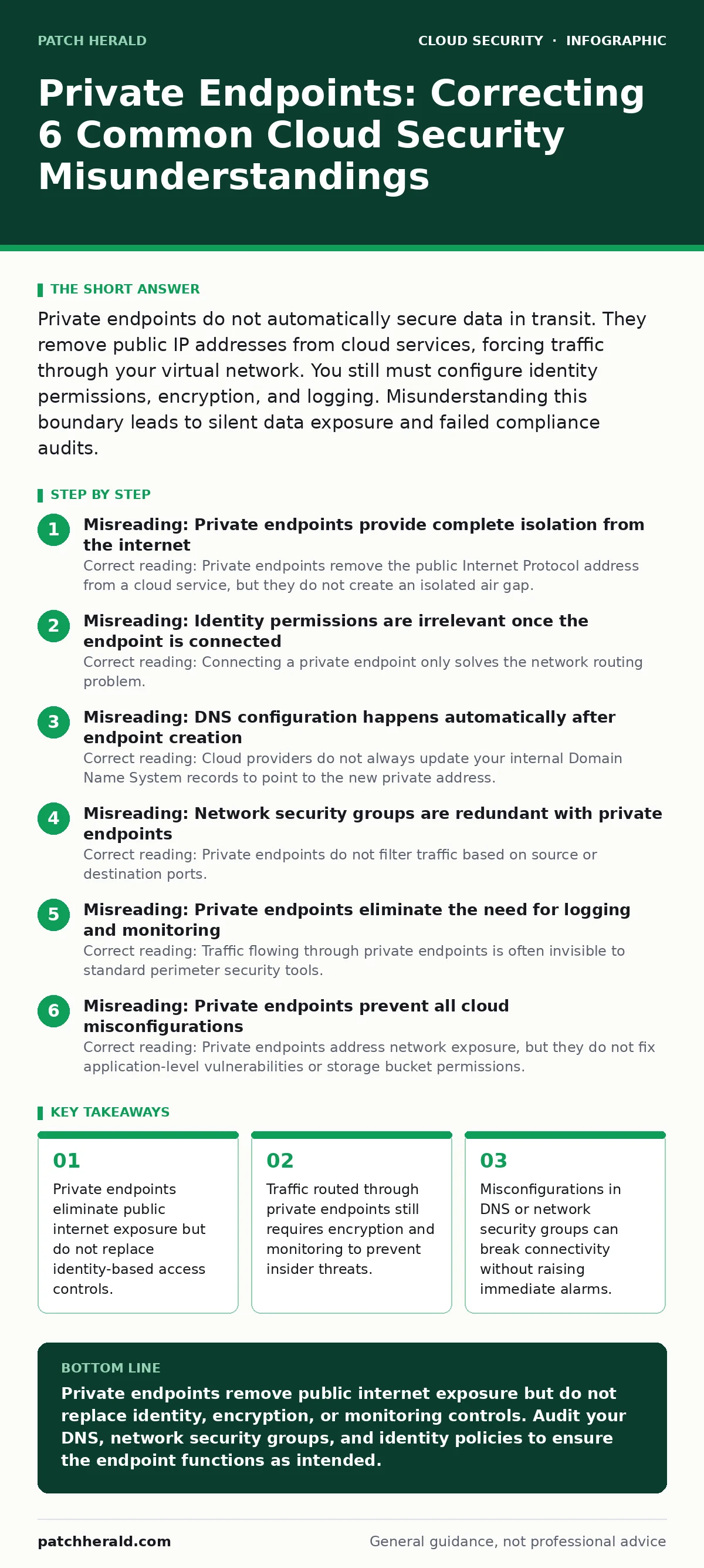
Misreading: Identity permissions are irrelevant once the endpoint is connected
Correct reading: Connecting a private endpoint only solves the network routing problem. It does not grant authorization to the resource itself. A private endpoint acts like a private lane to a building, but it does not hand you a key to the office. You must still configure cloud IAM policies to define who can read or write data. Without these policies, any user or service with access to the virtual network can attempt to interact with the resource. The network path is secure, but the application layer remains vulnerable to unauthorized access if identity checks are missing.
Misreading: DNS configuration happens automatically after endpoint creation
Correct reading: Cloud providers do not always update your internal Domain Name System records to point to the new private address. If your application resolves the public hostname instead of the private one, traffic leaves your virtual network and hits the public internet. This creates a silent failure where security tools see no private traffic, yet the application functions normally. You must manually create or verify private DNS zones. This step ensures that internal queries resolve to the private endpoint’s local address. Neglecting this leads to data exfiltration via the public route, even when the endpoint exists.
Misreading: Network security groups are redundant with private endpoints
Correct reading: Private endpoints do not filter traffic based on source or destination ports. They only define the path. You still need network security groups to restrict which subnets can reach the endpoint. Suppose you have a database with a private endpoint. Without network security group rules, any compromised server in your virtual network can reach that database. The endpoint prevents external attacks, but it does not stop lateral movement from inside your infrastructure. You must apply least-privilege network rules to limit access to only the specific subnets that require connectivity.
Misreading: Private endpoints eliminate the need for logging and monitoring
Correct reading: Traffic flowing through private endpoints is often invisible to standard perimeter security tools. Because the data stays within the cloud provider’s internal network, traditional intrusion detection systems may not inspect it. You lose visibility into who accessed the resource and what data was transferred. This blind spot makes it difficult to detect insider threats or compromised credentials. You must enable flow logs and resource-level auditing. These logs provide the necessary trail to investigate anomalies. Without them, you cannot prove compliance or detect breaches that occur entirely within the private network path.
See also: Configuration Drift Meaning: How Silent Changes Break Cloud Security · Cloud Vulnerability Scanning: How to Find Hidden Risks in Your Infrastructure
Misreading: Private endpoints prevent all cloud misconfigurations
Correct reading: Private endpoints address network exposure, but they do not fix application-level vulnerabilities or storage bucket permissions. A storage container might have a private endpoint, yet still allow public read access if the bucket policy is misconfigured. This contradiction creates a false sense of security. Users assume the private path protects the data, while the application layer remains wide open. You must audit resource permissions independently of network settings. Configuration drift can reintroduce public access over time. Regular reviews of both network and identity settings are necessary to maintain the intended security posture.
Misreading: Private endpoints are a substitute for cloud firewalls
Correct reading: Private endpoints route traffic internally, but they do not inspect packet contents for malware or exploit patterns. A cloud firewall examines traffic for known threats, regardless of the path. If you rely solely on private endpoints, you bypass the deep packet inspection capabilities of your security tools.
Imagine sending sensitive documents through a secure courier who does not check for hidden cameras. The delivery is secure, but the content may still be compromised. You must integrate private endpoints with your cloud firewalls to ensure that internal traffic is also scanned for threats. This layered approach protects against both external and internal risks.
Misreading: Private endpoints solve all compliance requirements
Correct reading: Compliance frameworks require more than just network isolation. They demand encryption at rest, access logging, and regular audits. Private endpoints contribute to network security controls, but they do not fulfill data residency or encryption mandates. Suppose you store regulated data behind a private endpoint. If the storage bucket is not encrypted, you still fail compliance.
The endpoint hides the data from the public internet, but it does not protect it from unauthorized decryption if keys are compromised. You must align your endpoint strategy with broader security controls. Refer to CIS Benchmarks for specific configuration requirements. This ensures that your network design supports the full scope of regulatory obligations.
Misreading: Private endpoints are permanent and require no maintenance
Correct reading: Cloud environments change frequently. Subnets are modified, applications are updated, and access policies evolve. A private endpoint that works today may break tomorrow due to configuration drift. Imagine a bridge that connects two cities. If one city changes its traffic laws, the bridge may no longer be usable. You must monitor your endpoints for connectivity issues and policy changes. Regular reviews ensure that the endpoint remains aligned with your current architecture. Neglecting maintenance leads to unexpected outages and security gaps. Automated tools can help detect drift, but human oversight is still required to validate the changes.
Key takeaways
- Private endpoints eliminate public internet exposure but do not replace identity-based access controls.
- Traffic routed through private endpoints still requires encryption and monitoring to prevent insider threats.
- Misconfigurations in DNS or network security groups can break connectivity without raising immediate alarms.
Private endpoints remove public internet exposure but do not replace identity, encryption, or monitoring controls. Audit your DNS, network security groups, and identity policies to ensure the endpoint functions as intended.
Frequently asked questions
Do private endpoints hide my cloud resources from external scanners?
Yes, private endpoints remove public IP addresses, making resources unreachable from the public internet. External scanners cannot discover or probe these resources directly.
Can I use private endpoints for services that do not support them?
No, you must use the provider’s supported list of services. Attempting to force private connectivity for unsupported services requires complex workarounds that may introduce security risks.
How do private endpoints affect application latency?
Private endpoints often reduce latency by routing traffic through the provider’s internal backbone. This avoids the public internet’s variable routing and congestion, resulting in more consistent performance.
Are private endpoints compatible with hybrid cloud setups?
Yes, you can connect on-premises networks to cloud private endpoints using virtual network peering or site-to-site connections. This extends the private path to your local infrastructure securely.
How this guide was produced: written by the Patch Herald editorial team with AI assistance, checked against the public references listed below, and reviewed when the facts change. See our editorial policy or report an error.