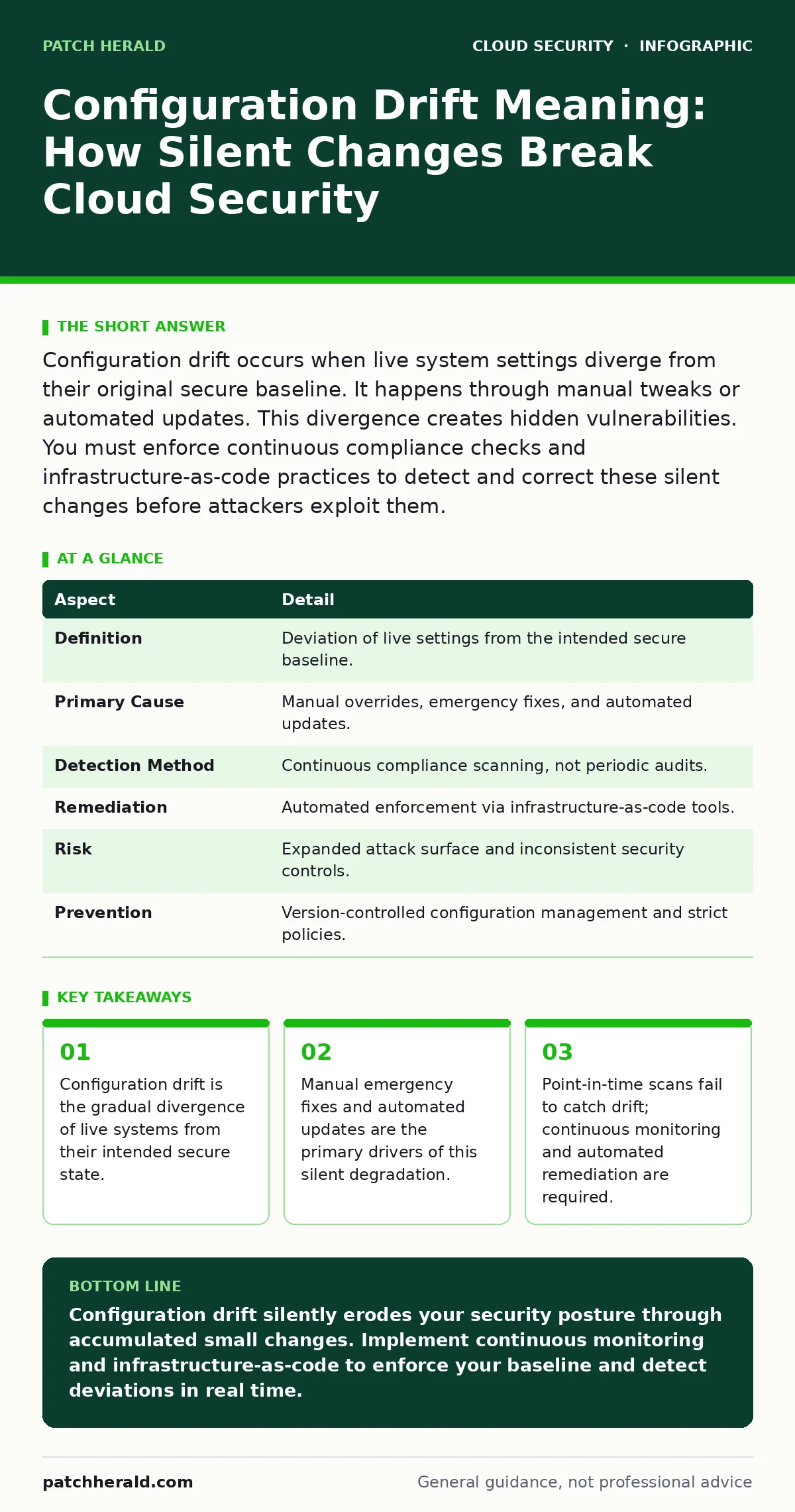
Configuration drift occurs when live system settings diverge from their original secure baseline. It happens through manual tweaks or automated updates. This divergence creates hidden vulnerabilities. You must enforce continuous compliance checks and infrastructure-as-code practices to detect and correct these silent changes before attackers exploit them.
The Leaky Faucet Analogy
Imagine a faucet that drips one drop per minute. You ignore it because the sink does not overflow. Over weeks, that single drip becomes a steady stream. The pipe eventually corrodes. The water damage spreads to the floorboards. You only notice the problem when the structure fails. Configuration drift works the same way. It is not a sudden breach. It is a slow accumulation of small deviations from your security baseline. Each individual change seems harmless. Together, they create a weak point that attackers can exploit.
Configuration Drift Meaning
Configuration drift meaning refers to the gradual divergence of a system’s actual settings from its intended, secure baseline. This phenomenon occurs in cloud environments where resources are dynamic. You start with a secure configuration. Over time, developers make manual adjustments. Operations teams apply hotfixes. Automated tools update software versions. Each change moves the system further from the original design. The system remains functional, but its security posture degrades. The gap between what you think is running and what is actually running widens silently.
| Aspect | Detail |
|---|---|
| Definition | Deviation of live settings from the intended secure baseline. |
| Primary Cause | Manual overrides, emergency fixes, and automated updates. |
| Detection Method | Continuous compliance scanning, not periodic audits. |
| Remediation | Automated enforcement via infrastructure-as-code tools. |
| Risk | Expanded attack surface and inconsistent security controls. |
| Prevention | Version-controlled configuration management and strict policies. |
How Drift Occurs in Practice
Drift happens because systems are not static. Cloud environments encourage rapid iteration. A developer needs temporary access to debug an application. They open a firewall port. They forget to close it after the fix. Another team member adjusts a database setting to improve performance. They bypass the standard approval process. These actions are often necessary for business continuity. They are rarely malicious. The problem is the lack of return to the baseline. The temporary change becomes permanent. The security control is weakened. The system state no longer matches the documentation.
Who Is Affected by Drift
Every organization using dynamic infrastructure faces this risk. Small businesses often rely on manual processes. They lack the automation budget to enforce strict baselines. Large enterprises have complex environments with multiple teams. Coordination failures lead to inconsistent configurations. Cloud-native applications are particularly vulnerable. They update frequently. Each update carries the risk of introducing a deviation. The impact is not limited to IT staff. Business owners face financial loss and reputational damage. Customers lose trust when data is exposed. The risk is universal. The scale varies, but the mechanism is the same.
What People Usually Get Wrong
Many teams believe a one-time security audit is sufficient. They scan their environment, fix the issues, and move on. This approach fails because drift is continuous. A snapshot in time does not reveal changes that happen between scans. Another common mistake is relying solely on manual reviews. Humans make errors. They miss subtle changes in complex configurations.
They become desensitized to alerts. The volume of changes overwhelms their ability to verify each one. Teams also ignore the difference between configuration drift and cloud misconfigurations. Misconfigurations are often initial setup errors. Drift is the decay of a correct setup over time. Both need attention, but the remedies differ.
See also: Federated Identity: Definition, Purpose and How It Works · Detect Misconfigured Cloud Storage Leaks Before Data Exfiltration
The Hidden Cost of Silent Changes
The cost of drift is not just the initial breach. It is the time spent investigating. Incident response teams struggle to understand the current state of the system. They must reconcile logs, manual notes, and actual settings. This friction delays containment. The attacker has more time to move laterally. The business suffers downtime. The cost extends to compliance failures. Auditors require proof of consistent security controls. Drift makes this proof difficult or impossible to provide. Fines and penalties follow. The hidden cost is the erosion of trust in your own infrastructure. You no longer know what you are protecting.
Strategies to Prevent and Correct Drift
Prevention requires a shift in mindset. You must treat configuration as code. Define your desired state in version-controlled files. Use infrastructure-as-code tools to apply these settings. This ensures every change is tracked and reversible. Implement continuous compliance scanning. Tools should check your live environment against the baseline in real time. When a deviation is detected, the system should alert you or automatically remediate it. Automate the correction process. Manual fixes introduce more drift. Establish a policy that requires justification for any manual override. Document every exception. Review exceptions regularly. Close them when they are no longer needed.
Integrating with Broader Security Frameworks
Configuration management does not exist in isolation. It supports other security controls. Properly managed configurations enhance the effectiveness of cloud IAM policies. If your identity settings drift, even strong policies fail. Drift can create shadow IT by allowing unauthorized services to run unchecked. It also impacts the reliability of cloud firewalls. If firewall rules drift, traffic flows through unintended paths.
Regularly review your alignment with CIS Benchmarks. These benchmarks provide established baselines for secure configuration. Use them as the reference point for your drift detection. Ensure your federated identity settings remain consistent. Inconsistent identity configurations lead to privilege escalation. Monitor for public code repository leaks that might expose your configuration files.
The Role of Automation in Stability
Automation is the only scalable solution. Manual processes cannot keep pace with cloud dynamics. You need tools that enforce policy at the point of change. These tools block non-compliant configurations before they are applied. They also detect and remediate drift that slips through. This reduces the burden on your team. It allows them to focus on strategic improvements rather than firefighting. Automation provides an audit trail. You can see who changed what and when. This transparency is vital for accountability. It also speeds up incident response. You know exactly what changed and why. This clarity reduces the mean time to resolution.
Maintaining Long-Term Security Posture
Security is not a destination. It is a continuous process. Configuration drift will always try to erode your defenses. You must commit to ongoing monitoring and improvement. Regularly update your baselines to reflect new threats. Test your detection and remediation processes. Simulate drift scenarios to ensure your tools work. Train your teams on the importance of baseline adherence. Make security a shared responsibility. Encourage a culture where reporting drift is rewarded, not punished. This cultural shift is as important as the technical controls. It ensures that everyone is aligned in protecting the organization.
Key takeaways
- Configuration drift is the gradual divergence of live systems from their intended secure state.
- Manual emergency fixes and automated updates are the primary drivers of this silent degradation.
- Point-in-time scans fail to catch drift; continuous monitoring and automated remediation are required.
- Infrastructure-as-code treats configuration as version-controlled data to prevent unauthorized deviations.
Configuration drift silently erodes your security posture through accumulated small changes. Implement continuous monitoring and infrastructure-as-code to enforce your baseline and detect deviations in real time.
Frequently asked questions
How is configuration drift different from a vulnerability?
A vulnerability is a specific flaw in software or hardware. Configuration drift is the deviation of settings from a secure baseline. Drift can expose vulnerabilities or create new attack paths.
Can configuration drift occur in on-premise servers?
Yes. Drift happens in any dynamic environment. On-premise servers drift through manual updates, patching, and administrative changes. The principles of baseline management apply equally.
How often should I scan for configuration drift?
Continuous scanning is ideal. Point-in-time scans miss changes that occur between checks. Real-time monitoring ensures immediate detection and remediation of deviations.
What is the first step to fixing existing drift?
Define your desired secure baseline. Document the correct settings for each resource. Then scan your live environment to identify current deviations. Prioritize fixing high-risk drift first.
How this guide was produced: written by the Patch Herald editorial team with AI assistance, checked against the public references listed below, and reviewed when the facts change. See our editorial policy or report an error.