
Federated identity allows users to log in to multiple services using credentials from a single trusted provider. It eliminates the need for separate passwords per application, reduces administrative overhead, and centralizes security controls across your organization’s digital ecosystem.
The Problem with Siloed Access
Imagine a library that requires a unique key for every single book. You carry a heavy ring of keys, and the librarian spends hours managing who holds which key. When you lose the ring, every book becomes inaccessible. Most organizations face this same friction with digital assets. Each application demands its own username and password. This creates a fragmented security posture where users reuse weak credentials to cope with the memory load. Administrators struggle to enforce consistent rules across dozens of isolated systems.
This siloed approach creates a hidden cost. When an employee leaves, you must revoke access in every system individually. If you miss one, that account remains a backdoor. Federated identity solves this by establishing a single source of truth for user identity. It replaces the key ring with a single, verified passport.
How Federated Identity Functions
At its core, federated identity is a trust relationship between two or more security domains. It allows a user to authenticate with one provider and gain access to multiple services. The mechanism relies on three main components. The Identity Provider is the system that authenticates the user. It verifies credentials and issues a digital token.
The Service Provider is the application the user wants to access. It trusts the token from the Identity Provider. The Protocol is the language they use to exchange information. Common standards include Security Assertion Markup Language and OpenID Connect. These protocols ensure that the Service Provider can understand and validate the token.
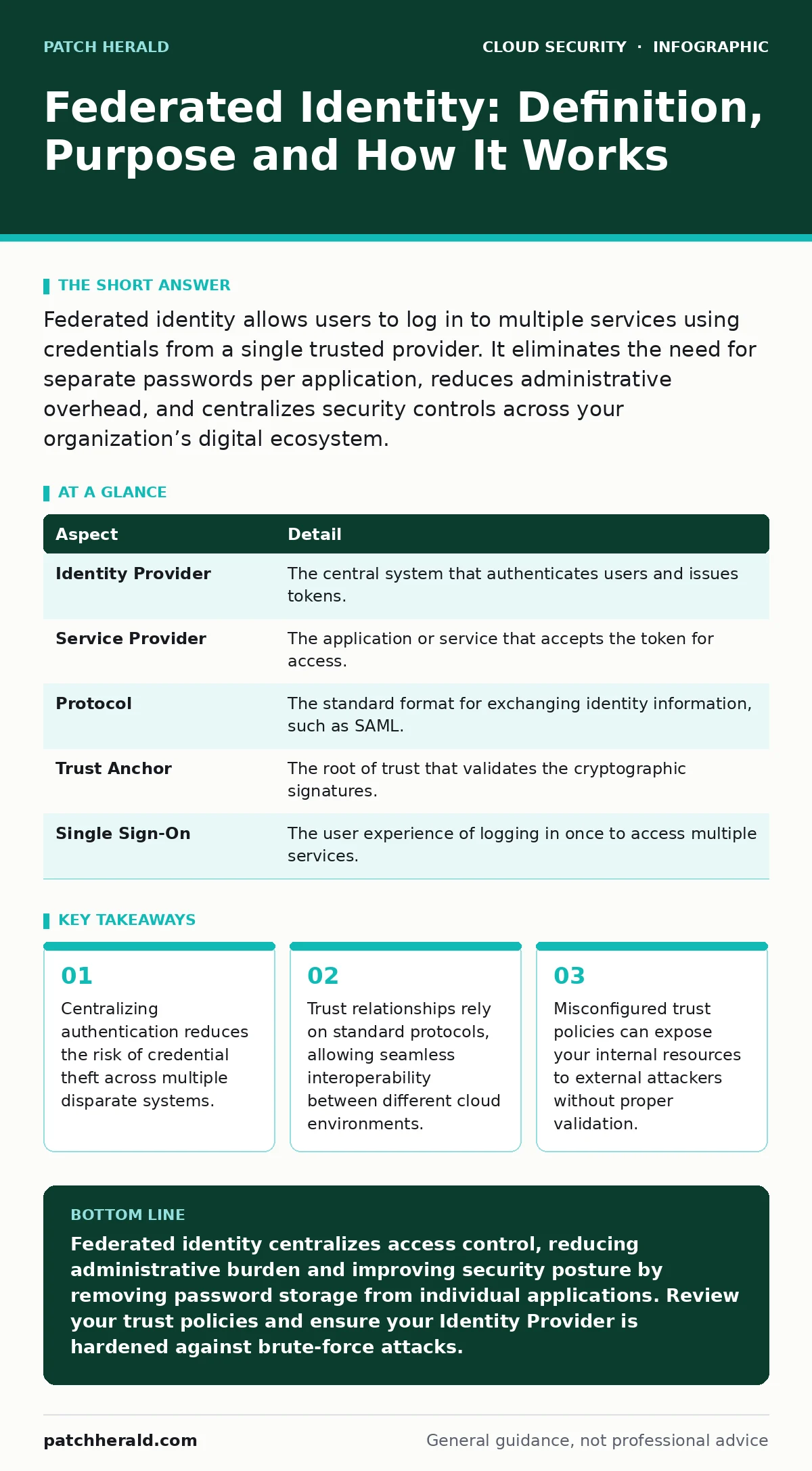
| Aspect | Detail |
|---|---|
| Identity Provider | The central system that authenticates users and issues tokens. |
| Service Provider | The application or service that accepts the token for access. |
| Protocol | The standard format for exchanging identity information, such as SAML. |
| Trust Anchor | The root of trust that validates the cryptographic signatures. |
| Single Sign-On | The user experience of logging in once to access multiple services. |
The Mechanics of Trust
The magic happens in the handshake between the provider and the service. When you request access to an application, the Service Provider checks if it has a valid token from your Identity Provider. If not, it redirects you to the login page of the Identity Provider. You enter your credentials there. The Identity Provider verifies them and sends a signed token back to the Service Provider.
This token contains claims about your identity, such as your role or group membership. The Service Provider reads the claims and grants access. It never sees your password. This separation of duties is critical. It means the application does not store sensitive authentication data. If the application is compromised, the attacker gains no passwords.
Where Federated Identity Fits
Federated identity is not a standalone shield. It is a component of a broader security architecture. It works best when combined with other controls. For instance, it complements cloud firewalls by ensuring that only authenticated and authorized users reach the network perimeter. It also supports hybrid cloud security by allowing consistent identity management across on-premises and cloud environments.
Without federated identity, managing users in a hybrid setup becomes a manual nightmare. It also helps mitigate shadow IT by providing a centralized way to monitor and control access to unsanctioned applications. If users bypass approved channels, the central identity log still shows their activity.
Common Misconceptions
Many organizations misunderstand the scope of federated identity. The first mistake is assuming it eliminates the need for strong passwords. It does not. The Identity Provider still requires secure authentication. If the central login is weak, the entire federation is weak. The second error is believing that federation guarantees security. It only manages access. It does not protect against malware or data leakage once a user is inside. The third misconception is that all protocols are interchangeable. SAML and OAuth serve different purposes. SAML is for web-based Single Sign-On. OAuth is for delegating access to APIs. Mixing them up leads to broken integrations and security gaps.
See also: Shadow IT Myths: 6 Misconceptions Blocking Cloud Security · Detect Misconfigured Cloud Storage Leaks Before Data Exfiltration
The Hidden Costs of Implementation
Implementing federated identity requires more than just software. It demands a review of your trust boundaries. You must define who can connect and what claims are necessary. Over-permissive claims can leak sensitive data. For example, sending a user’s salary information to a project management tool is unnecessary and risky. You must also plan for key rotation.
If the cryptographic keys used to sign tokens are compromised, the entire system is vulnerable. Rotating these keys regularly is a maintenance task that is often overlooked. Furthermore, you must have a plan for when the Identity Provider goes down. If the central service is unavailable, no one can log in. This creates a single point of failure. Redundancy and offline fallback procedures are necessary, though difficult to implement.
Protecting the Trust Chain
The security of federated identity depends on the integrity of the trust chain. You must monitor the tokens for anomalies. Look for unexpected claim values or unusual login times. Integrate your Identity Provider with your cloud incident response plan. If a breach is detected, you can revoke tokens across all connected services instantly.
This is faster than changing passwords in every application. You should also be aware of cloud attack surface expansion. Each new Service Provider you connect to increases your risk. Vet each provider before establishing a trust relationship. Check their security posture and compliance records. Do not assume that because they are a large vendor, they are secure.
Key takeaways
- Centralizing authentication reduces the risk of credential theft across multiple disparate systems.
- Trust relationships rely on standard protocols, allowing seamless interoperability between different cloud environments.
- Misconfigured trust policies can expose your internal resources to external attackers without proper validation.
Federated identity centralizes access control, reducing administrative burden and improving security posture by removing password storage from individual applications. Review your trust policies and ensure your Identity Provider is hardened against brute-force attacks.
Frequently asked questions
Does federated identity work for mobile apps?
Yes, mobile apps can use federated identity through protocols like OpenID Connect and OAuth, allowing users to log in with their corporate credentials.
Can I use federated identity with on-premises servers?
Yes, many Identity Providers support hybrid deployments, allowing them to authenticate users for both cloud and on-premises applications.
What happens if the Identity Provider is hacked?
If the central provider is compromised, attackers may gain access to all connected services. This highlights the need for strong multi-factor authentication at the identity level.
Is federated identity the same as single sign-on?
Single sign-on is a feature of federated identity. Federation is the underlying trust mechanism that allows single sign-on to work across different organizations.
How this guide was produced: written by the Patch Herald editorial team with AI assistance, checked against the public references listed below, and reviewed when the facts change. See our editorial policy or report an error.