
Shadow IT is not just unauthorized software; it is often approved tools used in unmonitored ways. Blocking all unknown apps fails because employees will find workarounds. You must map your actual attack surface and enforce least privilege across all cloud services, not just the ones you manage directly.
Myth: Shadow IT is always malicious
Reality: Most shadow IT originates from good intentions. Employees encounter a bottleneck in their approved workflow and seek a faster solution. They might use a free file-sharing service to collaborate on a deadline or a personal cloud storage account to back up sensitive data. The intent is productivity, not sabotage.
This distinction matters because treating all unauthorized tools as threats leads to blunt enforcement. If you block every unknown application, you create friction that drives users to more covert methods. They may use personal devices or unmonitored networks to access these tools, which removes any chance of oversight.
The goal is not to punish the employee but to understand the gap in your official technology stack. If a specific function is consistently being outsourced to unvetted services, your approved tools may be lacking features or usability. Addressing the root cause reduces the incentive to go outside the approved perimeter.
Myth: Blocking unauthorized apps stops shadow IT
Reality: Network-level blocking is ineffective against modern cloud services. Many shadow IT applications operate over standard web ports that your firewall allows for legitimate business traffic. If you block a specific domain, users simply find an alternative service that offers similar functionality. This cat-and-mouse game drains security resources without reducing risk.
Furthermore, many cloud services are accessed through APIs or mobile applications that do not traverse your traditional network perimeter. An employee might sync data from a personal tablet to a cloud service while on a cellular connection. Your network security tools never see this traffic, rendering blocks useless.
The focus must shift from perimeter blocking to identity-centric control. You cannot stop a user from accessing a cloud service if you do not know they are doing it. Instead of trying to seal every hole in the network, you should enforce least privilege through identity providers. This ensures that even if a user accesses an unauthorized app, they cannot exfiltrate sensitive corporate data.
Myth: Shadow IT only happens in IT departments
Reality: Shadow IT is most prevalent in departments with high autonomy and tight deadlines, such as marketing, sales, and human resources. These teams often require specialized tools for campaign tracking, customer relationship management, or applicant screening. IT departments are usually more constrained by policy and technical knowledge, making them less likely to adopt rogue tools.
Marketing teams, for instance, frequently use analytics platforms and social media schedulers that operate outside the company’s main infrastructure. These tools often require access to customer data or internal analytics. When these services are unmanaged, they become entry points for attackers who target the weakest link in the chain.
Sales teams might use personal cloud drives to share large files with clients quickly. This bypasses the company’s secure file transfer protocol, exposing proprietary information to unsecured environments. The risk is not limited to technical staff; it spreads wherever workflow pressure exceeds procedural friction.
Myth: You can find shadow IT with network scans
Reality: Traditional network scans look for open ports and known vulnerabilities on servers within your infrastructure. They do not detect cloud services accessed via the public internet. Shadow IT lives outside your network boundary, often in third-party data centers you do not control.
Imagine a scenario where an employee uses a public code repository to share scripts. This traffic looks like standard HTTPS web browsing to your network monitors. A port scan will not reveal that this repository contains sensitive intellectual property or credentials. The service is external, and the connection is encrypted.
To find these services, you must analyze cloud metadata service attacks vectors and monitor for unusual data egress patterns. You also need to integrate with identity providers to see what applications users are authenticating to. This is where cloud IAM policies become critical. By reviewing which applications have been granted access to your identity provider, you can uncover services that users are actively using, even if they are not on your approved list.
Myth: Shadow IT is a visibility problem only
Reality: Visibility is the first step, but it does not equal security. Knowing that an unauthorized application is in use does not mitigate the risk if that application has broad access to your data. You must enforce strict access controls regardless of where the data resides.
Consider unsecured cloud databases created by developers for testing. These databases might be visible in your audit logs, but if they are left open to the internet, the visibility does not protect the data. The risk lies in the configuration, not just the existence of the service.
You need to apply hybrid cloud security principles to these shadow environments. This means treating external services as part of your attack surface. Implement cloud incident response plans that account for third-party breaches. If a shadow IT service is compromised, your response plan must include steps to revoke access and contain the spread, even if the service is outside your direct control.
See also: Cloud Vulnerability Scanning: How to Find Hidden Risks in Your Infrastructure · Federated Identity: Definition, Purpose and How It Works
Myth: Employees will stop using shadow IT if you train them
Reality: Training alone cannot change behavior when the approved tools are inefficient. If the official process takes ten steps and the shadow IT tool takes one, human nature favors the easier path. Training raises awareness, but it does not remove the friction that drives shadow IT adoption.
The solution is to provide approved alternatives that match the functionality and ease of use of the shadow tools. If employees can achieve their goals within the approved ecosystem, the incentive to look elsewhere disappears. This requires collaboration between IT and business units to evaluate and integrate useful tools securely.
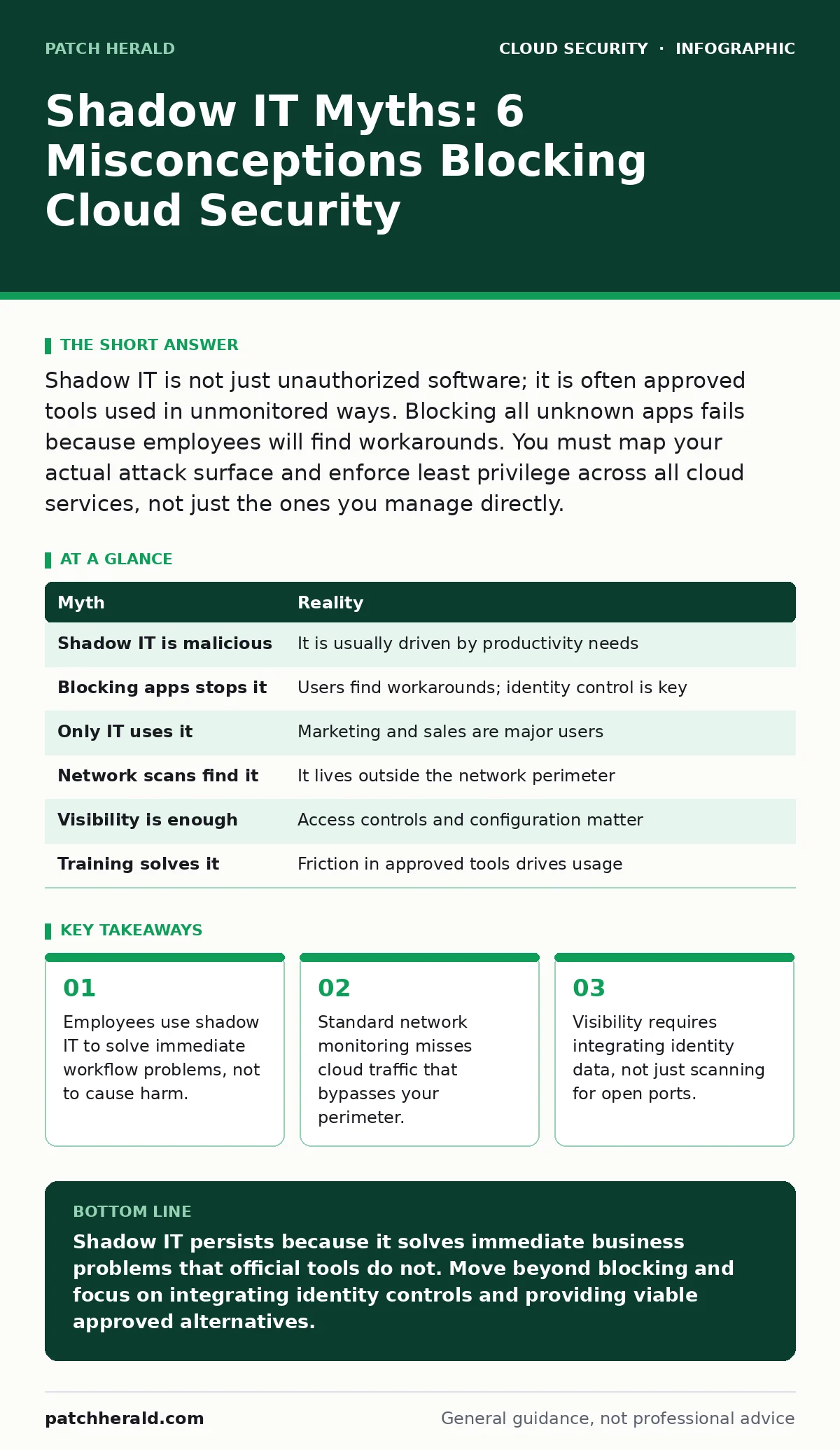
| Myth | Reality |
|---|---|
| Shadow IT is malicious | It is usually driven by productivity needs |
| Blocking apps stops it | Users find workarounds; identity control is key |
| Only IT uses it | Marketing and sales are major users |
| Network scans find it | It lives outside the network perimeter |
| Visibility is enough | Access controls and configuration matter |
| Training solves it | Friction in approved tools drives usage |
Key takeaways
- Employees use shadow IT to solve immediate workflow problems, not to cause harm.
- Standard network monitoring misses cloud traffic that bypasses your perimeter.
- Visibility requires integrating identity data, not just scanning for open ports.
- Blocking tools without providing alternatives increases risk through hidden workarounds.
Shadow IT persists because it solves immediate business problems that official tools do not. Move beyond blocking and focus on integrating identity controls and providing viable approved alternatives.
Frequently asked questions
How do I detect shadow IT without expensive tools?
Review application logs in your identity provider to see which third-party apps users are authenticating to. Look for unknown services with active sessions.
Is using personal cloud storage always shadow IT?
If it stores company data without approval or monitoring, yes. Personal use of personal data on personal devices is generally not a corporate security risk.
Should I ban all personal devices?
Banning devices often increases risk by driving activity to unmonitored networks. Instead, enforce strict access controls and data encryption on all devices.
How does federated identity help?
It allows you to manage access to third-party applications centrally. You can revoke access to shadow IT services instantly without changing user passwords.
How this guide was produced: written by the Patch Herald editorial team with AI assistance, checked against the public references listed below, and reviewed when the facts change. See our editorial policy or report an error.