
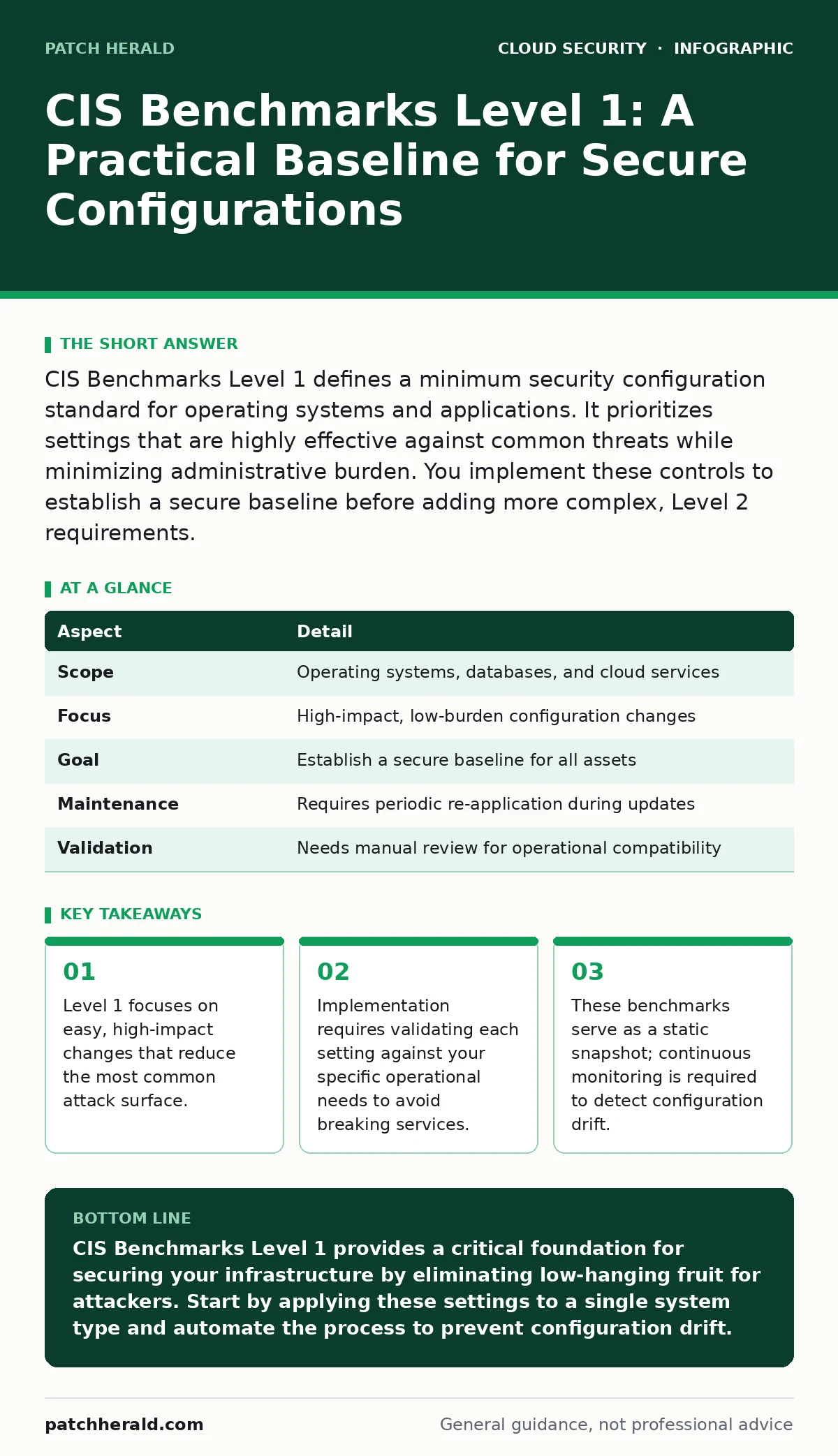
CIS Benchmarks Level 1 defines a minimum security configuration standard for operating systems and applications. It prioritizes settings that are highly effective against common threats while minimizing administrative burden. You implement these controls to establish a secure baseline before adding more complex, Level 2 requirements.
Understanding the CIS Benchmarks Level 1 Baseline
Secure configuration is like locking the doors of a building before you install a sophisticated alarm system. You cannot rely on advanced detection if the front door remains wide open. The Center for Internet Security (CIS) Benchmarks provide a standardized way to lock those doors across various technologies. CIS Benchmarks Level 1 represents the foundational tier of this framework. It consists of configuration settings that are deemed safe and effective for most environments. These settings address the most frequent vulnerabilities found in software and infrastructure.
The Level 1 standard focuses on actions that offer the highest security return for the lowest implementation cost. You will find recommendations for disabling unnecessary services, enforcing password complexity, and restricting file permissions. These controls are designed to stop automated scanning tools and common exploitation scripts. They do not require specialized hardware or complex architectural changes. Instead, they rely on adjusting the default settings provided by the vendor. This approach makes it accessible for teams with limited security resources.
| Aspect | Detail |
|---|---|
| Scope | Operating systems, databases, and cloud services |
| Focus | High-impact, low-burden configuration changes |
| Goal | Establish a secure baseline for all assets |
| Maintenance | Requires periodic re-application during updates |
| Validation | Needs manual review for operational compatibility |
How CIS Benchmarks Level 1 Works in Practice
The mechanism behind these benchmarks is simple but rigorous. A group of security experts reviews the documentation for a specific technology. They identify every setting that could be hardened to prevent unauthorized access. They then categorize these settings by risk and impact. Level 1 contains only those settings where the security benefit clearly outweighs the operational risk. You apply these settings to your systems to reduce the attack surface.
Consider a web server installed with default settings. It likely runs several services that are not needed for its primary function. Each unused service is a potential entry point for an attacker. CIS Benchmarks Level 1 instructs you to disable these unused services. It also tells you to change default port numbers or restrict access to management interfaces. By following these steps, you remove the easy targets that automated malware scans for first. This reduces the likelihood of a successful breach significantly.
Who Is Affected by These Standards
You are affected by these standards if you manage any digital infrastructure. This includes physical servers, virtual machines, and cloud instances. The benchmarks apply regardless of your industry or company size. Many regulatory frameworks reference these benchmarks as a best practice. Compliance auditors often look for evidence that you have applied a recognized configuration standard. Implementing Level 1 shows due diligence in securing your data.
Cloud providers often offer pre-configured images that align with these standards. However, relying solely on these images is not enough. You must verify that your specific workloads do not conflict with the hardened settings. Some applications may require specific permissions that the benchmarks restrict. You need to understand the difference between a security recommendation and an operational requirement. This distinction prevents you from locking yourself out of your own systems.
What to Do About Configuration Drift
Applying the benchmarks is not a one-time task. Software updates, patching, and manual changes can overwrite your secure settings. This phenomenon is known as configuration drift. When your system drifts from the baseline, you reintroduce vulnerabilities. You must establish a process to detect and correct this drift. Automated configuration management tools can help enforce the baseline continuously.
You should schedule regular audits to compare your current settings against the CIS Benchmarks Level 1 standard. Tools like Ansible, Puppet, or Chef can apply these configurations automatically. This ensures that every new server starts with the correct settings. It also allows you to roll out changes across your entire infrastructure quickly. Consistency is key to maintaining a secure posture. Without automation, manual checks are prone to human error and oversight.
Common Misconceptions About Level 1
A common error is treating Level 1 as the final destination. It is a baseline, not a complete security solution. Some organizations believe that passing Level 1 means they are fully secure. This is incorrect. Level 1 addresses basic hygiene. It does not protect against targeted attacks or sophisticated threats. You must layer additional controls on top of this foundation. This includes network segmentation, intrusion detection, and regular penetration testing.
Another misconception is that all Level 1 settings must be applied blindly. Some recommendations may break specific applications. For example, a strict file permission setting might prevent a logging service from writing to a shared directory. You must test each setting in a non-production environment first. Document any deviations from the standard and justify them. This ensures you maintain security while keeping operations running smoothly.
See also: Configuration Drift Meaning: How Silent Changes Break Cloud Security · Cloud Vulnerability Scanning: How to Find Hidden Risks in Your Infrastructure
Integrating with Broader Security Controls
CIS Benchmarks Level 1 works best when combined with other security practices. For instance, proper cloud IAM policies ensure that only authorized users can modify system configurations. Without strict identity management, an attacker could revert your hardened settings. You should also monitor for configuration drift to catch unauthorized changes quickly. This creates a defense-in-depth strategy.
Consider how shadow IT impacts your baseline. Employees may spin up resources that bypass your security controls. These unmanaged assets often lack the CIS Benchmarks configurations. You need to discover and manage all assets in your environment. This includes checking for public code repository leaks that might expose sensitive configuration details. A holistic approach ensures that your baseline is applied everywhere.
Implementing the Standards Step by Step
Start by selecting a single system type to pilot the benchmarks. Choose a non-critical server to minimize risk. Download the relevant CIS Benchmark document for your operating system. Read the rationale for each Level 1 control. Understand why each setting is recommended. This knowledge helps you explain the changes to stakeholders.
Next, apply the settings in a test environment. Verify that all applications function correctly. Look for errors in logs that indicate permission issues. Resolve any conflicts before moving to production. Once validated, create an automation script to apply these settings. Roll out the script to your production servers. Monitor the systems closely for the first week. Adjust as needed based on real-world performance.
Key takeaways
- Level 1 focuses on easy, high-impact changes that reduce the most common attack surface.
- Implementation requires validating each setting against your specific operational needs to avoid breaking services.
- These benchmarks serve as a static snapshot; continuous monitoring is required to detect configuration drift.
CIS Benchmarks Level 1 provides a critical foundation for securing your infrastructure by eliminating low-hanging fruit for attackers. Start by applying these settings to a single system type and automate the process to prevent configuration drift.
Frequently asked questions
Do I need to implement Level 2 controls if I am not an enterprise?
No, Level 1 is designed for most environments. Level 2 adds stricter controls that may impact usability and require more resources. Focus on mastering Level 1 before considering Level 2.
How often should I review my CIS Benchmarks implementation?
You should review your settings after every major software update or patch. Additionally, conduct a full audit quarterly to ensure no configuration drift has occurred.
Can CIS Benchmarks protect against zero-day vulnerabilities?
No, these benchmarks focus on configuration hardening. They reduce the attack surface but cannot stop unknown exploits. You must combine them with patching and monitoring.
Are these benchmarks applicable to cloud environments?
Yes, CIS provides specific benchmarks for major cloud platforms. These address cloud-specific configurations such as storage bucket permissions and network security groups.
How this guide was produced: written by the Patch Herald editorial team with AI assistance, checked against the public references listed below, and reviewed when the facts change. See our editorial policy or report an error.