
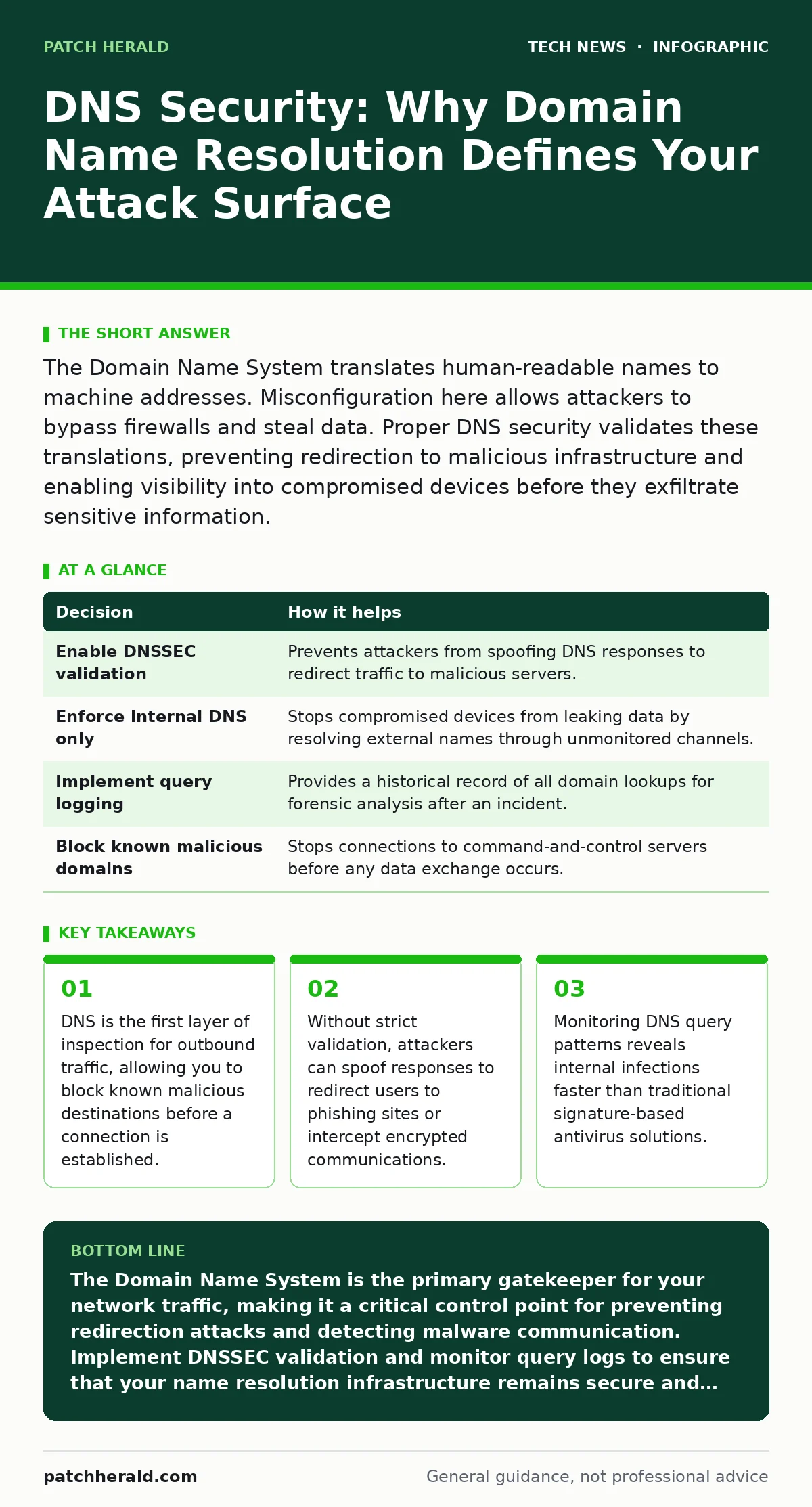
The Domain Name System translates human-readable names to machine addresses. Misconfiguration here allows attackers to bypass firewalls and steal data. Proper DNS security validates these translations, preventing redirection to malicious infrastructure and enabling visibility into compromised devices before they exfiltrate sensitive information.
The Invisible Gatekeeper
You likely think of the Domain Name System as a simple phonebook for the internet. It translates easy-to-remember names into numerical addresses that computers use to locate each other. This translation happens before any data moves between your devices and the external world. Because every web request, email, and software update begins with a DNS query, this protocol sits at the very edge of your digital perimeter.
If this translation fails or is manipulated, your entire security strategy collapses. Firewalls rely on IP addresses to filter traffic, but users interact with names. If an attacker convinces your system that a legitimate name points to a malicious address, your firewall may allow the connection because the destination IP looks new or harmless. The Domain Name System is not just a convenience feature; it is the foundation of trust for all network communications.
Decisions Informed by Resolution
Your security posture depends on how you handle the answers provided by the Domain Name System. Every time a device on your network asks for an address, you make a decision about whether to trust that answer. Most organizations accept these answers blindly, assuming the public infrastructure is secure. This assumption is dangerous. The protocol was designed for speed and simplicity, not security, which creates inherent vulnerabilities.
You must decide whether to validate the authenticity of DNS responses. Without validation, your devices are vulnerable to cache poisoning, where an attacker inserts false data into your local DNS cache. This forces your users to connect to addresses controlled by the attacker. You also decide how long to remember these answers. Long retention times improve performance but increase the window of exposure if an address is compromised. Short retention times reduce risk but increase query volume, which can impact network performance.
| Decision | How it helps |
|---|---|
| Enable DNSSEC validation | Prevents attackers from spoofing DNS responses to redirect traffic to malicious servers. |
| Enforce internal DNS only | Stops compromised devices from leaking data by resolving external names through unmonitored channels. |
| Implement query logging | Provides a historical record of all domain lookups for forensic analysis after an incident. |
| Block known malicious domains | Stops connections to command-and-control servers before any data exchange occurs. |
What Goes Wrong Without Validation
Imagine a scenario where an employee clicks a link in an email that appears to come from a trusted vendor. The link uses a legitimate domain name. However, an attacker has poisoned the DNS cache on your local network. When your employee’s computer asks for the address, the DNS server returns an address controlled by the attacker. The browser connects to this fake server. The connection is encrypted, so your network inspection tools see only scrambled data. The attacker now has full access to the employee’s credentials.
This failure mode is common because the Domain Name System does not verify the source of the answer by default. It simply returns the first valid-looking response it receives. This lack of verification means that anyone on the internet can attempt to inject false records into your cache. If you do not use DNS Security Extensions, you have no way to prove that the address you received actually came from the authoritative source for that domain.
How Teams Use DNS for Defense
Security teams use the Domain Name System as a primary sensor for detecting internal threats. When a device is infected with malware, it must communicate with the attacker’s control server. This communication almost always starts with a DNS query. By monitoring these queries, you can identify devices that are contacting known malicious domains. This method is effective because it detects activity before the malware can download large payloads or exfiltrate significant data.
Teams also use DNS to enforce policy. By configuring your network to use a specific internal DNS server, you can block access to categories of sites that pose a risk, such as gambling or adult content. More importantly, you can block access to newly registered domains, which are frequently used for phishing and malware distribution. This proactive blocking reduces the attack surface by preventing connections to destinations that have not established a reputation.
The Cost of Poor Configuration
Configuring the Domain Name System correctly requires ongoing effort. You must ensure that your internal servers do not allow open recursion, a setting that allows anyone on the internet to use your server to resolve names. Open recursion makes your server a target for amplification attacks, where attackers use your bandwidth to flood other victims. You must also ensure that your internal network cannot bypass your security controls by using public DNS resolvers directly.
Many organizations fail to monitor DNS query volume. A sudden spike in queries to unusual top-level domains can indicate a data exfiltration attempt. Attackers often encode stolen data in DNS queries because firewalls often allow DNS traffic to pass unchecked. If you do not inspect this traffic, you may not notice that sensitive information is leaving your network. This oversight turns your primary name resolution service into a covert channel for data theft.
See also: Difference Between Operating System and Kernel: Core Functions Explained · Can IP Addresses Be Traced? How Visibility Works
Integration with Other Controls
The Domain Name System works best when integrated with other security mechanisms. For example, Certificate Transparency logs help you verify that SSL certificates are issued correctly, but DNS validation ensures you are connecting to the correct server in the first place. Without proper DNS security, even valid certificates can be used by attackers to impersonate legitimate services. Similarly, network access control policies can restrict which devices are allowed to make DNS queries, limiting the impact of a compromised endpoint.
Consider how open-source software security practices apply here. Many DNS servers are open source, meaning you can inspect the code for vulnerabilities. However, this also means you must keep these servers updated to patch any discovered flaws. Neglecting updates leaves your resolution infrastructure vulnerable to exploitation. You must balance the need for stability with the need for security patches.
Beyond Basic Resolution
Advanced security requires looking beyond simple address resolution. You should consider how post-quantum cryptography will impact DNS Security Extensions in the future. Current cryptographic methods used to sign DNS records may become vulnerable to quantum computing attacks. Preparing for this shift now ensures that your long-term trust model remains valid. Additionally, operating system hardening includes configuring the OS to prefer secure DNS protocols, such as DNS over HTTPS, which encrypts the queries themselves.
Encrypting DNS queries prevents your internet service provider or local network attackers from seeing which sites you visit. While this improves privacy, it can complicate security monitoring because your internal tools can no longer inspect the content of the queries. You must weigh the benefits of privacy against the need for visibility. In a small business context, visibility is often more critical for detecting internal threats.
Maintaining Trust Over Time
The Domain Name System is a dynamic infrastructure. Domains expire, servers change, and new threats emerge. Your security strategy must adapt to these changes. You should establish a process for reviewing DNS configurations and access controls regularly. This includes checking who has administrative access to your DNS management console. Compromised admin credentials can lead to the complete takeover of your domain’s resolution.
You must also monitor for changes in your DNS records. Unauthorized changes to MX records can redirect your email to a server controlled by an attacker. Changes to A records can redirect web traffic. By logging and alerting on these changes, you can detect compromise early. The Domain Name System is not a set-and-forget technology. It requires active management to maintain the trust that your entire network relies upon.
Key takeaways
- DNS is the first layer of inspection for outbound traffic, allowing you to block known malicious destinations before a connection is established.
- Without strict validation, attackers can spoof responses to redirect users to phishing sites or intercept encrypted communications.
- Monitoring DNS query patterns reveals internal infections faster than traditional signature-based antivirus solutions.
The Domain Name System is the primary gatekeeper for your network traffic, making it a critical control point for preventing redirection attacks and detecting malware communication. Implement DNSSEC validation and monitor query logs to ensure that your name resolution infrastructure remains secure and visible.
Frequently asked questions
Does DNS over HTTPS make my network less secure?
DNS over HTTPS encrypts queries, preventing outsiders from seeing your browsing habits, but it also hides traffic from your internal security tools, potentially allowing malware to communicate undetected.
How often should I review my DNS configurations?
You should review DNS configurations quarterly or whenever you make significant changes to your network infrastructure, ensuring that access controls and record settings remain aligned with your security policy.
Can DNS security stop all phishing attacks?
DNS security can block access to known malicious domains, but it cannot stop phishing emails from reaching your inbox or prevent users from clicking links to legitimate-looking but compromised sites.
What is the risk of using public DNS resolvers?
Using public DNS resolvers bypasses your internal security controls, allowing compromised devices to communicate with external servers without your knowledge or ability to filter the traffic.
How this guide was produced: written by the Patch Herald editorial team with AI assistance, checked against the public references listed below, and reviewed when the facts change. See our editorial policy or report an error.