
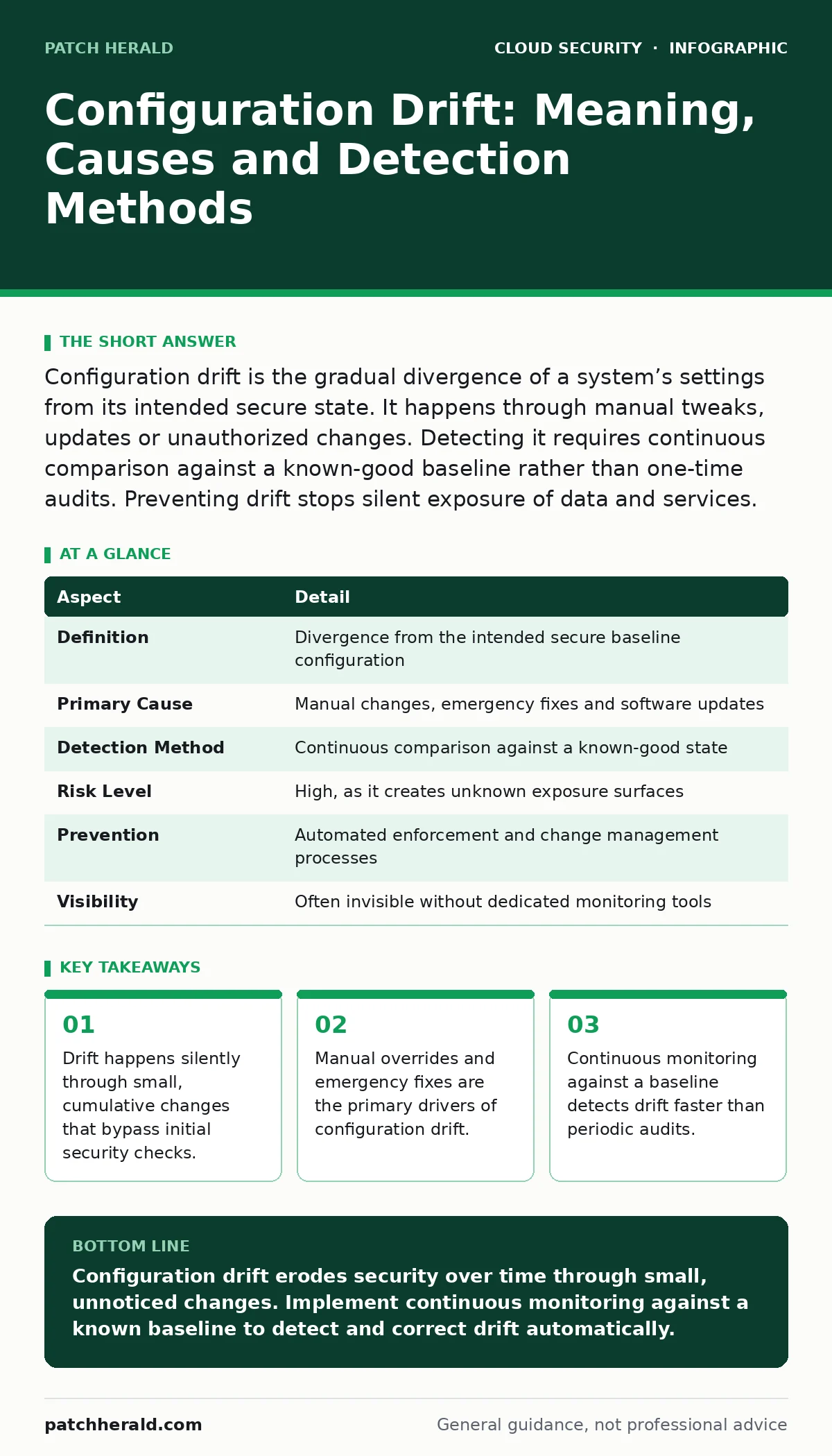
Configuration drift is the gradual divergence of a system’s settings from its intended secure state. It happens through manual tweaks, updates or unauthorized changes. Detecting it requires continuous comparison against a known-good baseline rather than one-time audits. Preventing drift stops silent exposure of data and services.
The Garden Analogy for System Integrity
Imagine a well-manicured garden where every plant has a specific place. Over time, weeds appear, vines overgrow fences and new plants sprout in unintended spots. Without regular maintenance, the garden looks different from the original design. Configuration drift works the same way in cloud environments. The initial setup is secure and documented. Daily operations introduce small changes. These changes accumulate until the system no longer matches the security blueprint.
The original design represents your security baseline. The weeds represent unauthorized or unintended changes. The overgrown vines represent manual adjustments made for convenience. Just as a gardener compares the current state to the original plan, security teams must compare live systems to their intended configuration.
What Configuration Drift Actually Means
Configuration drift is the gradual divergence of a system’s settings from its intended secure state. It occurs when the actual configuration of a server, database or network differs from the documented baseline. This difference is rarely a single catastrophic error. It is usually a series of small, seemingly harmless changes. These changes might include opening a port for testing and forgetting to close it. They might include disabling a security alert to stop noise.
The term comes from the idea of drifting away from a fixed point. In practice, it means your security controls are weaker than you believe. You think your system is locked down. In reality, settings have shifted. This shift creates gaps that attackers can exploit. The danger lies in the assumption that the system remains secure after the initial hardening. It does not.
| Aspect | Detail |
|---|---|
| Definition | Divergence from the intended secure baseline configuration |
| Primary Cause | Manual changes, emergency fixes and software updates |
| Detection Method | Continuous comparison against a known-good state |
| Risk Level | High, as it creates unknown exposure surfaces |
| Prevention | Automated enforcement and change management processes |
| Visibility | Often invisible without dedicated monitoring tools |
How Drift Enters Your Environment
Drift enters through human action and automated processes. Developers often make temporary changes to troubleshoot an issue. They open a firewall rule to test connectivity. They disable a security check to speed up deployment. Once the issue is resolved, they forget to revert the change. The system remains in a less secure state.
Software updates also cause drift. A patch might reset a configuration file to default values. These defaults are often less secure than your hardened settings. If your automation does not re-apply the hardening after the update, the system drifts. Another source is shadow IT, where teams provision resources outside standard processes. These resources lack the security baseline entirely.
The Hidden Cost of Silent Changes
The most dangerous aspect of configuration drift is its silence. There is no alert when a single setting changes. There is no notification when a firewall rule expands. The system continues to function normally. Users experience no disruption. This normalcy masks the growing risk.
You cannot see drift by looking at the system’s output. You must inspect the internal settings. This requires active monitoring. Without it, you operate on outdated information. You believe your controls are active. They are not. This false sense of security delays detection. By the time an incident occurs, the drift has existed for weeks or months.
This delay increases the impact of any breach. Attackers exploit the gap between your belief and reality. They find open ports, weak permissions or disabled logging. These are the results of drift. The cost is not just the breach. It is the time spent investigating why the controls failed.
What People Usually Get Wrong
Many teams believe that initial hardening is enough. They configure the system securely at deployment. They assume it stays that way. This is incorrect. Systems change. People change settings. Updates change files. Without continuous verification, the baseline becomes obsolete.
Another common error is relying on periodic audits. Audits provide a snapshot in time. They miss changes that happen between audits. A system might be secure on Monday and drifted by Wednesday. An audit on Friday would catch it, but the exposure existed for days. Continuous monitoring is required to catch drift as it happens.
Some teams blame users for drift. They see manual changes as the root cause. While manual changes are a factor, the root cause is the lack of enforcement. If the system prevents unauthorized changes, drift is impossible. Blaming users ignores the need for technical controls.
See also: Private Endpoints Explained: How to Stop Cloud Data Leaks · Stop Cloud Data Exfiltration: 4 Measures That Actually Work
Detecting Drift Before It Becomes a Breach
Detection requires a known-good baseline. This baseline is a detailed record of the secure configuration. It includes firewall rules, user permissions, logging settings and encryption standards. You must store this baseline in a version-controlled system.
Monitoring tools compare the live system against this baseline. They check for differences. If a setting differs, the tool flags it as drift. This comparison must happen frequently. Hourly or daily checks are common. Real-time monitoring is ideal but complex.
The key is automation. Manual checks are too slow and prone to error. Automated tools can scan hundreds of systems simultaneously. They identify drift quickly. They also provide a history of changes. This history helps you understand how the drift occurred.
Preventing Drift Through Automation
Prevention requires removing the ability to drift. This means enforcing configuration through code. Infrastructure as Code (IaC) tools define the desired state. When the system drifts, the tool detects it. It then automatically reverts the change.
This approach ensures consistency. Every system matches the baseline. Manual changes are blocked or reversed. This reduces human error. It also speeds up recovery. If an attacker changes a setting, the system corrects itself.
You must also manage updates carefully. Update processes must include re-hardening steps. If an update resets a configuration, the automation must re-apply the secure settings. This ensures that updates do not cause drift.
The Role of Governance and Policy
Technical controls alone are not enough. You need governance. Policies must define who can make changes. They must define the process for making changes. This includes approval workflows.
Changes must be documented. Every change must have a reason. This creates an audit trail. It helps you understand why drift occurred. It also holds teams accountable.
Governance also involves training. Teams must understand the risks of drift. They must know how to make changes safely. They must know how to revert changes. This cultural shift supports technical controls.
Related guides on cloud misconfigurations and private endpoints provide deeper context on specific settings. Understanding cloud data exfiltration risks helps prioritize which drift matters most.
Key takeaways
- Drift happens silently through small, cumulative changes that bypass initial security checks.
- Manual overrides and emergency fixes are the primary drivers of configuration drift.
- Continuous monitoring against a baseline detects drift faster than periodic audits.
Configuration drift erodes security over time through small, unnoticed changes. Implement continuous monitoring against a known baseline to detect and correct drift automatically.
Frequently asked questions
How often should I check for configuration drift?
Check for drift continuously or at least daily. Real-time monitoring is ideal for critical systems. Periodic audits are insufficient for catching rapid changes.
Can automation prevent all configuration drift?
Automation prevents most drift by enforcing baselines. However, it cannot prevent drift if the baseline itself is incorrect or outdated. Regular baseline reviews are necessary.
What is the difference between drift and misconfiguration?
Misconfiguration is an error in the initial setup. Drift is the change from a correct initial setup to an incorrect state over time. One is a starting error; the other is a process failure.
Does cloud IAM policies help with drift?
Yes, strict cloud IAM policies limit who can change settings. This reduces the surface area for unauthorized changes. It does not eliminate drift from automated processes or updates.
How this guide was produced: written by the Patch Herald editorial team with AI assistance, checked against the public references listed below, and reviewed when the facts change. See our editorial policy or report an error.