
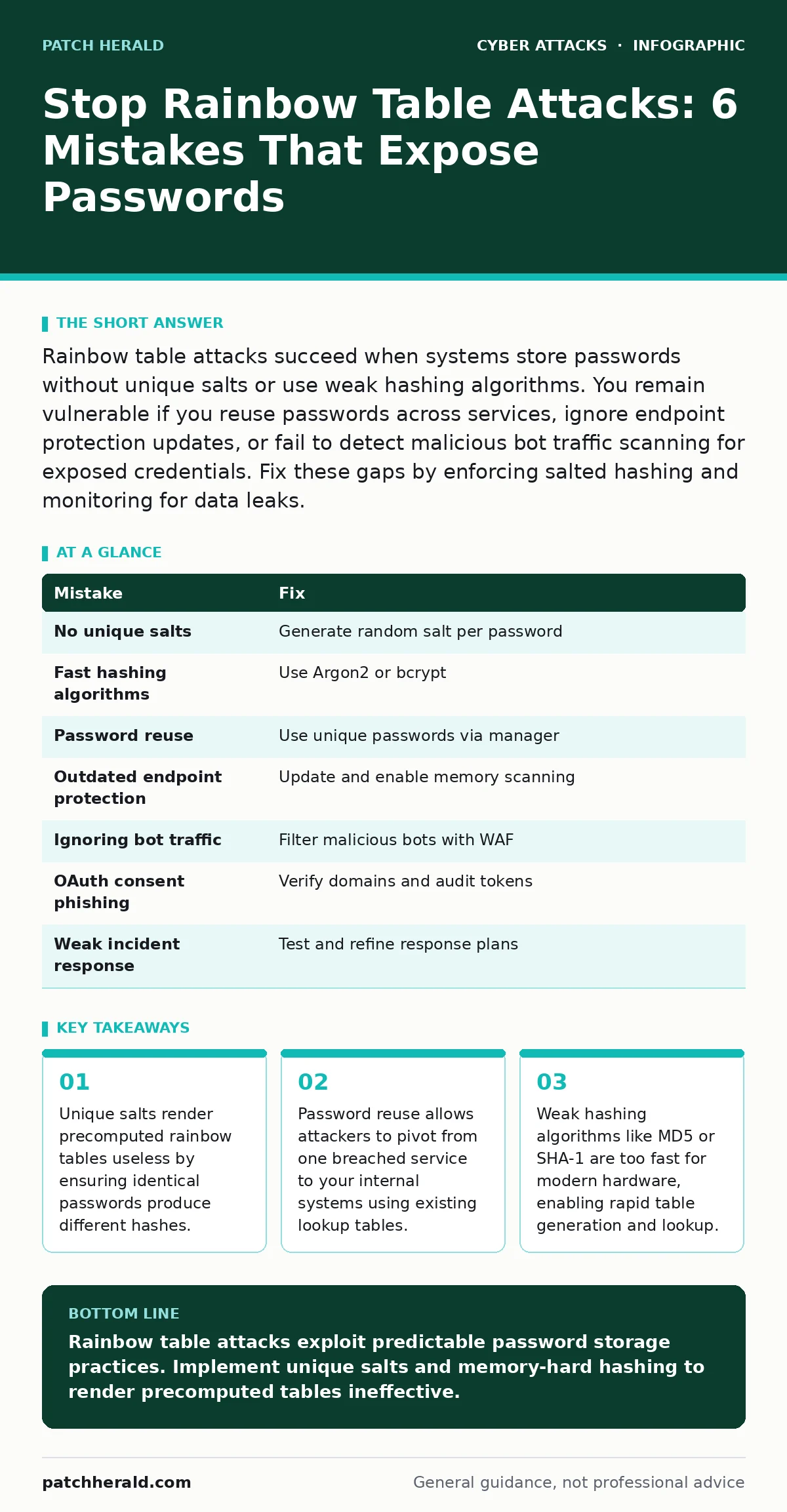
Rainbow table attacks succeed when systems store passwords without unique salts or use weak hashing algorithms. You remain vulnerable if you reuse passwords across services, ignore endpoint protection updates, or fail to detect malicious bot traffic scanning for exposed credentials. Fix these gaps by enforcing salted hashing and monitoring for data leaks.
Mistake 1: Storing Passwords Without Unique Salts
Using a global salt or no salt at all allows attackers to use a single rainbow table against your entire user database. A salt is a random value added to each password before hashing. If two users have the same password and the same salt, they produce the same hash. Attackers can match that hash against a precomputed table instantly.
Why it hurts:
Precomputed rainbow tables are massive databases of hash-to-password mappings. Without unique salts, an attacker does not need to compute anything. They simply look up the hash in their table. This turns a security breach into a trivial database query. The cost of generating these tables is paid once by the attacker, not by you during an attack.
The fix:
Generate a cryptographically secure random salt for every single password. Store this salt alongside the hash. When a user logs in, retrieve the salt, append it to the entered password, and hash the result. Compare this new hash to the stored one. Never reuse salts across users or systems.
Mistake 2: Using Fast or Broken Hashing Algorithms
Choosing algorithms designed for speed, such as MD5 or SHA-1, accelerates rainbow table generation. These algorithms were created for data integrity checks, not password security. Modern hardware can compute billions of these hashes per second. This speed allows attackers to build comprehensive tables covering common password patterns quickly.
Why it hurts:
Speed is the enemy of password security. A fast algorithm means an attacker can generate a table covering all 8-character alphanumeric passwords in hours. If your system uses these old standards, your password hashes are vulnerable to immediate lookup. The computational barrier that protects slower algorithms does not exist here.
The fix:
Use memory-hard hashing functions like Argon2 or bcrypt. These algorithms are designed to be slow and require significant memory resources. They make it economically unfeasible for attackers to generate large rainbow tables. The added login latency is negligible for users but creates a massive barrier for attackers.
Mistake 3: Reusing Passwords Across Multiple Services
Password reuse multiplies the impact of a single breach. If a third-party service you use is compromised, attackers obtain your password hash. If that service used weak security, they may recover your plain-text password. They then test this password on your primary business accounts. This is known as credential stuffing.
Why it hurts:
You lose control over your security perimeter. A breach at a low-value service becomes a high-value entry point for your critical systems. Attackers do not need to break your encryption if they already have your key from elsewhere. This bypasses your local defenses entirely.
The fix:
Enforce unique passwords for every service. Use a password manager to generate and store complex, random strings. This ensures that a breach at one vendor does not compromise your internal infrastructure. Monitor for data leaks using breach notification services.
Mistake 4: Ignoring Endpoint Protection Updates
Unpatched endpoints provide the initial access needed to steal password databases. Attackers often deploy malware that extracts browser-stored credentials or memory-resident password hashes. Without current endpoint protection, these tools operate undetected. The stolen data is then exfiltrated to build custom rainbow tables.
Why it hurts:
Rainbow table attacks are often the final step in a larger intrusion. If an attacker can access your live systems, they can harvest hashes in real-time. This allows them to create targeted tables for your specific user base. General network defenses do not stop malware running on the host device.
The fix:
Maintain updated endpoint protection on all devices that access sensitive data. Ensure these tools have memory scanning capabilities to detect credential harvesting malware. Regular updates close known vulnerabilities that attackers use to gain initial footholds.
Mistake 5: Failing to Detect Malicious Bot Traffic
Automated bots scan for exposed administrative panels and login pages. These bots identify systems that are vulnerable to brute-force attacks or have leaked credentials. If you do not monitor for this traffic, you miss the early warning signs of an impending attack. The bots are gathering intelligence for future rainbow table usage.
Why it hurts:
Silent scanning allows attackers to map your attack surface without triggering alarms. They identify which services are active and which users exist. This intelligence helps them prioritize which hashes to crack first. You remain unaware until the actual data extraction occurs.
The fix:
Implement web application firewalls that filter out known malicious bot traffic. Monitor login attempts for unusual patterns, such as rapid sequential failures. Block IP addresses that exhibit scanning behavior. This reduces the noise and highlights genuine threats.
See also: Dumpster Diving Mistakes That Expose Your Business Data · Malicious Bot Traffic: What It Is and How to Stop It
Mistake 6: Overlooking OAuth Consent Phishing Risks
OAuth consent phishing tricks users into granting attackers access to their accounts without needing passwords. Attackers create fake authorization requests that look legitimate. Users approve access, giving the attacker a valid token. This bypasses traditional password-based security controls entirely.
Why it hurts:
You may believe your password hashing is secure, but OAuth tokens provide direct access. Attackers do not need to crack hashes if they can steal active sessions. This renders rainbow table defenses irrelevant for those specific accounts. The user’s trust in the interface is exploited.
The fix:
Educate users to verify the domain and scope of OAuth requests. Implement strict consent screen policies that highlight third-party access requests. Regularly audit active OAuth tokens and revoke unnecessary permissions. This limits the damage of social engineering attacks.
Mistake 7: Lacking Effective Incident Response Plans
A delayed response allows attackers to exfiltrate data before containment. Without a clear plan, teams scramble to identify the scope of the breach. This delay gives attackers time to download password databases. Once the hashes are in the attacker’s possession, the clock starts on rainbow table generation.
Why it hurts:
Time is the attacker’s ally. The longer they have access, the more data they can steal. A disorganized response leads to incomplete evidence collection and prolonged exposure. You lose the ability to mitigate damage quickly.
The fix:
Develop and test incident response plans regularly. Define clear roles for containment, eradication, and recovery. Ensure the plan includes specific steps for credential rotation and user notification. Speed and precision limit the attacker’s window of opportunity.
| Mistake | Fix |
|---|---|
| No unique salts | Generate random salt per password |
| Fast hashing algorithms | Use Argon2 or bcrypt |
| Password reuse | Use unique passwords via manager |
| Outdated endpoint protection | Update and enable memory scanning |
| Ignoring bot traffic | Filter malicious bots with WAF |
| OAuth consent phishing | Verify domains and audit tokens |
| Weak incident response | Test and refine response plans |
Key takeaways
- Unique salts render precomputed rainbow tables useless by ensuring identical passwords produce different hashes.
- Password reuse allows attackers to pivot from one breached service to your internal systems using existing lookup tables.
- Weak hashing algorithms like MD5 or SHA-1 are too fast for modern hardware, enabling rapid table generation and lookup.
Rainbow table attacks exploit predictable password storage practices. Implement unique salts and memory-hard hashing to render precomputed tables ineffective.
Frequently asked questions
Can rainbow tables crack salted passwords?
No, unique salts force attackers to generate a new table for each password, making the attack computationally impractical.
Is bcrypt enough to stop rainbow tables?
Yes, bcrypt is designed to be slow and memory-intensive, preventing the rapid generation of large lookup tables.
Do password managers protect against rainbow tables?
Indirectly, by ensuring unique passwords, they prevent a breach at one site from compromising others via credential stuffing.
How often should I update my hashing algorithm?
Review your algorithm choice every few years to adopt newer standards like Argon2 as hardware capabilities evolve.
How this guide was produced: written by the Patch Herald editorial team with AI assistance, checked against the public references listed below, and reviewed when the facts change. See our editorial policy or report an error.