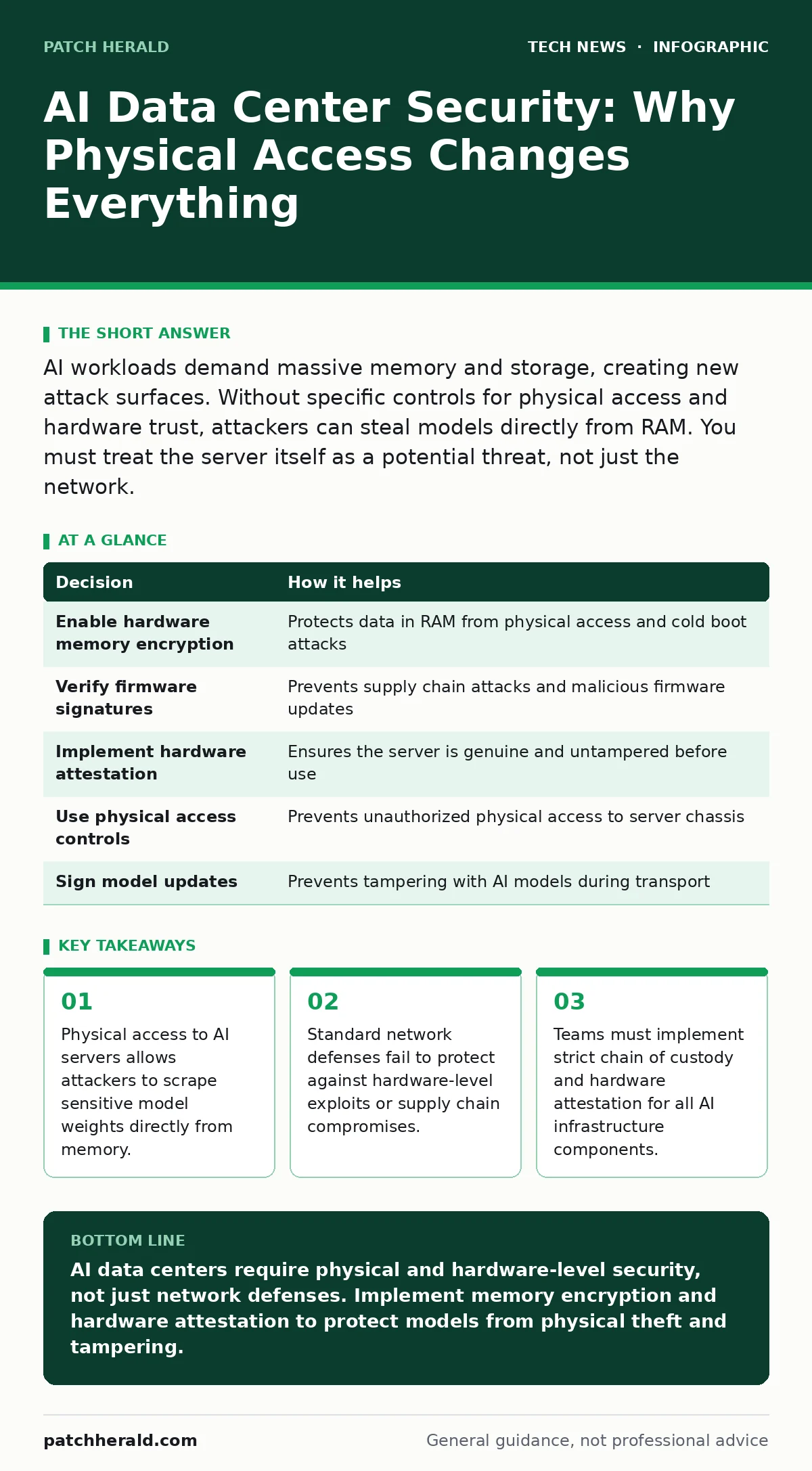
AI workloads demand massive memory and storage, creating new attack surfaces. Without specific controls for physical access and hardware trust, attackers can steal models directly from RAM. You must treat the server itself as a potential threat, not just the network.
The Shift from Network to Hardware
Traditional server security focuses on network boundaries. Firewalls filter traffic and intrusion detection systems monitor packets. AI data centers change this dynamic. The value resides in the memory and storage of the physical machines. Attackers no longer need to breach the network to steal intellectual property. They only need physical access to the server chassis. This shifts the security model from perimeter defense to hardware trust. You must assume the network is compromised and protect the data at rest and in memory.
Physical Access Risks
Imagine a server room with standard badge access. An attacker gains entry and opens a server chassis. They insert a debugging tool into a maintenance port. This tool reads the contents of the RAM. The RAM holds the AI model weights and training data. This data is unencrypted in memory during processing. Network encryption does not protect data inside the processor. The attacker copies the model to a USB drive and leaves. No network logs show an exfiltration. The theft is invisible to digital monitoring tools.
Supply Chain Integrity
Hardware components come from multiple vendors. Each component introduces a potential backdoor. A malicious firmware update in a network interface card can intercept data before encryption. A compromised baseboard management controller can grant remote access to the system. You must verify the integrity of every hardware component before installation. This requires checking digital signatures on firmware. You cannot trust the vendor alone. You must implement your own verification process. This adds time to deployment but prevents supply chain attacks.
Memory Protection Mechanisms
AI models require large amounts of memory. This memory is often volatile and fast. Encryption at rest protects data on disks. It does not protect data in RAM. Some processors offer memory encryption features. These features encrypt data as it moves between the processor and memory modules. This protects against cold boot attacks. These attacks involve freezing the RAM to preserve its contents after power loss. You must enable hardware-level memory encryption on all AI servers. This adds a small performance cost but prevents memory scraping.
Chain of Custody for Models
AI models are valuable assets. They move from development to training to production. Each transfer is a risk point. A model file can be swapped with a poisoned version. A poisoned model produces incorrect outputs or leaks data. You must maintain a strict chain of custody. This means verifying the hash of the model file at each step. Use public key cryptography to sign model updates. Only accept models signed by authorized developers. This prevents tampering during transport. It also ensures that the model running in production is the one you tested.
See also: Load Balancers Types: How Traffic Distribution Protects Your Systems
Hardware Attestation
Hardware attestation proves that a device is genuine. It verifies that the firmware has not been modified. You can use attestation to check the state of a server before loading sensitive data. If the attestation fails, the system refuses to run the AI workload. This prevents execution on compromised hardware. It also ensures that the hardware matches the expected configuration. This is critical for multi-tenant environments. It prevents one tenant from affecting another. Attestation adds complexity to deployment. It requires a secure root of trust in the hardware.
Decision Framework for Security
You must make specific choices about how to protect your AI infrastructure. These decisions affect cost, performance, and security. The table below outlines key decisions and their impact.
| Decision | How it helps |
|---|---|
| Enable hardware memory encryption | Protects data in RAM from physical access and cold boot attacks |
| Verify firmware signatures | Prevents supply chain attacks and malicious firmware updates |
| Implement hardware attestation | Ensures the server is genuine and untampered before use |
| Use physical access controls | Prevents unauthorized physical access to server chassis |
| Sign model updates | Prevents tampering with AI models during transport |
Operational Trade-offs
Security measures add overhead. Memory encryption slows down data access. Attestation adds time to server boot. Supply chain verification delays deployment. You must balance security with performance. AI workloads are sensitive to latency. Excessive security can degrade model performance. You should test security measures in a staging environment. Measure the impact on inference speed. Adjust settings to find the optimal balance. Do not disable security for performance. Instead, optimize the configuration. Use hardware that supports security features natively. This minimizes the performance penalty.
Integration with Existing Controls
AI security does not replace existing controls. It extends them. You still need strong network access control. You still need operating system hardening. You still need SSH key management for remote access. These controls protect the management plane. Hardware security protects the data plane. Both are necessary. You must integrate them into a unified strategy. Use the same identity provider for both. Ensure that logs from hardware and software are correlated. This provides a complete view of security events. It helps you detect attacks that span both layers.
Monitoring and Response
Physical intrusions are rare but high impact. You must monitor for them. Use sensors to detect chassis opens. Use cameras to record access. Integrate these logs with your security information system. Alert on any physical access event. Investigate every alert. Assume that physical access leads to compromise. Have a plan to rotate keys and models. If a server is compromised, assume the model is stolen. Rebuild the model if possible. Do not rely on obscurity. Assume the attacker has the model. Focus on limiting the damage. Use data minimization. Only store what is necessary. Delete old model versions. This reduces the value of a successful attack.
Future Considerations
AI hardware is evolving. New processors offer more security features. Quantum computing may break current encryption. You must plan for these changes. Evaluate new hardware for security capabilities. Choose vendors that support open standards. Avoid proprietary security features that lock you in. Plan for post-quantum cryptography. Identify algorithms that are vulnerable to quantum attacks. Prepare to migrate to quantum-resistant algorithms. This takes time. Start now. Review your encryption usage. Identify where you use vulnerable algorithms. Plan the migration path. This ensures long-term security for your AI infrastructure.
Key takeaways
- Physical access to AI servers allows attackers to scrape sensitive model weights directly from memory.
- Standard network defenses fail to protect against hardware-level exploits or supply chain compromises.
- Teams must implement strict chain of custody and hardware attestation for all AI infrastructure components.
AI data centers require physical and hardware-level security, not just network defenses. Implement memory encryption and hardware attestation to protect models from physical theft and tampering.
Frequently asked questions
Does network encryption protect AI models in memory?
No, network encryption protects data in transit. It does not protect data stored in RAM or on disks. You need memory encryption and disk encryption for full protection.
How do I detect a physical intrusion?
Use chassis intrusion sensors and video surveillance. Integrate these logs with your security monitoring system. Alert on any unauthorized physical access to server rooms.
What is hardware attestation?
Hardware attestation verifies that a device is genuine and its firmware is untampered. It ensures the hardware matches the expected configuration before running sensitive workloads.
Can I use standard servers for AI workloads?
You can, but they may lack advanced security features. Consider servers with hardware memory encryption and secure boot. These features provide better protection for AI models.
How this guide was produced: written by the Patch Herald editorial team with AI assistance, checked against the public references listed below, and reviewed when the facts change. See our editorial policy or report an error.