
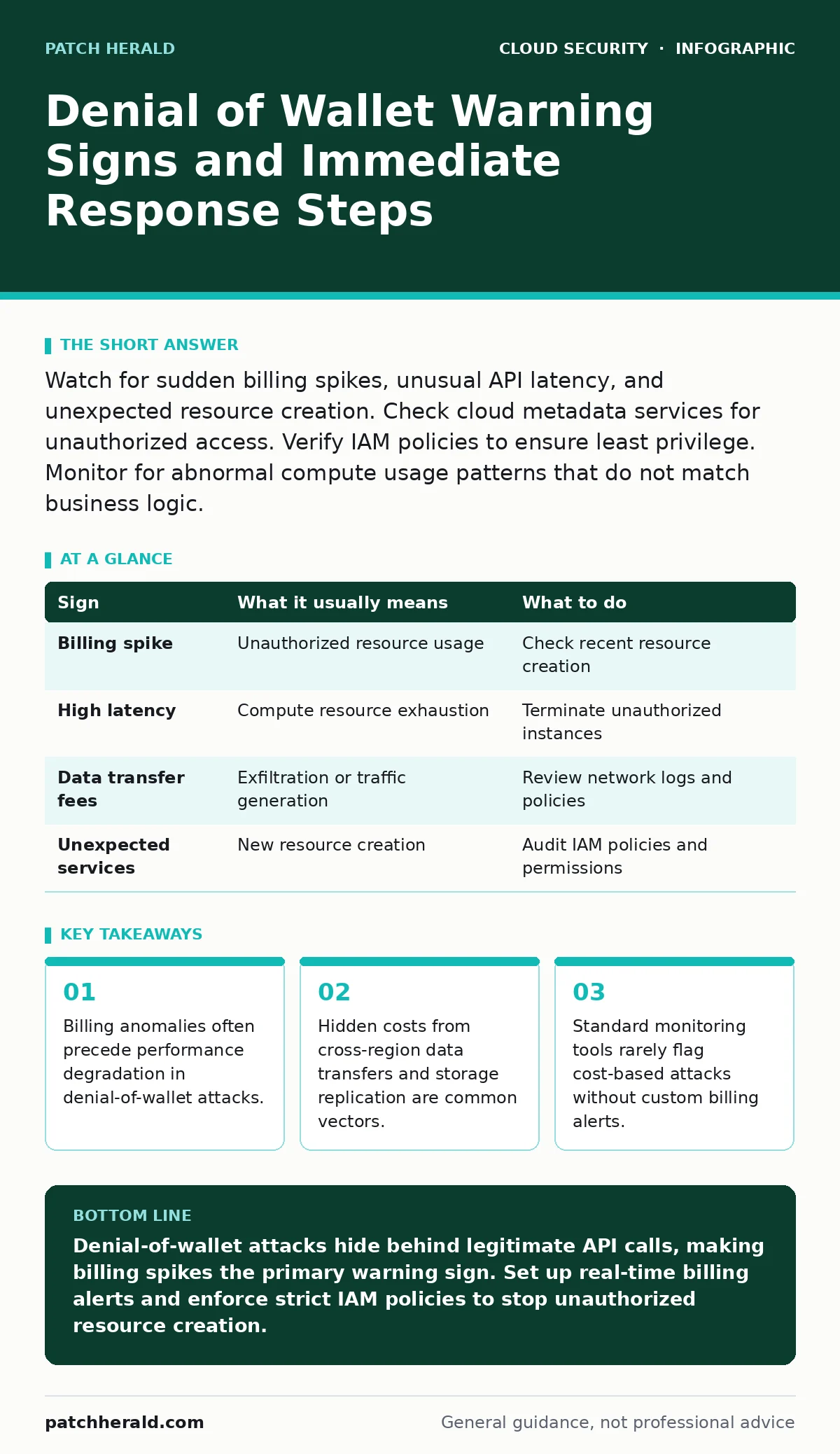
Watch for sudden billing spikes, unusual API latency, and unexpected resource creation. Check cloud metadata services for unauthorized access. Verify IAM policies to ensure least privilege. Monitor for abnormal compute usage patterns that do not match business logic.
The First Glitch in Performance
You notice your applications responding slower than usual. This latency is not caused by a traditional denial-of-service attack that floods your network with traffic. Instead, an attacker is consuming your compute resources. They are running expensive processes that exhaust your available CPU or memory.
This consumption happens within your own infrastructure. The traffic looks legitimate because it originates from authorized identities. Your cloud provider treats the requests as valid workloads. You pay for every cycle the attacker uses.
The Billing Shock
The most obvious sign is a sudden increase in your cloud bill. This spike often appears days or weeks after the attack begins. Cloud providers bill in arrears, meaning you pay for what was used in the previous period.
By the time you see the invoice, the damage is done. The attacker has already consumed the resources. You may see charges for services you do not typically use. These unexpected line items are a strong indicator of misuse.
Hidden Resource Consumption
Some signs are easy to miss because they blend into normal operations. Attackers often use low-and-slow techniques. They create small instances or storage buckets that individually seem harmless. Collectively, they drain your budget.
They may also trigger data transfer fees. Moving data between regions or to external networks costs money. An attacker can exfiltrate data or generate traffic to inflate these costs. You might not see the traffic spike, but you will see the transfer charges.
Monitoring the Metadata Service
Cloud instances often have metadata services. These services provide configuration data to the running instance. Attackers target these services to steal credentials. Once they have credentials, they can spawn new resources.
This is a key step in cloud metadata service attacks. The attacker does not need to hack your main account. They just need to compromise one instance. From there, they can escalate privileges. They can create expensive resources that run until you stop them.
Checking Identity and Access
You must review your cloud IAM policies. These policies define who can do what in your cloud environment. Weak policies allow attackers to create resources they should not be able to create.
Look for permissions that allow resource creation. Attackers often exploit overly broad permissions. They use these to spin up compute instances or storage. If a service account has the ability to create instances, it is a risk. You should follow the principle of least privilege.
See also: Shadow IT Myths: 6 Misconceptions Blocking Cloud Security · Federated Identity: Definition, Purpose and How It Works
Analyzing Network Traffic Patterns
Standard cloud firewalls may not detect these attacks. The traffic is often encrypted and legitimate. It comes from authorized sources. Traditional security tools look for known bad signatures. Denial-of-wallet attacks use valid signatures.
You need to look at the volume and pattern of requests. Are there many small requests coming from unusual locations? Are there requests for resources that do not match your business logic? These anomalies can indicate an attack.
Responding to the Attack
When you suspect a denial-of-wallet attack, act quickly. First, identify the unauthorized resources. Use your cloud provider's console to list recent creations. Look for resources that do not match your expected inventory.
Terminate the unauthorized resources immediately. This stops the bleeding. Then, rotate any credentials that may have been compromised. Review your access logs to understand how the attacker got in. Update your policies to prevent this from happening again.
Preventing Future Incidents
Prevention requires a shift in mindset. You must treat cost as a security metric. Monitor your spending in real-time. Set up alerts for unusual activity. Review your cloud incident response plans to include cost-based attacks.
Ensure your hybrid cloud security covers all environments. Attackers can move between on-premises and cloud resources. They can use one to attack the other. Keep your federated identity configurations tight. This reduces the risk of credential theft.
| Sign | What it usually means | What to do |
|---|---|---|
| Billing spike | Unauthorized resource usage | Check recent resource creation |
| High latency | Compute resource exhaustion | Terminate unauthorized instances |
| Data transfer fees | Exfiltration or traffic generation | Review network logs and policies |
| Unexpected services | New resource creation | Audit IAM policies and permissions |
Key takeaways
- Billing anomalies often precede performance degradation in denial-of-wallet attacks.
- Hidden costs from cross-region data transfers and storage replication are common vectors.
- Standard monitoring tools rarely flag cost-based attacks without custom billing alerts.
Denial-of-wallet attacks hide behind legitimate API calls, making billing spikes the primary warning sign. Set up real-time billing alerts and enforce strict IAM policies to stop unauthorized resource creation.
Frequently asked questions
How do I distinguish between a legitimate traffic spike and a denial-of-wallet attack?
Legitimate spikes usually correlate with business events. Denial-of-wallet attacks often involve resources you do not recognize or use.
Can cloud firewalls stop a denial-of-wallet attack?
No, because the traffic is authorized. You need identity-based controls and billing monitoring to detect and prevent these attacks.
What is the first step in responding to a suspected attack?
Identify and terminate unauthorized resources to stop further cost accumulation. Then rotate any potentially compromised credentials.
How often should I review my cloud IAM policies?
Regularly, especially after any changes to your infrastructure. Ensure that permissions follow the principle of least privilege.
How this guide was produced: written by the Patch Herald editorial team with AI assistance, checked against the public references listed below, and reviewed when the facts change. See our editorial policy or report an error.