Look for uninitiated state changes, unexpected balance shifts, or configuration updates you did not perform. These indicate a forged request. Verify that your applications enforce anti-CSRF tokens on all state-changing actions and reject requests missing valid synchronization data.
The Illusion of Normalcy
Cross-site request forgery relies on the trust a server places in a user’s browser session. When you are logged into a service, your browser automatically attaches authentication cookies to every request you make to that domain. An attacker exploits this by tricking your browser into sending a request to a target site while you are authenticated. The server sees your valid cookie and assumes the action is yours.
You rarely see a pop-up or an error message during a successful attack. The request looks identical to a legitimate one from the server’s perspective. This silence is the most dangerous feature of the vulnerability.
Signs You Notice First
The first signs are usually operational anomalies that contradict your recent actions. You might log in to check your account balance and see a withdrawal you did not authorize. Or you might return to a settings page and find your email address has changed.
These are state changes. The system has moved from one condition to another without your explicit instruction. If you rely on multi-factor authentication for login but not for transactions, these changes happen instantly. The attacker does not need your password; they only need you to be logged in.
Imagine you click a link in an email that loads a hidden image from your bank’s website. That image request might trigger a fund transfer. You see no warning. You only notice the missing money later.
Signs That Are Easy to Miss
Subtle indicators often hide in plain sight. A common sign is a request that succeeds despite coming from an unexpected origin. Modern browsers enforce same-origin policies for reading data, but they do not block sending requests to other domains.
Look for actions that occur after you visit a third-party site. If you browse a forum and then immediately see a "comment posted" notification on your social media account, something is wrong. The timing suggests a triggered request.
Another missed sign is the absence of anti-CSRF tokens in the network traffic. If you inspect the developer tools and see POST requests lacking a unique, unpredictable token, your application is vulnerable. This is a structural flaw, not a user error.
The Mechanics of the Forgery
The core mechanism involves a state-changing HTTP method, such as POST or PUT. The attacker creates a page that automatically submits a form to your target application. Because your browser includes your session cookies, the target application accepts the command.
The attack fails only if the application verifies that the request originated from its own interface. This verification usually involves a double-submit cookie or a synchronizer token pattern. Without this check, the server cannot distinguish between a user clicking "Delete" and a malicious page forcing the click.
Response Protocol
When you suspect a CSRF attack, immediate action is required. First, change your password to invalidate existing sessions. This stops the current unauthorized access. Second, revoke any active sessions or refresh tokens through your account security settings.
Do not assume the issue is resolved after a password change. Attackers may have altered critical settings, such as recovery emails or API keys. Review all account configurations for unauthorized changes.
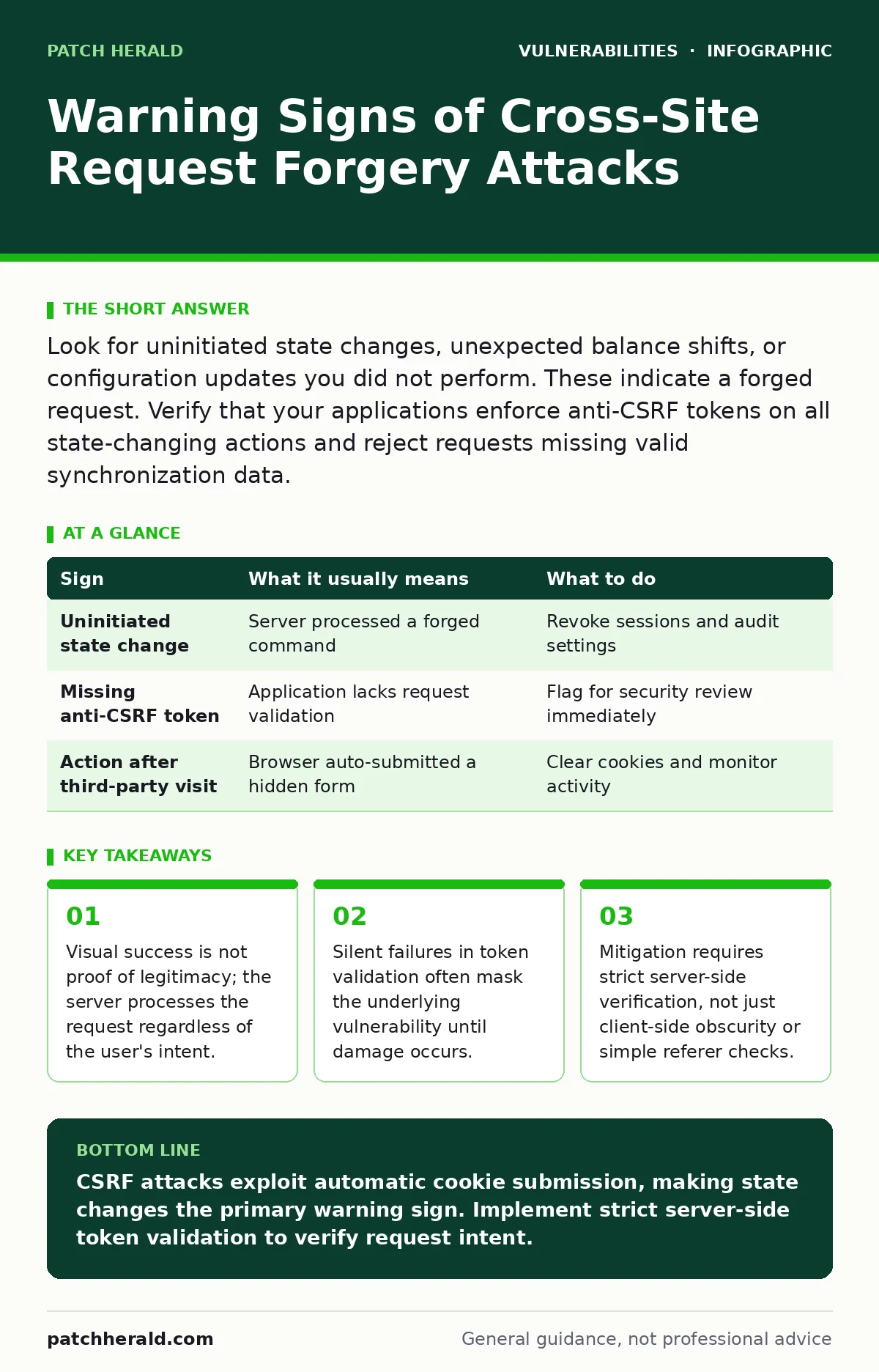
| Sign | What it usually means | What to do |
|---|---|---|
| Uninitiated state change | Server processed a forged command | Revoke sessions and audit settings |
| Missing anti-CSRF token | Application lacks request validation | Flag for security review immediately |
| Action after third-party visit | Browser auto-submitted a hidden form | Clear cookies and monitor activity |
See also: Malicious Bot Traffic: What It Is and How to Stop It
Structural Weaknesses
Many applications fail to protect state-changing endpoints. They assume that requiring a login is sufficient. It is not. Login authentication proves identity, but it does not prove intent.
The vulnerability often stems from a lack of strict referer checking. While some servers check the HTTP Referer header to ensure the request came from their own domain, this header can be stripped by proxies or spoofed by sophisticated attacks. It is a weak defense layer.
This relates to broader concepts in CWE weakness categories, which classify these flaws as improper verification of intent. Understanding these categories helps in identifying where your architecture lacks necessary controls.
Long-Term Mitigation
Prevention requires implementing anti-CSRF tokens on every state-changing form. These tokens are unique, unpredictable values generated by the server and embedded in forms. The server verifies the token before processing the request.
Do not rely on client-side obfuscation. Hiding the action URL or using JavaScript to generate requests does not stop determined attackers. The server must enforce the rule.
Consider how this interacts with exposed admin panels. These interfaces are high-value targets for CSRF because they allow configuration changes. If an admin panel lacks token validation, a single click can compromise the entire system.
Verification Steps
To verify your protection, inspect the HTML of your state-changing forms. Look for a hidden input field containing a unique token. Check the network tab to ensure this token is sent with the request.
If the token is missing, the application is vulnerable. If the token is present but static, it is weak. The token must be unique per session or per request.
This diligence mirrors the care needed for dependency confusion attacks, where internal systems are tricked into pulling malicious packages. In both cases, the system trusts an external input without proper validation.
Key takeaways
- Visual success is not proof of legitimacy; the server processes the request regardless of the user's intent.
- Silent failures in token validation often mask the underlying vulnerability until damage occurs.
- Mitigation requires strict server-side verification, not just client-side obscurity or simple referer checks.
CSRF attacks exploit automatic cookie submission, making state changes the primary warning sign. Implement strict server-side token validation to verify request intent.
Frequently asked questions
Can HTTPS prevent cross-site request forgery?
No, HTTPS encrypts the data in transit but does not verify that the user intended to send the request. The browser still sends valid cookies over secure connections.
Do I need to protect GET requests?
Generally, no. GET requests should not change state. If your application uses GET for actions like deleting items, you are violating security best practices and creating risk.
Is checking the User-Agent header effective?
No. The User-Agent header is easily spoofed and often identical for legitimate and malicious requests. It provides no reliable verification of intent.
How does this differ from XSS?
Cross-site scripting injects malicious code into your page, while CSRF tricks your browser into sending legitimate-looking requests. XSS steals data; CSRF performs actions.
How this guide was produced: written by the Patch Herald editorial team with AI assistance, checked against the public references listed below, and reviewed when the facts change. See our editorial policy or report an error.