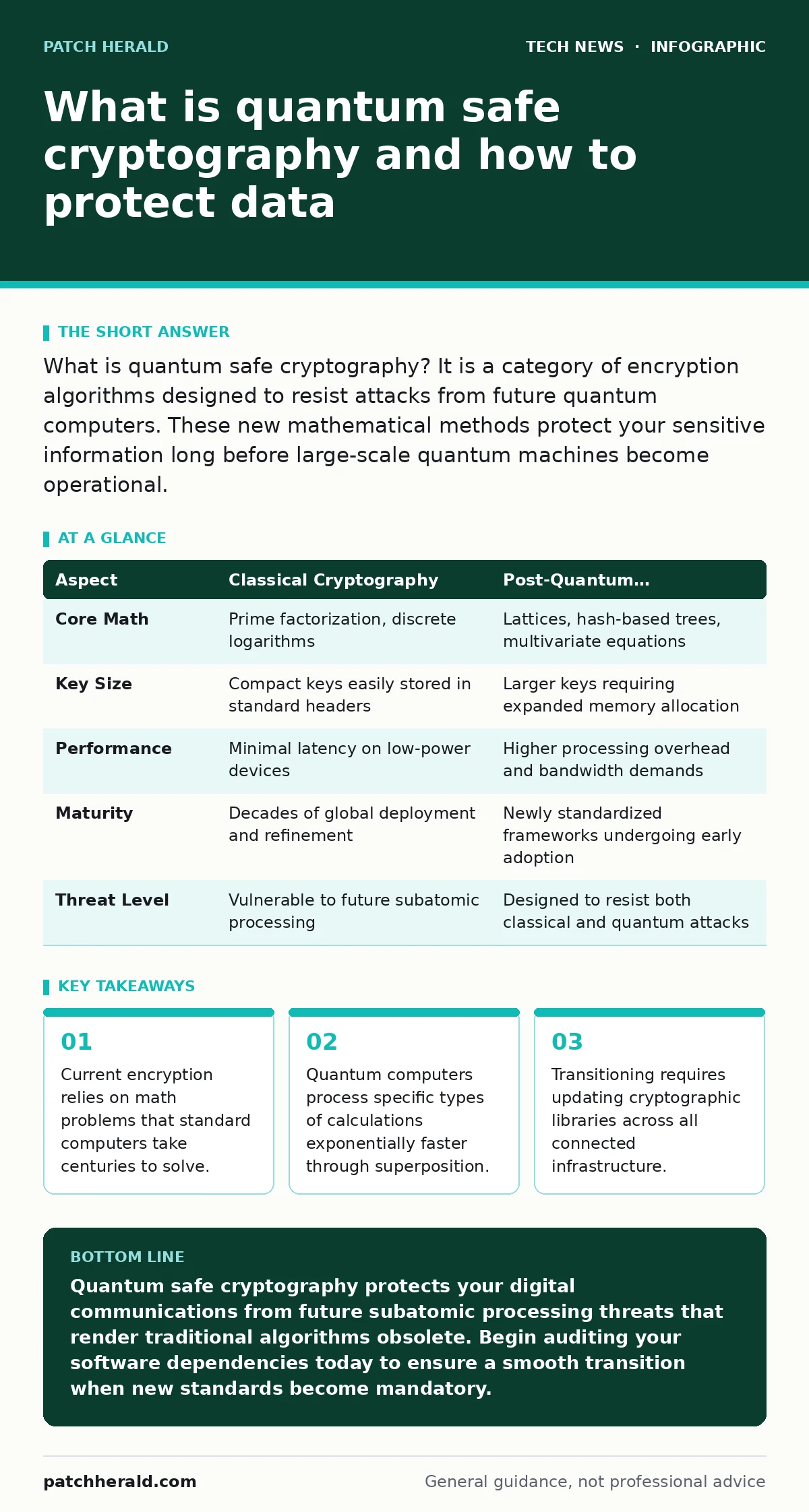
What is quantum safe cryptography? It is a category of encryption algorithms designed to resist attacks from future quantum computers. These new mathematical methods protect your sensitive information long before large-scale quantum machines become operational.
Understanding what is quantum safe cryptography
What is quantum safe cryptography? It is a specialized suite of security protocols built to withstand decryption attempts by subatomic processing units. Imagine securing your office building with a physical maze instead of a simple key tumbler. Standard computers must walk every single path of the maze sequentially to find the exit. Quantum machines possess the unique ability to test every path simultaneously. Security standards must therefore shift toward mathematical puzzles that even simultaneous testing cannot bypass within a reasonable timeframe.
Public-key cryptography forms the invisible foundation of digital trust across the internet today. Web browsers, email clients, and payment gateways rely on math problems involving large prime numbers or elliptic curves. Standard processors lack the raw computational capacity to factor these numbers efficiently. Engineers selected these specific equations decades ago because breaking them required astronomical amounts of time. That foundational assumption breaks down completely once subatomic processors reach commercial scale and operational stability.
The mechanical threat of subatomic processing
Subatomic processors operate on principles of quantum mechanics rather than binary bits. A classical computer bit reads strictly as a zero or a one. Quantum bits, known as qubits, exist in multiple states simultaneously through a phenomenon called superposition. This architectural difference allows quantum algorithms to solve specific mathematical operations in minutes instead of millennia. Elliptic curve cryptography and RSA algorithms face immediate obsolescence because specific mathematical formulas can find their private keys with terrifying speed.
Ciphertext intercepted today remains vulnerable to retroactive decryption methods. Malicious actors routinely siphon encrypted data streams and store them indefinitely on large servers. They wait quietly for hardware technology to mature enough to crack the underlying keys. Secure communications demand algorithms that resist both real-time interception and long-term storage threats. Protecting archived records requires adopting new cryptographic primitives long before quantum hardware becomes widely available.
At a glance: comparing classical and post-quantum methods
| Aspect | Classical Cryptography | Post-Quantum Cryptography |
|---|---|---|
| Core Math | Prime factorization, discrete logarithms | Lattices, hash-based trees, multivariate equations |
| Key Size | Compact keys easily stored in standard headers | Larger keys requiring expanded memory allocation |
| Performance | Minimal latency on low-power devices | Higher processing overhead and bandwidth demands |
| Maturity | Decades of global deployment and refinement | Newly standardized frameworks undergoing early adoption |
| Threat Level | Vulnerable to future subatomic processing | Designed to resist both classical and quantum attacks |
Who needs to worry about upcoming cryptographic shifts
Who needs to worry about upcoming cryptographic shifts involves anyone managing digital infrastructure, long-lifecycle hardware, or sensitive data assets. Certificate authorities must eventually phase out legacy signing keys to maintain unbroken chains of trust. Software updates distributed across corporate networks require code-signing signatures that resist subatomic decryption. Core infrastructure components like the Domain Name System rely heavily on cryptographic signatures to prevent spoofing and unauthorized redirection.
Small organizations often assume these algorithmic shifts concern only massive tech conglomerates or government agencies. Commercial vendors integrate these mathematical primitives into standard operating systems and database engines quietly over time. Your organization participates in this ecosystem whenever employees connect to remote servers or authenticate user identities. Ignoring these foundational changes leaves your proprietary communications exposed to entities harvesting data streams today for tomorrow's decryption capabilities.
Hidden costs and operational trade-offs
Post-quantum algorithms introduce significant performance penalties that administrators must manage carefully. Lattice-based cryptography requires transmission of much larger public keys and ciphertext blocks. Network bandwidth consumption increases noticeably when connection handshakes exchange these bulky cryptographic parameters. Legacy embedded devices with constrained memory allocations might crash or fail completely when attempting to process these expanded key sizes.
Software developers face backward-compatibility challenges when integrating new cryptographic libraries into existing application stacks. Codebases built decades ago often hardcode assumptions about key lengths and buffer allocations. Updating these legacy applications demands extensive testing to prevent unexpected memory leaks or authentication failures. Operational budgets must account for prolonged migration periods where classical and quantum-resistant algorithms run concurrently in hybrid modes.
See also: What Is Website Security: Cyber Security Fundamentals for Web Protection
What people usually get wrong about timelines
Many technologists mistakenly believe they can wait until physical quantum computers appear before updating their security posture. Hardware deployment schedules matter far less than the shelf life of sensitive data. Medical records, legal documents, and proprietary designs require confidentiality lasting decades past their creation date. Waiting for a visible hardware milestone guarantees that archived secrets remain vulnerable to retroactive decryption techniques.
Another widespread misunderstanding involves assuming that buying new hardware automatically resolves underlying cryptographic vulnerabilities. Hardware upgrades mean very little if application software continues calling legacy encryption protocols by default. Security teams must audit their entire software inventory to identify every instance where vulnerable algorithms govern data transmission. Changing an encryption standard requires a coordinated inventory of dependencies rather than a simple hardware purchase.
Practical steps for your transition strategy
- Audit your current digital inventory to catalog every protocol and library handling encryption duties.
- Monitor standards bodies as they finalize official post-quantum algorithm specifications for commercial deployment.
- Establish hybrid encryption modes that combine classical algorithms with quantum-resistant layers during early testing phases.
Prioritizing your cryptographic migration requires focusing on assets with the longest confidentiality requirements first. Review vendor roadmaps for cloud services and security appliances to verify their readiness timelines. Network administrators should monitor ongoing protocol updates closely to ensure seamless transitions when vendors push new firmware versions. Modernizing your security architecture remains an ongoing engineering discipline rather than a single completed project.
Key takeaways
- Current encryption relies on math problems that standard computers take centuries to solve.
- Quantum computers process specific types of calculations exponentially faster through superposition.
- Transitioning requires updating cryptographic libraries across all connected infrastructure.
Quantum safe cryptography protects your digital communications from future subatomic processing threats that render traditional algorithms obsolete. Begin auditing your software dependencies today to ensure a smooth transition when new standards become mandatory.
Frequently asked questions
Do I need to replace my existing hardware immediately?
Hardware replacement depends primarily on memory capacity and processing power limitations rather than immediate physical failure. Most modern devices handle new algorithms through software updates unless memory constraints prove prohibitive.
How long will the transition to new encryption standards take?
Industry-wide migration spans multiple years because organizations must inventory, test, and update complex software dependencies safely.
Are quantum-resistant algorithms completely unbreakable?
No algorithm offers absolute security against every conceivable mathematical breakthrough or implementation flaw. These new methods simply resist known mathematical shortcuts used by subatomic processors.
Can I implement these new algorithms myself using custom code?
Custom cryptographic implementations introduce severe security vulnerabilities through accidental side channels and mathematical miscalculations. Always rely on standardized implementations vetted by global security researchers.
How this guide was produced: written by the Patch Herald editorial team with AI assistance, checked against the public references listed below, and reviewed when the facts change. See our editorial policy or report an error.