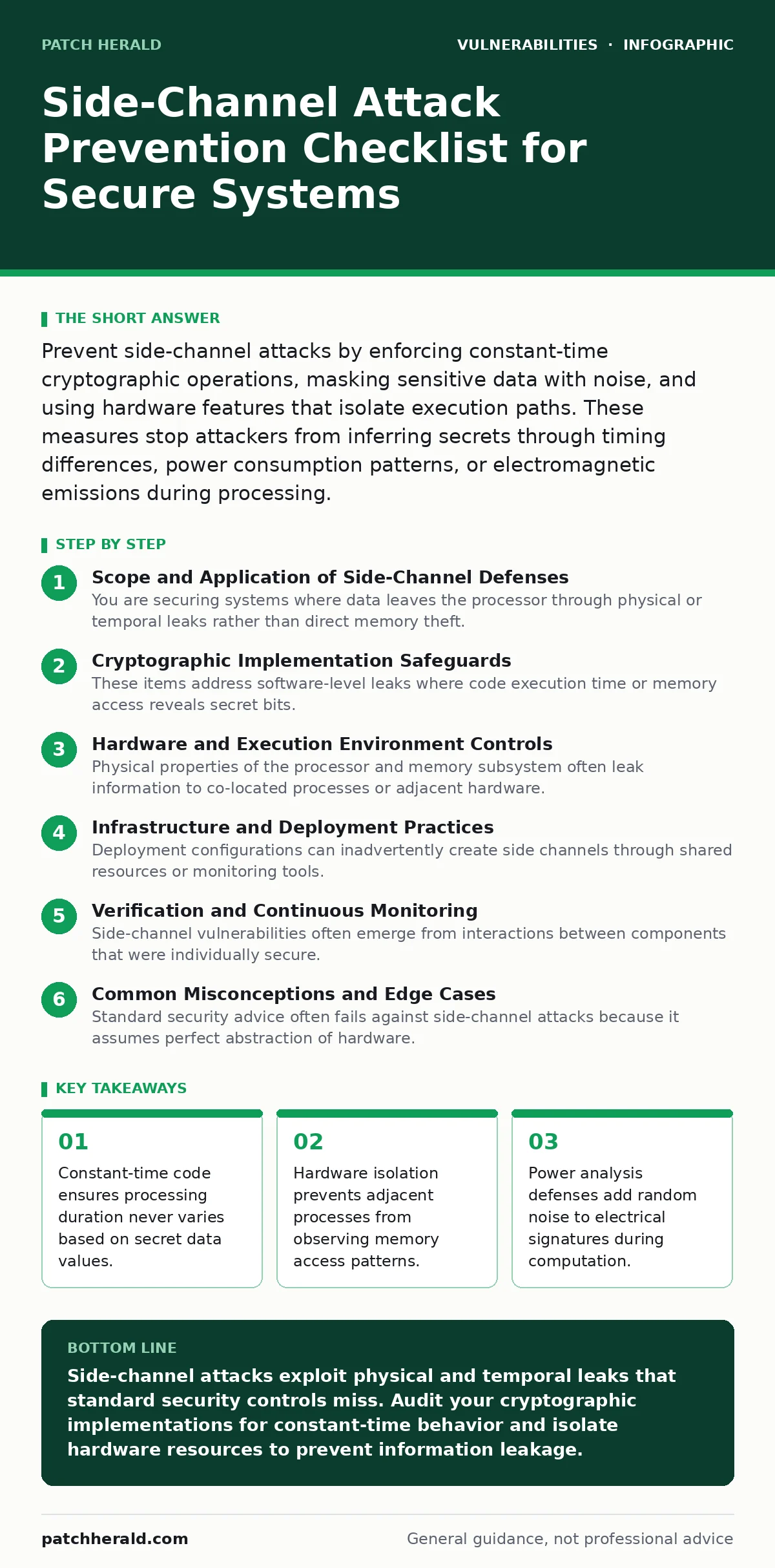
Prevent side-channel attacks by enforcing constant-time cryptographic operations, masking sensitive data with noise, and using hardware features that isolate execution paths. These measures stop attackers from inferring secrets through timing differences, power consumption patterns, or electromagnetic emissions during processing.
Scope and Application of Side-Channel Defenses
You are securing systems where data leaves the processor through physical or temporal leaks rather than direct memory theft. Side-channel attacks exploit these unintended information channels. They bypass traditional access controls by observing how the system behaves, not what it stores. This checklist applies to embedded devices, servers, and cloud workloads that handle sensitive cryptographic material. Use this list to audit your development pipeline and hardware configuration.
Cryptographic Implementation Safeguards
These items address software-level leaks where code execution time or memory access reveals secret bits.
- Enforce constant-time comparisons: Prevents timing analysis from distinguishing correct from incorrect values.
- Use fixed-iteration loops: Stops branch prediction from varying execution paths based on secret inputs.
- Mask intermediate values: Hides true data states from cache-based observation techniques.
- Avoid conditional branches on secrets: Eliminates timing variations caused by if-else statements processing keys.
- Zeroize sensitive buffers: Removes residual data from memory after cryptographic operations complete.
Constant-time programming ensures that the time taken to process data does not depend on the data itself. This is difficult to achieve because compilers may optimize code in ways that reintroduce timing variations. You must verify assembly output to confirm that optimizations did not break constant-time guarantees. This relates to the secure software development lifecycle, where verification steps catch unintended behavioral leaks.
Hardware and Execution Environment Controls
Physical properties of the processor and memory subsystem often leak information to co-located processes or adjacent hardware.
- Enable hardware random number generators: Provides unpredictable noise that masks power consumption patterns.
- Isolate cryptographic threads: Prevents cache sharing between sensitive and non-sensitive execution contexts.
- Disable speculative execution features: Stops processors from pre-fetching data that leaks via cache timing.
- Use separate memory regions: Ensures sensitive data does not share cache lines with public data.
- Monitor electromagnetic emissions: Detects shielding failures that allow remote signal interception.
Speculative execution improves performance by guessing future instructions. Attackers exploit this by measuring cache access times of guessed instructions. Disabling these features reduces performance but eliminates a major leak vector. This connects to CWE weakness categories, which classify these hardware-assisted vulnerabilities for tracking and remediation.
Infrastructure and Deployment Practices
Deployment configurations can inadvertently create side channels through shared resources or monitoring tools.
- Segment virtual machines physically: Prevents hypervisor-level cache attacks between tenant workloads.
- Limit logging granularity: Stops detailed timing logs from exposing processing duration variations.
- Use dedicated hardware modules: Isolates cryptographic operations from general-purpose processor interference.
- Audit third-party libraries: Identifies external code that may introduce non-constant-time operations.
- Implement rate limiting on APIs: Mitigates remote timing attacks that measure response delays.
Remote timing attacks allow an attacker to infer secrets by measuring network response times. Even small variations in milliseconds can reveal cryptographic keys over many attempts. Rate limiting reduces the number of measurements an attacker can take. This approach complements SQL injection defenses, as both require input validation and response normalization.
Verification and Continuous Monitoring
Side-channel vulnerabilities often emerge from interactions between components that were individually secure.
- Conduct timing analysis tests: Measures execution time variance across different input values.
- Perform power analysis audits: Checks for correlation between power draw and secret data processing.
- Review compiler optimization flags: Ensures build settings do not introduce timing variations.
- Test cross-tenant isolation: Validates that one user's activity does not affect another's performance metrics.
- Update firmware regularly: Patches known hardware-level side-channel vulnerabilities discovered post-release.
Verification requires specialized tools that measure time, power, or electromagnetic output with high precision. Standard functional testing does not catch these leaks. You must integrate these checks into your CI/CD pipeline. This mirrors practices in bug bounty programs, where external testers probe for unintended information leaks.
Common Misconceptions and Edge Cases
Standard security advice often fails against side-channel attacks because it assumes perfect abstraction of hardware.
- Assume encryption alone is secure: Ignores that the decryption process itself may leak timing data.
- Trust library documentation blindly: Many libraries claim constant-time but fail under specific compiler optimizations.
- Ignore cloud shared resources: Hypervisor caching can leak data between isolated virtual machines.
- Neglect error handling paths: Exception handling often takes different time than normal execution paths.
- Dismiss remote measurements: Network latency can provide enough precision for statistical key recovery.
Imagine a system where encryption is mathematically unbreakable, but the time it takes to decrypt varies by 2 microseconds depending on the key bit. An attacker measuring thousands of responses can statistically reconstruct the key. This scenario shows why mathematical security is insufficient without physical and temporal security. It also highlights why dependency confusion attacks are less relevant here, as the leak is in execution, not package sourcing.
Key takeaways
- Constant-time code ensures processing duration never varies based on secret data values.
- Hardware isolation prevents adjacent processes from observing memory access patterns.
- Power analysis defenses add random noise to electrical signatures during computation.
Side-channel attacks exploit physical and temporal leaks that standard security controls miss. Audit your cryptographic implementations for constant-time behavior and isolate hardware resources to prevent information leakage.
Frequently asked questions
What is a side-channel attack?
A side-channel attack extracts secret information by analyzing physical implementations of a system, such as timing variations, power consumption, or electromagnetic emissions, rather than breaking the cryptographic algorithm directly.
How do you detect a timing side-channel?
You detect timing side-channels by measuring the execution time of cryptographic functions across many different inputs and looking for statistical correlations between input values and processing duration.
Can encryption libraries prevent side-channel attacks?
Modern cryptographic libraries often implement constant-time operations to prevent timing leaks, but you must verify that compiler optimizations have not reintroduced timing variations during the build process.
Are side-channel attacks only a hardware concern?
No, side-channel attacks affect software, hardware, and network layers. Software leaks through timing, hardware leaks through power and electromagnetic signals, and networks leak through response latency measurements.
How this guide was produced: written by the Patch Herald editorial team with AI assistance, checked against the public references listed below, and reviewed when the facts change. See our editorial policy or report an error.