
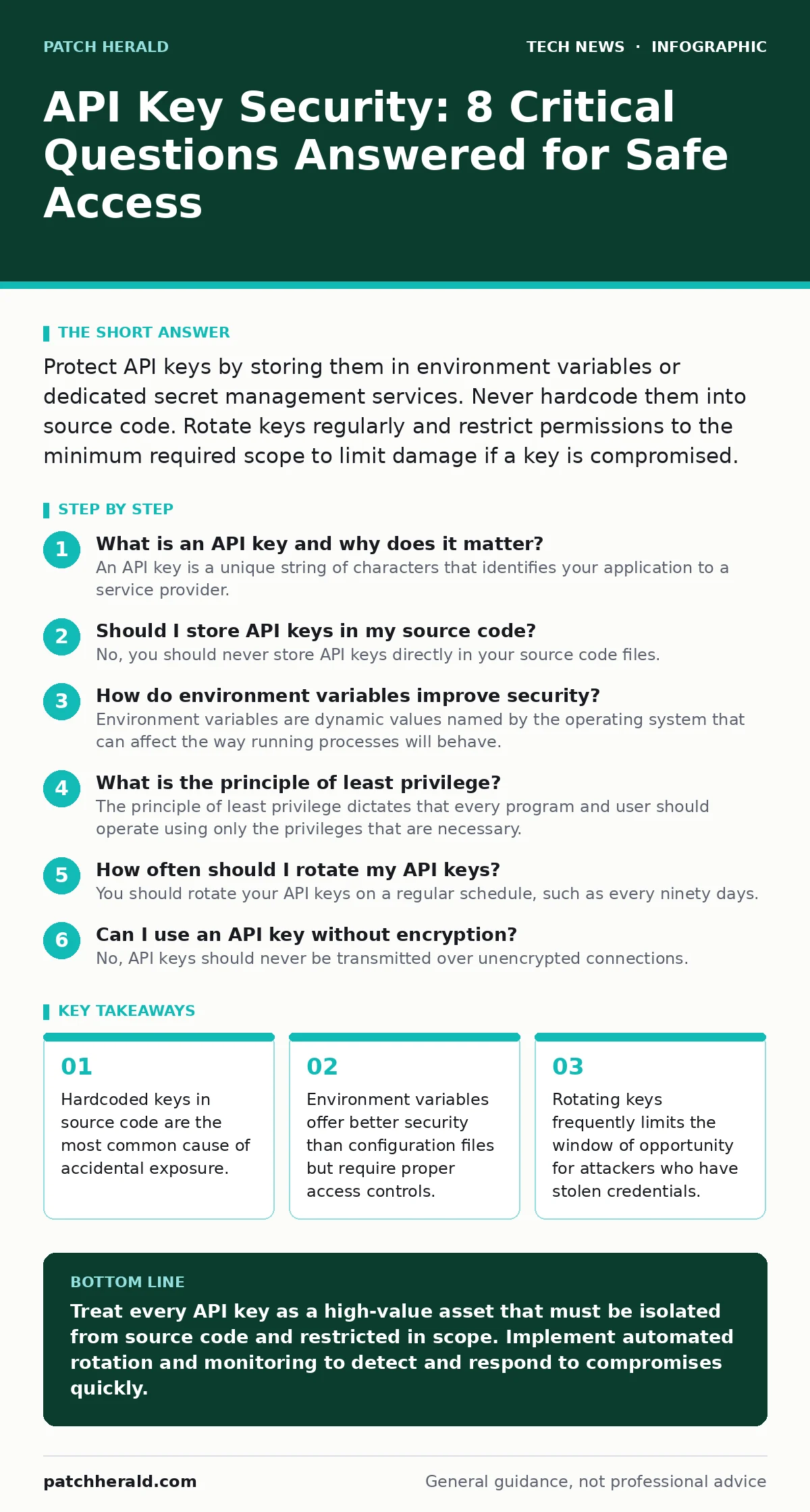
Protect API keys by storing them in environment variables or dedicated secret management services. Never hardcode them into source code. Rotate keys regularly and restrict permissions to the minimum required scope to limit damage if a key is compromised.
What is an API key and why does it matter?
An API key is a unique string of characters that identifies your application to a service provider. It acts as a digital handshake, proving that your software is authorized to request data or perform actions. Without this key, the server rejects your request to protect its resources.
You must treat this key like a physical master key to your office. If an attacker obtains it, they can impersonate your application. They might drain your account balance, access private user data, or disrupt your service. The key itself does not usually grant administrative control, but it grants access to whatever permissions the application holds.
Should I store API keys in my source code?
No, you should never store API keys directly in your source code files. When you commit code to a version control system like Git, that history is often shared with multiple developers or hosted on public platforms. Once a key is in the public repository history, it is effectively exposed to the entire internet.
Even if you remove the key later, the previous versions of the file remain in the repository history. Attackers use automated tools to scan public repositories for recognizable key patterns. Finding a valid key in a commit history is a common entry point for breaches. This makes source code storage a critical vulnerability that is difficult to remediate once discovered.
How do environment variables improve security?
Environment variables are dynamic values named by the operating system that can affect the way running processes will behave. By storing keys in these variables, you separate secrets from your code logic. Your application reads the variable at runtime, keeping the actual key out of the source files.
This approach prevents accidental leakage during code reviews or public publishing. However, environment variables are not encrypted by default. Any process running on the same server with sufficient privileges can read them. You must ensure that only the necessary applications have access to these variables to maintain security boundaries.
What is the principle of least privilege?
The principle of least privilege dictates that every program and user should operate using only the privileges that are necessary. For API keys, this means creating keys with restricted scopes rather than using a single master key with full access.
Imagine an application that only needs to read public weather data. It should not have an API key that allows writing to a database or deleting user accounts. If that limited key is stolen, the attacker can only perform the specific allowed action. This containment strategy significantly reduces the potential damage of a compromise.
How often should I rotate my API keys?
You should rotate your API keys on a regular schedule, such as every ninety days. Rotation involves generating a new key and updating your applications to use it, then disabling the old one. This practice limits the time window an attacker has to use a stolen key before it becomes invalid.
The main challenge of rotation is operational complexity. You must ensure all dependent systems are updated simultaneously. If you disable an old key before all systems switch to the new one, your service will break. Automated secret management tools can help orchestrate this process without causing downtime.
See also: Difference Between Operating System and Kernel: Core Functions Explained · Can IP Addresses Be Traced? How Visibility Works
Can I use an API key without encryption?
No, API keys should never be transmitted over unencrypted connections. Standard HTTP traffic is sent in plain text, allowing anyone on the network path to intercept it. You must use HTTPS, which encrypts the data between your client and the server.
Encryption ensures that even if an attacker captures the network traffic, they cannot read the key. However, encryption only protects data in transit. It does not protect the key if it is stored insecurely on the server or client device. You must secure the key at rest as well as in motion.
What are the risks of client-side keys?
API keys used in client-side applications, such as web browsers or mobile apps, are inherently insecure. The code runs on the user’s device, meaning the key is visible to anyone who inspects the application files or network traffic. You cannot truly hide a secret in code that runs on untrusted hardware.
To mitigate this risk, use a backend proxy server. The client sends requests to your server, which then forwards them to the API provider using a secure server-side key. This keeps the actual key hidden from the end user. Your server can also validate requests before forwarding them, adding an extra layer of control.
| Storage Method | Security Level | Risk of Exposure | Management Complexity |
|---|---|---|---|
| Source Code | Very Low | High | Low |
| Environment Variables | Medium | Medium | Medium |
| Secret Manager | High | Low | High |
| Client-Side Code | None | Critical | Low |
How do I detect if a key has been compromised?
You should monitor usage logs for unusual patterns, such as spikes in request volume or access from unexpected geographic locations. Most API providers offer dashboards that show recent activity and failed authentication attempts.
If you notice suspicious activity, assume the key is compromised. Immediately revoke the key and generate a new one. Then, investigate the source of the leak. Common sources include misconfigured logging systems that print keys to console output or error logs that are stored insecurely.
What is the role of secret management tools?
Secret management tools are specialized services designed to store, distribute, and rotate secrets securely. They provide a centralized interface for managing API keys, database passwords, and other sensitive data. These tools often integrate with your application framework to inject secrets at runtime.
Using these tools reduces the risk of human error. They enforce access controls and audit logs, showing who accessed which secret and when. While they add complexity to your infrastructure, the security benefits outweigh the setup cost for most organizations handling sensitive data.
Key takeaways
- Hardcoded keys in source code are the most common cause of accidental exposure.
- Environment variables offer better security than configuration files but require proper access controls.
- Rotating keys frequently limits the window of opportunity for attackers who have stolen credentials.
Treat every API key as a high-value asset that must be isolated from source code and restricted in scope. Implement automated rotation and monitoring to detect and respond to compromises quickly.
Frequently asked questions
Can I share an API key with my development team?
You can share a key, but it is better to provide each developer with their own unique key. This allows you to track individual usage and revoke access for specific members without affecting the entire team.
What happens if I lose my API key?
If you lose the key, you cannot use the service until you generate a new one. Most providers allow you to create new keys from your account dashboard, but you will need to update your applications to use the new credential.
Is it safe to log API keys for debugging?
No, logging keys is a major security risk. Logs are often stored in plain text and accessed by multiple systems. Use masking techniques to hide sensitive parts of the key in logs, or avoid logging them entirely.
Do API keys expire automatically?
Some providers offer keys with automatic expiration dates, while others require manual rotation. Check the documentation of your specific service provider to understand their default behavior and security recommendations.
How this guide was produced: written by the Patch Herald editorial team with AI assistance, checked against the public references listed below, and reviewed when the facts change. See our editorial policy or report an error.